Relevant Resources
- Ep. 14 | One Church to Rule Them All: Discovering the “Big C” Catholic Church of the Creeds | YouTube | Apple | Spotify
- Article #2 | The “Big C” Catholic Church in the Church Fathers
Introduction
Growing up as a protestant, we would somewhat often recite the Nicene Creed on Sundays. But two lines in particular really bothered me. The first was: “I believe in one, holy, Catholic, and Apostolic Church.” The second was: “I confess one Baptism for the forgiveness of sins.”
The first seemed to include us in a Church I clearly knew we did not belong to: the Catholic Church. The second ascribed forgiveness of sins to baptism, which did not match the various “faith alone” theologies I had encountered, particularly those among evangelicals who claimed we could be “saved” by simply placing our trust in Jesus. Baptism, they believed, was good, but not the means by which our sins are forgiven—though that is not what the Nicene Creed seemed to say.
But while I had questions about what the Nicene Creed said about baptism, it was its words about the Church that truly concerned me. While my parents had not raised me to be anti-Catholic, such sentiments were simply part of the air we breathed in many of the protestant denominations I was part of. We knew we had left the Catholic Church back in the 16th century, and “good riddance!” as far as I was concerned (particularly given the many falsehoods and myths I had been told about it).
And yet, here were our ancient forebears quite plainly declaring their belief in “one, holy, Catholic, and Apostolic Church.” Other than when we occasionally recited the Nicene Creed, we normally didn’t describe ourselves that way. “Why?” I often wondered. “I thought we weren’t Catholic?”
The answer I was often given was that we protestants were “little ‘c’ catholics.” After all, “catholic” simply meant “universal,” and was therefore a reference to all believers, particularly Trinitarians (see Becoming Catholic #2, The “Big C” Catholic Church in the Church Fathers, and Ep. 14, One Church to Rule them All: Discovering the “Big C” Catholic Church of the Creeds).
But that answer became impossible for me to take seriously upon simply doing what I should have done from the beginning of my doubts: read the acts of the Council of Nicaea itself (in addition to reading the Church Fathers more generally). Once I did this, I saw that this answer about us being “little ‘c’ catholics” from protestants who I otherwise knew to be wise, virtuous, and in good faith, was simply wrong.
The Council of Nicaea had entirely different ideas about what it meant to be “Catholic.”
Roadmap
With that background in mind, our Roadmap for this two-part series is as follows:
- Our thesis is that protestants cannot affirm all of the Nicene Creed as understood by the fathers of the Council of Nicaea itself. Specifically, none of them can affirm the belief in “one, holy, Catholic, and Apostolic Church” in a way that is consistent with those fathers; and very few of them can affirm the belief in “one baptism for the forgiveness of sins,” which is a reference to baptismal regeneration. We will show this in two parts: Part 1 (this article) will focus on the line in the Creed about the Church, and Part 2 will focus on the line about baptism. In this article (Part 1), we will defend our thesis by:
- Providing some quick historical context, and quoting the Nicene Creed; then
- Analyzing the acts of the Council of Nicaea itself, specifically a one-by-one examination of each of its twenty canons, as well as its Synodal Letter. This analysis will show that the Council’s notion of “one, holy, Catholic, and Apostolic Church”—far from being a general reference to all believers (even Trinitarian ones) such as I was often taught as a protestant—referred instead to a single visible society of Christians united by faith, worship, and government that claimed to be the one true Church established by Jesus Christ.
- Finally, we’ll summarize the characteristics of the “Catholic Church” according to the Council of Nicaea, by which we will show that the Nicene Creed excludes protestant notions of “Catholic.”
Basic Historical Context, and the Nicene Creed
Before examining the Council of Nicaea’s notions of the “Catholic Church” in greater detail, let’s first cover some basic historical context, and quote the Creed in its entirety.
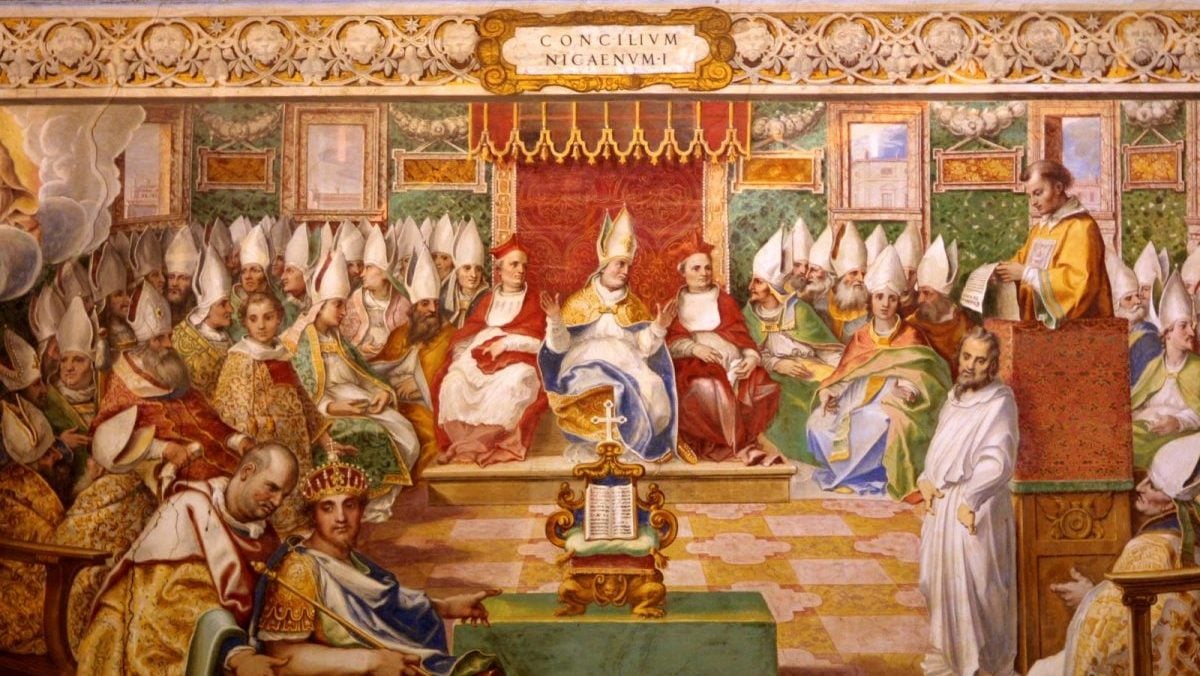
The Council of Nicaea took place in 325 to confront the Arian heresy, which had been spawned by a priest named Arius in Alexandria, Egypt, and taught that Christ was not divine. The Council of Nicaea met in Nicaea, in modern day Turkey, to condemn the heresy, and promulgated a Creed for the whole Church that formally defined the divinity of Christ (though this had been universally believed since the beginning). In particular, the Council used a Greek term, homoousios, or “consubstantial,” to describe the relationship between the Father and the Son within the Trinity. The term meant they had the “same substance,” namely, divinity, and thus, within the one Godhead, both Persons were equally God.
The “Nicene Creed” issued by the Council of Nicaea also included other details about the Catholic Faith, including a description of the Church as “Catholic and Apostolic.” However, the “Nicene Creed” professed by most Christians is actually the Nicene-Constantinopolitan Creed, which is the form of the Creed issued by the Second Ecumenical Council of Constantinople I in 381. It included additional language not previously included by the Council of Nicaea in 325, both about the Church, and especially the Holy Spirit, as a new batch of heresies had arisen that denied the divinity of the Holy Spirit. While the phrase “one, holy, Catholic, and Apostolic” comes from this somewhat later Creed, the acts of the Council of Nicaea refer to the “Catholic and Apostolic Church” multiple times. Thus, while we will refer to this later Creed by its colloquial name, the “Nicene Creed,” we do so having provided this historical context in order to avoid confusion.
Here is the text of that Nicene Creed professed in the Catholic Church, and that virtually all protestants likewise claim to profess:
I believe in one God, the Father almighty, maker of heaven and earth, of all things visible and invisible.
I believe in one Lord Jesus Christ, the Only Begotten Son of God, born of the Father before all ages. God from God, Light from Light, true God from true God, begotten, not made, consubstantial with the Father; through him all things were made. For us men and for our salvation he came down from heaven, and by the Holy Spirit was incarnate of the Virgin Mary, and became man. For our sake he was crucified under Pontius Pilate, he suffered death and was buried, and rose again on the third day in accordance with the Scriptures. He ascended into heaven and is seated at the right hand of the Father. He will come again in glory to judge the living and the dead and his kingdom will have no end.
I believe in the Holy Spirit, the Lord, the giver of life, who proceeds from the Father and the Son, who with the Father and the Son is adored and glorified, who has spoken through the prophets.
I believe in one, holy, Catholic, and Apostolic Church. I confess one Baptism for the forgiveness of sins, and I look forward to the resurrection of the dead and the life of the world to come. Amen.
While the language about “one, holy, Catholic, and Apostolic Church” comes from the later Council of Constantinople, the original Creed promulgated by the Council of Nicaea includes the following anathema at the end:
And whosoever shall say that there was a time when the Son of God was not, or that before he was begotten he was not, or that he was made of things that were not, or that he is of a different substance or essence [from the Father] or that he is a creature, or subject to change or conversion—all that so say, the Catholic and Apostolic Church anathematizes them.
We can therefore see that describing the Church in this way is not original to the Council of Constantinople in 381, but to the Council of Nicaea itself, despite the fact that the later Council included the words “one” and “holy,” which no one disputed then, or in the centuries prior (the Church Fathers were everywhere insistent that there was only one Church). And as we can see here, this “Catholic and Apostolic Church” in whose name the Council of Nicaea claims to speak possesses and exercises the authority to speak for all Christians, and to anathematize those who dissent from the Catholic Faith.
But, as we will further see, those who were anathematized by the Council of Nicaea not only claimed to be “Christians,” but also included Trinitarians who were not in communion with the Catholic Church because of heresy and schism.
As I’ll explain, this was one of many indications to me, as a protestant, from the documents of the Council of Nicaea itself, that the “Catholic Church” referenced by the Nicene Creed was something entirely incompatible with my protestant notions of “little ‘c’ catholic.”
Those indications would increase exponentially upon reading the canons, or laws, issued by the Council of Nicaea.
Canon by Canon Analysis
Upon examining those canons, it became increasingly clear that the “one, holy, Catholic, and Apostolic Church” referred to a society with four traits:
- It was visible; and possessed
- A common faith (the Catholic Faith);
- A common worship (the Holy Mass/Sacred Liturgy); and
- A common government (the bishops, the successors of the Apostles).
It also considered itself to be the one true Church established by Jesus Christ. The members of this society were thereby bound by a common set of laws, and could be visibly identified and distinguished from non-Catholics.
“Catholic,” therefore, did not refer to a vague and abstract gathering of all who claimed to be Christian, regardless of their theological differences, or all those who were among “the elect” (whoever those were), which I had been told was what it meant as a protestant. Indeed, every protestant view of “Catholic” denied at least two of these traits, and often all four, often expressly disclaiming the idea that there even was a visible communion that could claim to be the “one true Church.”
What became crystal clear immediately was that “Catholic” certainly didn’t include everyone who claimed to be “Chrsitians.” After all, the Arians (and other heretics) themselves claimed to be “Christians.” Some of the other heretics referenced by the Council of Nicaea were, as I mentioned before, Trinitarians like me. But even that did not make them “Catholic,” which flatly contradicted my views as a protestant that “Catholic,” at the very least, included all Trinitarian Christians.
Not so, according to the Council of Nicaea. Indeed, as I would discover throughout the writings of the Church Fathers, many such heretics—whether they were Trinitarian or non-Trinitarian—were sharply distinguished from the “one, holy, Catholic, and Apostolic Church” both by the Council of Nicaea, and in all the forthcoming Ecumenical Councils (including many local councils). They were condemned as such because of their refusal to assent to the faith, participate in the worship, and/or submit to the government of the Catholic Church.
Let us go canon by canon to prove this point with respect to the Council of Nicaea. For most of them, to save time, the ancient epitome (or summary) of the canon is sufficient to communicate its substance. However, we will quote several of them in full because of how clearly they make some of these points.
Canon 1: Regulations for Castrated Men Among the Clergy
Canon 1 regulated the admission and expulsion of castrated men into the clergy. The ancient summary of this canon is as follows:
Eunuchs may be received into the number of the clergy, but those who castrate themselves shall not be received.
We see in this canon that the “Catholic Church” exercised authority over all clergy throughout the world by ecclesiastical law. It is obvious that no protestant sect claims or possesses such authority, or believes that it even exists.
Canon 2: Admitting New Converts to the Clergy
Canon 2 regulated how long converts must have been Catholic before being ordained as priests or bishops. The ancient summary of this canon is as follows:
Those who have come from the heathen shall not be immediately advanced to the presbyterate [the canon itself include “episcopate”]. For without a probation of some time a neophyte is of no advantage. But if after ordination it be found out that he had sinned previously, let him then be expelled from the clergy.
We see in this canon, once more, that the “Catholic Church” exercised authority over all clergy throughout the world—an authority neither claimed nor possessed by any protestant sect. Likewise, the episcopacy, or office of bishop, was everywhere taken for granted, which is denied by the vast majority of protestants today (with the main exception being Anglicans).
Canon 3: Clerical Cohabitation
Canon 3 regulated the cohabitation of clergy with women. The ancient summary of this canon is as follows:
No one shall have a woman in his house except his mother, and sister, and persons altogether beyond suspicion.
The canon itself specified three clerical offices: bishop, presbyter, and deacon, a tripartite structure that most protestants deny (the main exception, again, being Anglicans). Once more, we see the “Catholic Church” possessed a common law for all clergy, which is neither claimed nor possessed by any protestant sect.
Canon 4: The Election of Bishops
Canon 4 regulated the appointment of bishops at the provincial and metropolitan levels. This naturally assumes a visible society with identifiable leaders throughout the world. The ancient summary of this canon is as follows:
A bishop is to be chosen by all the bishops of the province, or at least by three, the rest giving by letter their assent; but this choice must be confirmed by the Metropolitan.
Once more, we see in this canon that the “Catholic Church” has an episcopate, and possesses authority to legislate down to the level of all local churches and their territories with respect to the selection of clergy—an authority neither claimed nor possessed by any protestant sect.
Canon 5: Regulating the Readmission of the Excommunicated
Canon 5 regulated the readmission of clergy and laity into the Church who had been previously excommunicated. The ancient summary of this canon is as follows:
Such as have been excommunicated by certain bishops shall not be restored by others, unless the excommunication was the result of pusillanimity, or strife, or some other similar cause. And that this may be duly attended to, there shall be in each year two synods in every province—the one before Lent, the other toward autumn.
Once more, we see in this canon that the “Catholic Church” possesses an episcopate, and exercises authority superior to that of local bishops. This same “Catholic Church” can also command local churches to meet on a regular basis according to a regular schedule. Once more, this authority is neither claimed nor possessed by any protestant sect.
Canon 6: The Authority of the Bishops of Alexandria and Antioch
Canon 6 regulated the jurisdiction of large apostolic churches like Alexandria in Egypt over other local churches in the region, modelling it on a similar metropolitan jurisdiction exercised by the Roman Church in its own region. The ancient summary of this canon is as follows:
The Bishop of Alexandria shall have jurisdiction over Egypt, Libya, and Pentapolis. As also the Roman bishop over those subject to Rome. So, too, the Bishop of Antioch and the rest over those who are under them. If any be a bishop contrary to the judgment of the Metropolitan, let him be no bishop. Provided it be in accordance with the canons by the suffrage of the majority, if three object, their objection shall be of no force.
Once more, this canon exemplifies the authority of the “Catholic Church” to regulate the jurisdiction exercised by its bishops at the local level—an authority neither claimed nor possessed by any protestant sect.
Canon 7: The Authority of the Bishop of Jerusalem
Canon 7 regulated the prestige owed to the bishop of Jerusalem. The ancient summary of this canon is as follows:
Let the Bishop of Aelia [Roman name for Jerusalem after its destruction] be honored, the rights of the Metropolis being preserved intact.
This canon exemplifies the same reality as the previous one, namely, that the “Catholic Church” has the authority to regulate the jurisdiction and honor of local churches, whose leaders are identifiable bishops—a reality once more neither claimed nor possessed by any protestant sect.
Canon 8: Admission of Novatian (Cathari) Heretics into the Church
Canon 8 regulated the admission of repentant non-Arian heretics into the “one, holy, Catholic, and Apostolic Church.” The heretics in question were the Novatians, or “Cathari” (“the pure”), based on their adherence to the teachings of the Roman priest Novatian, a third century anti-Pope. They were Trinitarian, but heretical in their rejection of what they considered to be the moral laxity of the Church, given that the Church offered absolution through the Sacrament of Confession to Catholics who had “lapsed” (the lapsi) from the faith during periods of pagan persecution. This was extended by later Novatians to include other post-baptismal mortal sins.
It’s worth quoting this canon in full, as it illustrates the profoundly visible, identifiable nature of the “Catholic Church” referred to in the Nicene Creed, and the fact that it did not refer to Christians in general, or even Trinitarians (which the Novatians were):
Concerning those who call themselves Cathari, if they come over to the Catholic and Apostolic Church, the great and holy Synod decrees that they who are ordained shall continue as they are in the clergy. But it is before all things necessary that they should profess in writing that they will observe and follow the dogmas of the Catholic and Apostolic Church; in particular that they will communicate with persons who have been twice married, and with those who having lapsed in persecution have had a period [of penance] laid upon them, and a time [of restoration] fixed so that in all things they will follow the dogmas of the Catholic Church. Wheresoever, then, whether in villages or in cities, all of the ordained are found to be of these only, let them remain in the clergy, and in the same rank in which they are found. But if they come over where there is a bishop or presbyter of the Catholic Church, it is manifest that the Bishop of the Church must have the bishop’s dignity; and he who was named bishop by those who are called Cathari shall have the rank of presbyter, unless it shall seem fit to the Bishop to admit him to partake in the honor of the title. Or, if this should not be satisfactory, then shall the bishop provide for him a place as Chorepiscopus, or presbyter, in order that he may be evidently seen to be of the clergy, and that there may not be two bishops in the city.
Again, this canon, like all the others, assumes that the “Catholic Church” is a visible society, with visible clergy, with laws and regulations for the maintenance of its own members, and the readmission or expulsion of others. Those who are in or out can be clearly identified and distinguished based on whether they share this society’s faith, worship, and government. Likewise, this “Catholic Church” has the authority to define its own dogmas, and require that outsiders seeking to join Her assent to those dogmas as a condition for being “Catholic.”
There was an interesting episode recorded by at least two Church historians—Socrates of Constantinople, and Sozomen—in which the Emperor Constantine (who had convoked the Council of Nicaea) attempted to use it as an opportunity to bring the Novatians back into the Church by inviting their bishop, Acesius, to subscribe to the Council’s teaching. The Novatians completely agreed with the Council’s dogmatic teaching on the Trinity, and its dating of Easter (which was addressed in its Synodal Letter). However, Acesius refused to subscribe to it, for he knew precisely what the “Catholic Church” referred to, and rejected its teaching on penance and absolution for those in a state of post-baptismal mortal sin. So despite being a Trinitarian, and subscribing to Catholic belief on nearly everything else, he knew he did not belong to the “Catholic Church” referred to in the Council’s Creed. Socrates, whose source for the story was likely a very old Novatian priest named Auxanon who had traveled with Acesius to see the emperor at Nicaea, records the story as follows in his Ecclesiastical History (Book 1, Ch. 10):
The emperor’s diligence induces me to mention another circumstance expressive of his mind, and serving to show how much he desired peace. For aiming at ecclesiastical harmony, he summoned to the council Acesius also, a bishop of the sect of Novatians. Now, when the declaration of faith had been written out and subscribed [to] by the Synod, the emperor asked Acesius whether he would also agree to this creed, [and] to the settlement of the day on which Easter should be observed. He replied, “The Synod has determined nothing new, my prince. For thus heretofore, even from the beginning, from the times of the apostles, I traditionally received the definition of the faith, and the time of the celebration of Easter.” When, therefore, the emperor further asked him, “For what reason then do you separate yourself from communion with the rest of the Church?” he related what had taken place during the persecution under Decius, and referred to the rigidness of that austere canon which declares that it is not right [for] persons who, after baptism, have committed a sin which the sacred Scriptures denominate “a sin unto death” (1 John 5:16) to be considered worthy of participation in the sacraments; that they should indeed be exhorted to repentance, but were not to expect remission from the priest, but from God, who is able and has authority to forgive sins. When Acesius had thus spoken, the emperor said to him, “Place a ladder, Acesius, and climb alone into heaven.” Neither Eusebius Pamphilus [the famous Church historian] nor any other has ever mentioned these things. But I heard them from a man by no means prone to falsehood, who was very old, and simply stated what had taken place in the council in the course of a narrative. From which I conjecture that those who have passed by this occurrence in silence, were actuated by motives which have influenced many other historians, for they frequently suppress important facts, either from prejudice against some, or partiality towards others.
The Eusebius referred to by Socrates was none other than the famous 4th century “Father of Church History,” who was nonetheless suspected of being an Arian, or quasi-Arian. This would explain why he possibly had a motive to suppress certain historical events, as Socrates suspected. Fortunately, in this case, Socrates very likely had a source who had first-hand knowledge of this incident, namely, Auxanon.
The same story can be found in Sozomen’s Ecclesiastical History (Book 1, Ch. 22):
It is related, that the emperor, under the impulse of an ardent desire to see harmony re-established among Christians, summoned Acesius, bishop of the church of the Novatians, to the council, placed before him the definition of the faith and of the feast [Easter], which had already been confirmed by the signatures of the bishops, and asked whether he could agree thereto. Acesius answered that their exposition defined no new doctrine, and that he accorded in opinion with the Synod, and that he had from the beginning held these sentiments with respect both to the faith and to the feast. “Why, then,” said the emperor, “do you keep aloof from communion with others, if you are of one mind with them?” He replied that the dissension first broke out under Decius, between Novatius and [Pope] Cornelius, and that he considered such persons unworthy of communion who, after baptism, had fallen into those sins which the Scriptures declare to be unto death [1 John 5:16]; for that the remission of those sins, he thought, depended on the authority of God only, and not on the priests. The emperor replied, by saying, “O Acesius, take a ladder and ascend alone to heaven.” By this speech I do not imagine the emperor intended to praise Acesius, but rather to blame him, because, being but a man, he fancied himself exempt from sin.
Thus, the Novatians were a type of Christian that many protestants, today, could try to claim are “Catholic” in the sense of the Nicene Creed, particularly because they were Trinitarian. And yet, this heretical sect, though Trinitarian, was not Catholic, because they were not in communion with the “one, holy, Catholic, and Apostolic Church” that had promulgated the Nicene Creed. The reason why is simple: they denied other Catholic dogmas, including the authority of priests to forgive mortal sins through the Sacrament of Confession (which is ironically denied by protestants as well). But the Novatians at least had this going for them: unlike many protestants, they were honest enough (or at least sufficiently informed) to admit they were not “Catholic,” even in the sense of the Nicene Creed.
So we can see that Canon 8 is particularly devastating to any protestant notions of being “Catholic” in the way it was understood by the Council of Nicaea. This canon shows that being a “believer,” even a Trinitarian one, was not sufficient to be considered “Catholic” in the sense of the Nicene Creed. To add insult to injury, the Novatian heretics likewise denied the authority of the priesthood to forgive mortal sins—a trait they share with all protestants today.
Canon 9: Deposing Clergy
Canon 9 regulated how the Church dealt with priests guilty of particular crimes and violations of canon law, for, as it says, “the Catholic Church requires that [only] which is blameless.” The ancient summary of this canon is as follows:
Whoever are ordained without examination, shall be deposed if it be found out afterwards that they had been guilty.
This canon shows that the “Catholic Church” possessed authority to regulate its own criminal procedures with regard to Christian clergy—once more, an authority neither claimed nor possessed by any protestant sect.
Canon 10: Deposing Previously Lapsed Catholics Who Have Been Ordained
Canon 10 regulated ordinations of previously lapsed Catholics, and referred to “the canon [law] of the Church.” The ancient summary of this canon is as follows:
Whoso had lapsed are to be deposed whether those who ordained and promoted them did so conscious of their guilt or unknowing of it.
Once more, this canon indicates the same authority the “Catholic Church” over clergy under the guise of a universal “canon law” of some kind—something neither claimed nor possessed by any protestant sect.
Canon 11: Admission of Lapsed Catholics into the Church
Canon 11 regulated the readmission of Catholics who had lapsed during a persecution, and the length of penance they must endure before being readmitted to the sacrifice of the Eucharist (the “oblation”), which was twelve years:
- Three years as a “hearer” (just inside the door of the Church during mass); then
- Seven years as a “prostator” (sitting within catechumens, or those being instructed in the faith, but who had to leave during the second half of mass); and finally
- Two years as a communicant “in prayers” but “without oblation” (i.e. the Eucharist). So they could participate in the mass in every other way, except receiving communion.
The ancient summary of this canon is as follows:
As many as fell without necessity, even if therefore undeserving of indulgence, yet some indulgence shall be shown them and they shall be prostrators for twelve years.
Once more, this canon showed that the “Catholic Church” possessed the authority to readmit fallen members to its worship based on their ascent to its faith, and repentance in submission to its government. Indeed, this canon references the authority the Church exercised through the Sacrament of Confession, and its authority to set terms of penance for re-admission to communion. Once more, as in Canon 8 about the Cathari, we see a canon that assumes the one true faith, worship, and government of Christ’s Church is found only in the “Catholic Church,” and that its authority applied to all Christians—even heretics who were Trinitarian, but digressed from its teachings in other ways. Likewise, we see that the Eucharist is referred to as an “oblation,” or sacrifice, which is completely denied by virtually every protestant sect.
Canon 12: Admission of Certain Types of Soldiers into the Church
Canon 12 regulated similar matters with respect to soldiers. The ancient summary of this canon is as follows:
Those who endured violence and were seen to have resisted, but who afterwards yielded to wickedness, and returned to the army, shall be excommunicated for ten years. But in every case the way in which they do their penance must be scrutinized. And if anyone who is doing penance shows himself zealous in its performance, the bishop shall treat him more leniently than had he been cold and indifferent.
Once more, this canon refers to the episcopate, the Sacrament of Confession, and the authority of the Church to dictate terms of penance for readmission to communion, assigning the authority for making such determinations to the local bishop. Such authority is neither claimed nor possessed by any protestant sect.
Canon 13: Giving the Eucharist to the Dying
Canon 13 regulated the availability of the Eucharist to those at the point of death (known as “Viaticum”), once again referring to ancient canons that had apparently long governed the Church before the Council of Nicaea. The ancient summary of this canon is as follows:
The dying are to be communicated. But if any such get well, he must be placed in the number of those who share in the prayers, and with these only.
This canon shows that the “Catholic Church” likewise regulated its liturgical life and the availability of its sacraments, in this case, the Eucharist. Similarly, the canon says that the general rule is that the Eucharist is given to the dying by the bishop, who has the authority to examine them. Once more, this is an authority neither claimed nor possessed by any protestant sect.
Canon 14: Fallen Catechumens
Canon 14 regulated lapsed members of the catechumenate (those being instructed in the Catholic Faith). The ancient summary of this canon is as follows:
If any of the catechumens shall have fallen for three years he shall be a hearer only, and then let him pray with the catechumens.
This canon exhibits the same authority of the “Catholic Church” we have already seen applied to others, now applied to those who are in the process of being admitted to its communion. Once more, this is an authority neither claimed nor possessed by any protestant sect.
Canon 15: Clerical Movement Between Cities
Canon 15 regulated various local customs that violated the laws of the Church with respect to the movement of clergy between cities. The ancient summary of this canon is as follows:
Neither bishop, presbyter, nor deacon shall pass from city to city. But they shall be sent back, should they attempt to do so, to the Churches in which they were ordained.
Once again, this canon shows that the “Catholic Church” possessed a three-grade clergy (bishop, presbyter, and deacon), and exercised an authority that is not merely local, but applied to all churches with respect to the conduct of its clergy, and the ways in which local churches interact with one another. Once again, this authority is neither claimed nor possessed by any protestant sect.
Canon 16: Clergy Who Abandon Their Churches
Canon 16 further regulated clergy who had left or otherwise abandoned their home church and diocese, particularly without the permission of their bishop. The ancient summary of this canon is as follows:
Such presbyters or deacons as desert their own Church are not to be admitted into another, but are to be sent back to their own diocese. But if any bishop should ordain one who belongs to another Church without the consent of his own bishop, the ordination shall be cancelled.
This canon further illustrates exactly what we saw in the previous canon.
Canon 17: Usury Among the Clergy
Canon 17 regulated clergy who engaged in usury. The ancient summary of this canon is as follows:
If anyone shall receive usury or 150 per cent, he shall be cast forth and deposed, according to this decree of the Church.
Once more, this canon exemplifies the authority of the “Catholic Church” over the clergy, and the terms upon which men are admitted to or deposed from its ranks. And once again, this authority is neither claimed nor possessed by any protestant sect.
Canon 18: The Distribution of the Eucharist Among the Clergy
Canon 18 regulated the relationship between bishops, priests, and deacons, clarifying that, since deacons are lower in rank than priests (and thus lower than bishops as well), they should never distribute the Eucharist to them, but only receive it from them, as bishops and priests are the ones who offer the Eucharistic sacrifice. This canon is worth quoting in full as well:
It has come to the knowledge of the holy and great Synod that, in some districts and cities, the deacons administer the Eucharist to the presbyters, whereas neither canon nor custom permits that they who have no right to offer [the Eucharist] should give the Body of Christ to them that do offer. And this also has been made known, that certain deacons now touch the Eucharist even before the bishops. Let all such practices be utterly done away, and let the deacons remain within their own bounds, knowing that they are the ministers of the bishop and the inferiors of the presbyters. Let them receive the Eucharist according to their order, after the presbyters, and let either the bishop or the presbyter administer to them. Furthermore, let not the deacons sit among the presbyters, for that is contrary to canon and order. And if, after this decree, any one shall refuse to obey, let him be deposed from the diaconate.
This canon, as many others before it, likewise illustrates the authority of the “Catholic Church” over both the clergy and its worship. We see that it was assumed that the Eucharist is only handled by the clergy (bishops, priests, and deacons). Likewise, it simply equates the Eucharist with “the Body of Christ,” a one-to-one formulation Catholics continue to affirm. Finally, it required deacons to receive the Eucharist from those (i.e. bishops and priests) who “do offer” (i.e. as a sacrifice), rather than give the Eucharist to them, once more affirming the sacrificial nature of the Eucharist, which is denied by virtually all protestant sects.
While the purpose of the canon was not to lay out the details of the Church’s faith with regard to these matters, we nonetheless see clear indications of various elements of the Catholic Faith: once more, the three grades of Holy Orders (bishop, priest, and deacon); the Eucharist as the “Body of Christ”; and the Eucharist as a sacrifice that is only offered by bishops and priests. Each of these continue to be Catholic belief to this day, and denied by either the vast majority of, or all protestant sects.
Canon 19: Admission of Paulianist Heretics into the Church
Canon 19, like Canon 8, regulated the reception of repentant heretics into the Church—this time, those who previously professed the teachings of Paul of Samosata, and were thus known as “Paulianists” (a non-Trinitarian sect). We will once more quote this canon in full:
Concerning the Paulianists who have flown for refuge to the Catholic Church, it has been decreed that they must by all means be rebaptized; and if any of them who in past time have been numbered among their clergy should be found blameless and without reproach, let them be rebaptized and ordained by the Bishop of the Catholic Church; but if the examination should discover them to be unfit, they ought to be deposed. Likewise in the case of their deaconesses, and generally in the case of those who have been enrolled among their clergy, let the same form be observed. And we mean by deaconesses such as have assumed the habit, but who, since they have no imposition of hands, are to be numbered only among the laity.
We see in this canon what we have seen in many others, all illustrating the same reality of the “Catholic Church” as the one true Church, a visible society bound by one faith, worship, and government, with the authority to dictate terms upon which others are either expelled or brought into its ranks. This authority is neither claimed nor possessed by any protestant sect.
One detail worth noting: we see in this canon that the fathers of Nicaea recognized in the case of non-Trinitarian heretics that “rebaptism” was required, whereas this was not so with Trinitarian heretics (like the Novatians/“Cathari” mentioned in Canon 8). This remains the case in the Catholic Church to this day, where new converts from Trinitarian but otherwise heretical or schismatic sects do not need to be “rebaptized” (assuming they have been validly baptized and proof of this is obtained), while new converts from non-Trinitarian sects (such as Mormons, Jehovah’s Witnesses, etc.) must be “rebaptized” (i.e. given a valid baptism). I myself did not need to be re-baptized when I became Catholic, because I had been Trinitarian, and received a valid Trinitarian baptism as a protestant. We thus see yet another example of astounding continuity in the dogmas of the Catholic Church over millennia.
Canon 20: All Must Stand at Mass
Last, but not least, Canon 20 regulated divine worship in every parish of the Church, declaring that prayer should be done standing, not kneeling. The ancient summary of this canon is as follows:
On Lord’s days [Sundays] and at Pentecost all must pray standing and not kneeling.
In this, the final canon, we once more see that the “Catholic Church” exercised authority over all Christians, including the liturgical practices of each of its members at Holy Mass—an authority neither claimed nor possessed by any protestant sect.
The Synodal Letter: Heresy, Schism, and Easter
We will conclude our analysis of the acts of the Council of Nicaea by examining its Synodal Letter, which is likewise revealing about the nature of the “Catholic Church” referenced in the Nicene Creed. In short, it addresses itself to all local churches, and speaks with universal authority on matters of the dogmas of Christianity, heresy, schism, and the dating of Easter.
The letter addresses itself to “the Church of Alexandria…the orthodox clergy and laity throughout Egypt, and Pentapolis, and Libya, and every nation under heaven,” declaring it had “considered matters which concern the faith of the Church,” and to inform the world “what has been mooted and investigated, and also what has been decreed and confirmed.” We thus see it is writing to all Christians, and asserting its authority with respect to what it has “decreed and confirmed” for the whole Church. Since the Arian heresy arose in the Church of Alexandria, that church is referenced first in the salutation.
The letter also addressed the schism of Egyptian bishop Meletius of Lycopolis (this was not the same “Meletian Schism” that occurred later in Antioch). This portion of the letter also alludes to the Sacrament of Holy Orders (ordinations to the clergy by the laying on of hands), and the canon law of the Church:
The Synod, then, being disposed to deal gently with Meletius (for in strict justice he deserved no leniency), decreed that he should remain in his own city, but have no authority either to ordain, or to administer affairs, or to make appointments; and that he should not appear in the country or in any other city for this purpose, but should enjoy the bare title of his rank; but that those who have been placed by him, after they have been confirmed by a more sacred laying on of hands, shall on these conditions be admitted to communion: that they shall both have their rank and the right to officiate, but that they shall be altogether the inferiors of all those who are enrolled in any church or parish, and have been appointed by our most honorable colleague Alexander [bishop of Alexandria]. So that these men are to have no authority to make appointments of persons who may be pleasing to them, nor to suggest names, nor to do anything whatever, without the consent of the bishops of the Catholic and Apostolic Church, who are serving under our most holy colleague Alexander; while those who, by the grace of God and through your prayers, have been found in no schism, but on the contrary are without spot in the Catholic and Apostolic Church, are to have authority to make appointments and nominations of worthy persons among the clergy, and in short to do all things according to the law and ordinance of the Church.
Once more, we clearly see the exercise of a universal authority over even local bishops and churches, with clear demarcations of legitimate and illegitimate, Catholic and non-Catholic, authority.
The letter also addressed the dating of Easter, which had been celebrated on different dates throughout the Catholic Church since the apostolic era based on different types of calendars. The Council of Nicaea decided in favor of celebrating Easter at the same time as the Roman Church (an implicit recognition of its greater authority in the Catholic Church):
We further proclaim to you the good news of the agreement concerning the holy Easter, that this particular also has through your prayers been rightly settled; so that all our brethren in the East who formerly followed the custom of the Jews are henceforth to celebrate the said most sacred feast of Easter at the same time with the Romans and yourselves and all those who have observed Easter from the beginning.
We see from this yet another example of the “Catholic Church” regulating its worship, in this case the celebration of Easter, or all Christians—an authority neither claimed nor possessed by any protestant sect.
The Synodal Letter ended with joy over “the cutting off of every heresy,” obviously referring primarily to the condemnation of the Arian heresy.
Once more, we see in this letter that the “Catholic Church” referenced by the Nicene Creed claimed to be the one true Church, and was a visible society united in faith, worship, and government. “Catholic” was, in no way, an amorphous adjective referring to all believers in general (or at least Trinitarians), but to only those Christians who subscribed to the faith, participated in the worship, and submitted to the government of the Catholic Church.
Conclusion
As we see in both the canons and the Synodal Letter of the Council of Nicaea, the term “Catholic Church” was not meant as a vague, malleable word to refer to all self-proclaimed Christians (even Trinitarian ones). Rather, it was a concrete term that referred quite explicitly to the one true Church, a visible society united by faith, worship, and government, with authority over all Christians (whether they acknowledged it or not—and plenty did not, even back then).
While, as a protestant, I had been confused by our use of the term “catholic” in the Nicene Creed we occasionally received, I was satisfied with the answer I was given: this was a general “universal” reference to all believers, particularly Trinitarians. But when I began reading the Church Fathers, and indeed the acts of the Council of Nicaea itself, I saw that this simply wasn’t true.
I realized that when we protestants attempted to fit ourselves into the “one, holy, Catholic, and Apostolic Church” of the Nicene Creed, we were engaged in the impossible. Indeed, the “Catholic Church” referred to by the Nicene Creed was wholly different from my protestant preconceptions.
In summary, the “one, holy, Catholic, and Apostolic Church” referred to by the Nicene Creed, as conceived by the Council of Nicaea itself (as we see in its acts) can be described as follows:
- It is the one true Church established by Jesus Christ.
- It is a visible society bound by faith (the Catholic Faith), worship (the Mass), and government (by the bishops, the successors of the Apostles). This is seen by the fact that:
- It possesses universal authority over all local churches, both clergy and laity.
- It legislates and/or establishes regulations for all its members, both clergy and laity.
- It establishes dogmatic standards with which all of its members—current and prospective—must comply, promulgating both standards of orthodoxy that must be affirmed, and exercising authority to condemn heretics and schismatics, and require all Christians to cease communicating with them.
- It does not consider self-proclaimed “Christians” who are non-Trinitarian heretics to be among its members (such as the Arians and Paulianists).
- It does not consider self-proclaimed “Christians” who are Trinitarian, but nonetheless heretical on other matters, to be among its members (such as the Novatians/“Cathari”), despite frequent protestant claims today that believing in the Trinity is sufficient to be considered “Catholic” according to the Nicene Creed.
- It is governed by a clergy that consists of three grades: bishops, priests, and deacons. It has authority to ordain, depose, and otherwise set regulations for their ordination, morality, movement between churches, etc.
- It calls the Eucharist “the Body of Christ,” and affirms it is a sacrifice that can only be offered by bishops and priests (not deacons).
- It possesses authority to regulate various liturgical practices for all local churches, including the administration of the Eucharist, the conduct of the laity at mass, and the date of liturgical feasts like Easter (in which it follows the practice of the Roman Church).
In short, whatever protestants of any kind believe in, they do not believe in a “Catholic Church” such as this. Simply reading the acts of the Council of Nicaea itself showed me that the term “Catholic” in the Nicene Creed always referred to a visible society bound by a common faith, worship, and government. This Church believed itself to be the one true Church established by Christ, making self-proclaimed Christians outside of its boundaries either heretics or schismatics (objectively). To be “Catholic,” according to the Council of Nicaea, was to assent to the faith, participate in the worship, and obey the government of the Catholic Church.
This is in no sense comparable with protestant notions of the “Catholic Church” by which they attempt to fit into the Nicene Creed. If they do in fact belong to the same “Catholic Church” espoused by the Council of Nicaea, let them believe in anything remotely like what the Council of Nicaea so clearly believed in. Let them entertain in mere theory alone what the Council of Nicaea assumed, affirmed, and did.
But this they cannot do, either in theory or in practice—even among themselves—because whatever their own beliefs about what constitutes the “Catholic Church,” it is not the beliefs of the fathers of the Council of Nicaea, who wrote and defended the Nicene Creed.
As shocking and truly depressing as this realization was for me as a protestant, it was nonetheless what the plain facts required me to accept.
My initial hunch as a young protestant that it perhaps didn’t make sense to claim we believed in the “one, holy, Catholic, and Apostolic Church” of the Nicene Creed had turned out to be correct. We didn’t.
 Buy Us a Coffee