Introduction
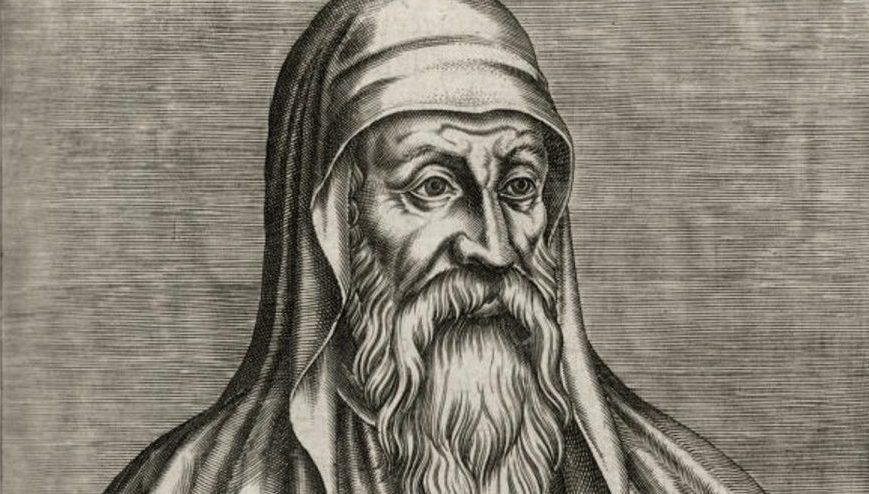
Origen (c. 184-c. 253), from Alexandria, Egypt, was one of the greatest but most controversial theologians in the ancient Church. Though not considered a “Church Father” because of later condemnations of some of his views (though there is evidence he repented of at least some of them to St. Pope Fabian), he nonetheless made major contributions to early Christian theology, and a great number of his writings remained within the standards of orthodoxy at the time (and today).
As such, his witness—though less authoritative than a Church Father’s—carries significant weight.
Roadmap
With that brief background in mind, our Roadmap for this Eucharist Snapshot is as follows:
- Our thesis is that Origen’s Homily 13 on Exodus provides striking evidence for Catholic belief in the Eucharist in the ancient Church. We will show this by:
- Quoting and analyzing the relevant portion of his Homily 13 on Exodus; then
- Summarizing the conclusions we believe can be reached.
Origen, Homily 13 on Exodus
Let us now examine Origen’s words about the Eucharist in Homily 13 on Exodus (§3):
I wish to admonish you with examples from your religious practices. You who are accustomed to take part in divine mysteries [the mass] know, when you receive the body of the Lord, how you protect it with all caution and veneration lest any small part fall from it, lest anything of the 380 | 381 consecrated gift be lost. For you believe, and correctly, that you are answerable if anything falls from there by neglect. But if you are so careful to preserve his body, and rightly so, how do you think that there is less guilt to have neglected God’s word than to have neglected his body?
This text, though brief, strongly suggests a deeply Catholic view of the Eucharist, about which we offer the following observations.
First, Origen’s comments about the Eucharist are situated within the “religious practices” of those to whom he is speaking, namely everyday Christians. Thus, he is not appealing to his own unique theory about the Eucharist, but to a reality that those to whom he is preaching already know and affirm.
Second, the practice to which he is specifically referring are the “divine mysteries,” which was a common term among ancient Christians (and in the Catholic Church to this day) for the liturgy of the mass, the primary act of Christian worship.
Third, though he is speaking about the mass and the Eucharist, Origen never refers to the Eucharist as “bread,” but only and everywhere as “the body of the Lord,” or “his body.” Thus, as was common throughout the ancient Church, the Eucharist is simply equated with the body (and blood, when the wine is included) of Christ, often (as here) without further qualification.
Fourth, he refers to the Eucharist as “the consecrated gift.” Throughout his writings, Origen often speaks about the three-fold office of the clergy consisting of bishops, priests, and deacons, as well as to the “priesthood” in general to whom have been committed “the administration of the sacraments,” as he observed in his Commentary on Matthew (Book 14, Ch. 22). Obviously, the Eucharist would be one of these sacraments. In his work Against Celsus (Book 8, Ch. 33), he also refers to the prayer of consecration, in which “this bread becomes by prayer a sacred body, which sanctifies those who sincerely partake of it.” It is thus reasonably certain that priests charged with “the administration of the sacraments” bring about this “consecrated gift” by their prayer, and in this case, the ultimate sacrament in which “this bread becomes…a sacred body.”
Fifth, Origen sees the Eucharist as something incredibly holy, such that, if it is mishandled in any way—even through negligence (rather than an intent to commit sacrilege)—those who mishandle it will be “answerable if anything falls [to the ground],” for which they will incur “guilt.” He says the Eucharist must be protected “with all caution and veneration lest any small part fall from it,” and thereby applies his descriptions of the Eucharist as a whole to “any small part” of it, which would be incompatible with basically every protestant view of the Eucharist, whether symbolic, spiritual, or even the Lutheran view in which both the body of Christ and bread remain present. Origen does not seem to entertain any such admixture of body and bread. For him, it is all the body of Christ. He further reinforces this point when he compares neglecting God’s word with neglecting “to preserve his body” in the Eucharist.
In short, Origen’s description of the Eucharist—which he assumes is known and affirmed by the ordinary Christians to which he is speaking—fits Catholic teaching incredibly well. He everywhere treats it as if it is the same thing as Christ Himself, equating it not only with His very body, and its sanctity with the word of God itself (down to each and every “small part” of it), but attributing very severe guilt to any mishandling of it. Likewise, he describes the Eucharist as a “consecrated gift,” which elsewhere in his writings he attributes to the Christian priesthood who administers the sacraments, and whose prayer takes what was “bread” and transforms it into “a sacred body.”
Conclusion
Though brief, these comments from Origen offer persuasive evidence of a very Catholic view of the Eucharist in the Church of the 2nd and 3rd centuries—centuries before the later conversion of the Roman Empire that so many protestants often continue to blame for supposed Catholic “corruptions” of Christian doctrine. While the Church today uses the term “transubstantiation” to more precisely describe the change of bread into the Eucharist through consecration, Catholics today can affirm everything Origen states in this homily about the Eucharist, which is itself an astounding witness to the ancient origins (no pun intended) of Catholic belief.
 Buy Us a Coffee