Introduction
Few things opened my eyes to the reality of Catholic truth, and its biblical basis, more than typology. What is “typology”? It can be summarized this way: “the New Testament lies hidden in the Old and the Old Testament is unveiled in the New.” In short, it’s a method of reading Scripture in which everything in the Old Testament represents a type, or prefigurement that is fulfilled in the New Testament, and everything in the New Testament likewise sheds light on the prefigurement/type in the Old Testament. While protestantism, as such, does not reject typology, it did not play as prominent a role in the biblical understanding of most theologians and preachers I knew of as a protestant, particularly when compared with the writings of the saints, Church Fathers, and theologians of the Catholic Church.
It is no exaggeration to say that learning how to interpret Scripture typologically, particularly with the help of the Church Fathers, has been one of the most fascinating and exciting intellectual journeys of my life. While I loved and studied Scripture constantly as a protestant, diving deeper into typology with the Catholic Church took my understanding of the Bible from black and white to full, ultra high-definition color. Phrases, sentences, stories, indeed entire books of the Bible overflowed with new and deeper layers of meaning that I had never seen before, and all of them pointed to Christ and His Catholic Church.
Since typology is so essential to explaining the depth, beauty, and rationale of Catholic doctrine, I decided to write this introductory article as a reference point for future articles that explore typology, proving its deep biblical roots in the teachings of Christ and the Apostles.
Roadmap
With that in mind, our Roadmap is as follows:
- Our thesis is that typology–the principle that “the New Testament lies hidden in the Old and the Old Testament is unveiled in the New”–is not a method of understanding Scripture imposed upon it by Catholic theologians, but one that Scripture itself explicitly and consistently endorses and practices, particularly in the teachings of Christ and the Apostles. In fact, typology is so essential that it is not too much to say that without typology, there would be no Gospel. We will show this by:
- First, explaining what typology is according to the Catholic Church;
- Second, providing several brief examples from Church Fathers–both East and West–that show the ancient roots of typology among the saints and doctors of the Church;
- Third, showing examples of Jesus using typology;
- Fourth, showing examples of St. Paul using typology;
- Fifth, showing an example of St. Peter using typology; and
- Finally, summarizing our conclusions from this evidence.
Typology According to the Catechism
First, let us review what the Catechism of the Catholic Church teaches about typology, for it is a very enlightening and succinct summary (par. 128-30):
128. The Church, as early as apostolic times [1 Cor. 10:6; Heb. 10:1; 1 Pet. 3:21], and then constantly in her Tradition, has illuminated the unity of the divine plan in the two Testaments through typology, which discerns in God’s works of the Old Covenant prefigurations of what he accomplished in the fullness of time in the person of his incarnate Son.
129. Christians therefore read the Old Testament in the light of Christ crucified and risen. Such typological reading discloses the inexhaustible content of the Old Testament; but it must not make us forget that the Old Testament retains its own intrinsic value as Revelation reaffirmed by our Lord himself. Besides, the New Testament has to be read in the light of the Old. Early Christian catechesis made constant use of the Old Testament. As an old saying put it, the New Testament lies hidden in the Old and the Old Testament is unveiled in the New.
130. Typology indicates the dynamic movement toward the fulfillment of the divine plan when “God [will] be everything to everyone” (1 Cor. 15:28). Nor do the calling of the patriarchs and the exodus from Egypt, for example, lose their own value in God’s plan, from the mere fact that they were intermediate stages.
The Catechism points out a few noteworthy principles of typology:
- Typology is the principle of unity between the Old and New Testaments, where all that is old is revealed in light of Christ.
- Types in the Old Covenant find fulfillment in the New Testament. The fulfillments are always greater than the types, which nonetheless retain “their own value in God’s plan.”
- Far from making the Old Testament unnecessary, typology affirms the Old Testament as intrinsically valuable divine revelation, full of “inexhaustible content.”
The Church grounds typology in both Scripture and Tradition. As we will see, typology is explicitly affirmed by Christ and the Apostles in the New Testament as one of the primary means by which to understand the Old Testament. But it is also ubiquitous throughout Tradition, by which we mean–in this context–all else that is not contained explicitly in Scripture: the Church’s prayer, Her liturgy, and the modes of theology by which Her saints, doctors, and magisterium have contemplated and defined the truths of divine revelation.
While our primary purpose is to demonstrate that typology is thoroughly grounded in Scripture, let us first consider some brief examples from Tradition, as contained in the writings of the Church Fathers.
Typology in the Church Fathers
Perhaps the most famous summation of typology comes from St. Augustine, who defined it as follows in Question 73 of his Quaestiones in Heptateuchum1:
The New is hidden in the Old, and the Old is revealed in the New.
But typology was well-established among the Church Fathers long before St. Augustine. For example, in the second century, St. Justin Martyr observed as follows about the Torah in his Dialogue with Trypho (Ch. 42):
[B]y enumerating all the other appointments of Moses, I can demonstrate that they were types, and symbols, and declarations of those things which would happen to Christ, of those who it was foreknown were to believe in Him, and of those things which would also be done by Christ Himself.
Likewise, also in the second century, St. Irenaeus of Lyon wrote around 180 as follows in his great work, Against Heresies (Book 5, Ch. 26, §1):
If anyone, therefore, reads the Scriptures with attention, he will find in them an account of Christ, and a foreshadowing of the new calling. For Christ is the treasure which was hid in the field [Matt. 13:44], that is, in this world, for “the field is the world” (Matt. 13:38); but the treasure hid in the Scriptures is Christ, since He was pointed out by means of types and parables…
[W]hen it [the Old Testament] is read by the Christians, it is a treasure, hid indeed in a field, but brought to light by the cross of Christ, and explained, both enriching the understanding of men, and showing forth the wisdom of God and declaring His dispensations with regard to man, and forming the kingdom of Christ beforehand, and preaching by anticipation the inheritance of the holy Jerusalem, and proclaiming beforehand that the man who loves God shall arrive at such excellency as even to see God, and hear His word, and from the hearing of His discourse be glorified to such an extent, that others cannot behold the glory of his countenance, as was said by Daniel: “Those who do understand, shall shine as the brightness of the firmament, and many of the righteous as the stars for ever and ever” (Dan. 12:3).
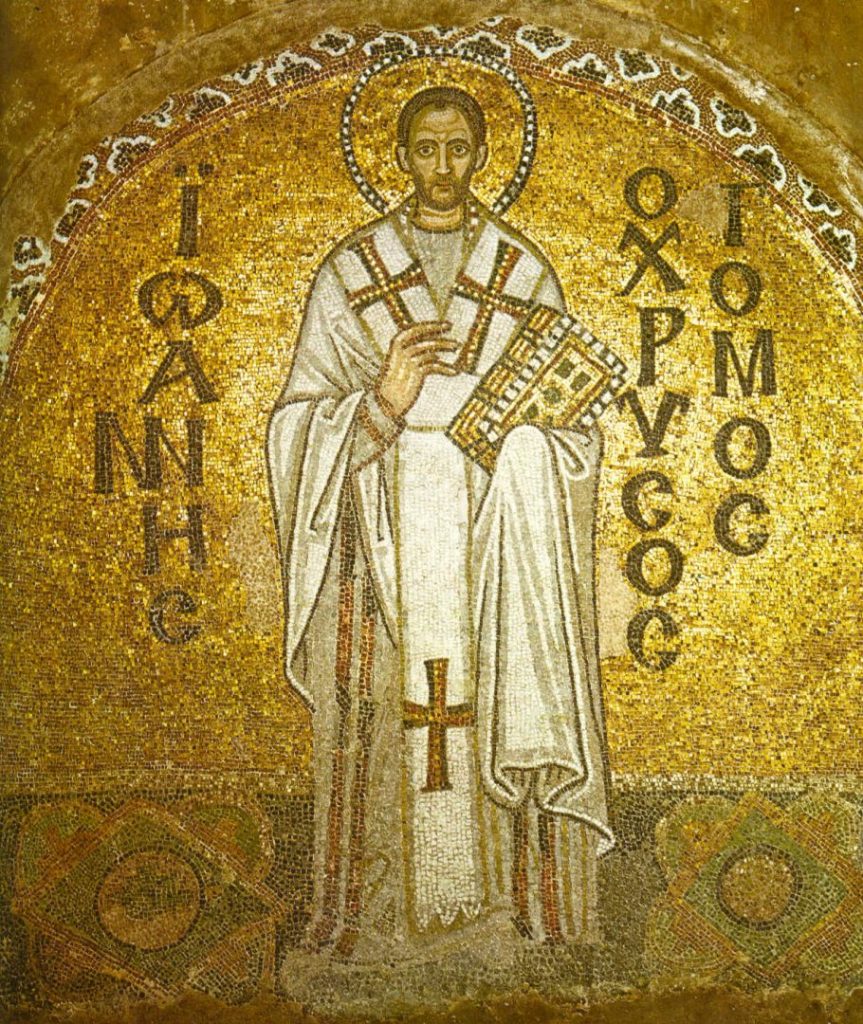
Similarly, as St. John Chrysostom—perhaps the greatest homilist among the eastern Church Fathers—observed, typology is based on the principle that the type is “in figure,” and the fulfillment “in power.” In other words, as the Catechism states, the fulfillment in the New Testament is always greater than the type in the Old Testament, just as Christ is greater than Moses, and the New Covenant is greater than the Old Covenant. He observed as much in his Homily 17 on Hebrews (§5):
The types therefore contain the figure only, not the power; just as in images, the image has the figure of the man, not the power. So that the reality and the type have [somewhat] in common with one another. For the figure exists equally in both, but not the power.
Finally, the great eastern Church Father St. Cyril of Alexandria, who presided over the Ecumenical Council of Ephesus on behalf of St. Pope Celestine I, described typology as the means by which the infinite treasures of Scripture could be unlocked (Book 9: Exodus, Part 2)2:
[W]e do not reject as useless the instruction of the law, which was earlier gathered and stored up among us, so to speak, and which leads us to Christ, for the law was a tutor [Gal. 3:24]. Rather, having the law as well as the teachings of the gospel, we will not be far from offering befitting praise, and God will not be angry at those who do this. The Savior himself teaches this when he says to us, “Every scribe instructed about the kingdom of heaven is like the owner of a house who brings out of his storeroom new things as well as old” (Matt. 13:52).
Countless such quotations could be offered from the Fathers of the Church extolling the use of typology for understanding the Scriptures. They constantly applied this method whenever they unfolded the riches of the Bible, especially the Old Testament.
As we will see, this was not arbitrary. In fact, it is clear from Scripture itself that typology was used by Christ and the Apostles themselves in order to properly interpret the Old Testament in light of its fulfillment in Christ.
Typology is Biblical
As alluded to by the Catechism, the Church has not devised typology on its own, but has in fact drawn it from the words of Scripture itself, for it is one of the most important methods by which Christ and the Apostles interpreted the Old Testament. Indeed, as we observed earlier, it is not an exaggeration to say that without typology, there is no Gospel, or certainly nothing like the Gospel as we know it. The reason why is because, while some prophecies of Christ and His kingdom are more literal, many are not. To understand many of them as pointing to Christ requires reading them through the lens of typology, of which we have many examples of Christ and the Apostles doing.
Let us now dig into some of these examples.
Jesus Using Typology
The Transfiguration as an “Icon” of Typology
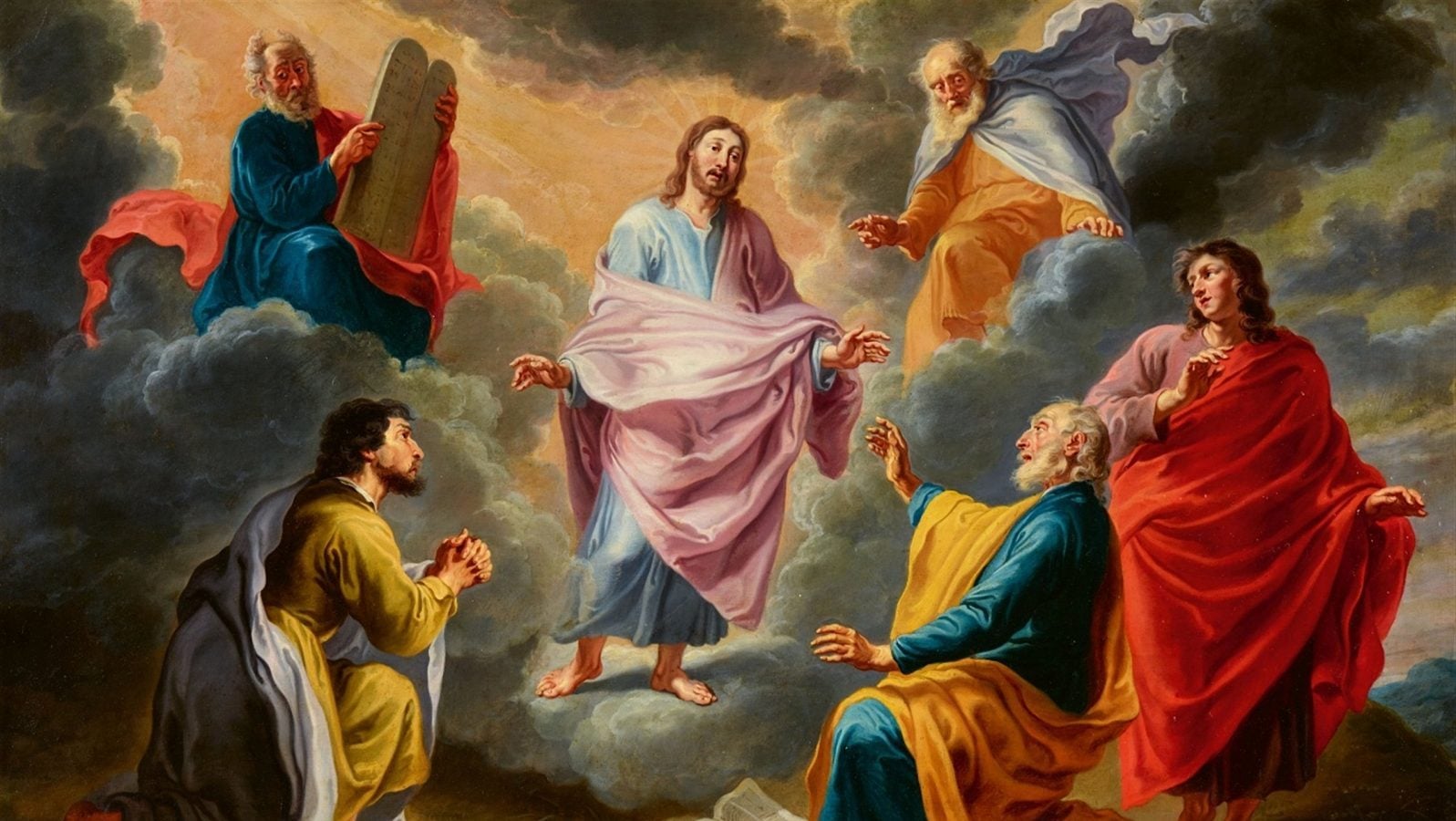
Before proceeding to Christ’s specific uses of typology, I’d like to present an “icon” of sorts from the Gospels that represents the reality of typology, namely, the Transfiguration (Matt. 17:1-8; Mark 9:2-8; Luke 9:28-36), in which Christ ascended Mount Tabor with some of His closest disciples, and His body was brilliantly illuminated, showing forth His divine nature. In each account of the Transfiguration, Jesus is joined by two other figures, Moses and Elijah, who themselves represent the Law and the Prophets–in other words, the Old Testament–and are speaking with Christ. Likewise, in each account, God speaks from heaven, identifying Christ as His son, and commanding He be obeyed: “my beloved Son, with whom I am well pleased; listen to him” (Matt. 17:5); “my beloved Son; listen to him” (Mark 9:7); and “my Son, my Chosen; listen to him!” (Luke 9:35).
Thus, in the Transfiguration, we have a living picture, or icon, of the reality of typology: the Law and the Prophets, the Old Testament, points to and is fulfilled by Jesus Christ.
Now, let us proceed to various examples of Christ explicitly appealing to a typological reading of the Old Testament, explaining it in light of Himself.
Christ Fulfills the Law and the Prophets
We will start with an example of Our Lord’s more general reference to typology. Near the beginning of Matthew’s Gospel, Our Lord says that He has not come to abolish but to fulfill the law and the prophets (Matt. 5:17-18):
17 “Think not that I have come to abolish the law and the prophets; I have come not to abolish them but to fulfill them. 18 For truly, I say to you, till heaven and earth pass away, not an iota, not a dot, will pass from the law until all is accomplished.
From this, we see Christ establish the fundamental key by which we may unlock the meaning of the Old Testament, namely: Himself. This is the essence of typology. Christ, as the fulfillment of the Old Testament, is also thereby its interpretive key. As the Old Testament was full of types, so those types were brought to completion in Him.
The Sign of Jonah and the Greater Solomon
Let us now move on to more explicit and particular examples of Our Lord using typology.
One of the clearest examples of Christ utilizing typology in order to reveal the deeper meaning of the Old Testament is His discussion about the “sign of Jonah.” The Gospels contain two accounts of this exchange, one in Matthew (12:38-42), and the other in Luke (11:29-32). They are substantially the same, so we will examine only the account in Matthew for the sake of brevity (Matt. 12:38-42):
38 Then some of the scribes and Pharisees said to him, “Teacher, we wish to see a sign from you.” 39 But he answered them, “An evil and adulterous generation seeks for a sign; but no sign shall be given to it except the sign of the prophet Jonah. 40 For as Jonah was three days and three nights in the belly of the whale, so will the Son of man be three days and three nights in the heart of the earth. 41 The men of Nineveh will arise at the judgment with this generation and condemn it; for they repented at the preaching of Jonah, and behold, something greater than Jonah is here. 42 The queen of the South will arise at the judgment with this generation and condemn it; for she came from the ends of the earth to hear the wisdom of Solomon, and behold, something greater than Solomon is here.
In this account, Our Lord Himself explicitly states the typological connection between the story of Jonah and Himself: Jonah’s three nights in the whale are compared to Messiah’s three nights in the “heart of the earth” (Sheol, or the realm of the dead). But does the book of Jonah anywhere state that it is Messianic? No. Not once–not literally, at least. But Our Lord is showing us that Jonah possesses depths of meaning which can only be understood through Him.
Now that we know this, the story of Jonah takes on a whole new world of meaning that does not “abolish,” but rather “fulfills” its literal meaning. For example, it is all but certain that Jonah was dead when in the belly of the whale. Not only is this common sense, but when he offers his prayer to God, he says he does so from Sheol, which is the realm of the dead (Jon. 2:1-2):
Then Jonah prayed to the Lord his God from the belly of the fish, 2 saying,
“I called to the Lord, out of my distress,
and he answered me;
out of the belly of Sheol I cried,
and thou didst hear my voice…
We are then told, after his prayer for deliverance from Sheol, that “the Lord spoke to the fish, and it vomited out Jonah upon the dry land” (Jon. 2:10). Thus, we have a resurrection, and with it, yet another parallel with Christ: both died, went down to Sheol, and rose again on the third day. For the Christian, this is all beginning to sound very familiar.
But that isn’t all. Jonah was tasked by God with preaching repentance to a Gentile nation, namely, the Assyrians. Initially, God simply asks him to go to Nineveh and point out its wicked ways (Jon. 1:1-2):
Now the word of the Lord came to Jonah the son of Amittai, saying, 2 “Arise, go to Nineveh, that great city, and cry against it; for their wickedness has come up before me.”
As the capital of the Assyrian empire, Nineveh represented the arch-enemy of the Israelites. Jonah thus refused to go, leading to his eventual detour to the belly of the whale.
But upon his resurrection, Jonah obeys God’s command and goes to Nineveh. “Arise, go to Nineveh, that great city, and proclaim to it the message that I tell you” (Jon. 3:2), God says. Once there, he proclaimed that Nineveh would be destroyed in 40 days (Jon. 3:4):
4 Jonah began to go into the city, going a day’s journey. And he cried, “Yet forty days, and Nineveh shall be overthrown!”
But the people of Nineveh, far from rejecting this warning from a pesky Israelite, took it to heart, and repented (Jon. 3:5-9):
5 And the people of Nineveh believed God; they proclaimed a fast, and put on sackcloth, from the greatest of them to the least of them.
6 Then tidings reached the king of Nineveh, and he arose from his throne, removed his robe, and covered himself with sackcloth, and sat in ashes. 7 And he made proclamation and published through Nineveh, “By the decree of the king and his nobles: Let neither man nor beast, herd nor flock, taste anything; let them not feed, or drink water, 8 but let man and beast be covered with sackcloth, and let them cry mightily to God; yea, let every one turn from his evil way and from the violence which is in his hands. 9 Who knows, God may yet repent and turn from his fierce anger, so that we perish not?”
Indeed, that is precisely what God did–He showed mercy to Nineveh (Jon. 3:10):
10 When God saw what they did, how they turned from their evil way, God repented of the evil which he had said he would do to them; and he did not do it.
We have now come full circle: thanks to Christ showing there is a connection between Jonah’s three days in the whale, and His own in Sheol, we can now read the story of Jonah itself in a more complete way. Jonah, an Israelite, was sent by God to preach repentance to the Gentiles. Prior to this happening, Jonah himself died, was in Sheol for three days, and rose again on the third day. After his resurrection, he goes to the Gentile city of Nineveh, preaches repentance, and they repent. God in turn shows mercy on them.
Once more, this should all sound very familiar to the Christian, who believes that a Jewish Messiah died, rose again on the third day, and preached repentance to the Gentiles so that God might show mercy on them. Though these are not the only typological connections between the book of Jonah and the New Testament, they are among the more prominent ones.
Christ thereby showed us how multiple mysteries of the Gospel were foretold, as a type, in the book of Jonah. But this deeper understanding only became possible once we understood that Scripture was to be read beyond the literal.
That is the power of typology.
Moses and the Prophets Point to Christ (Luke 24:27)
Prior to His Ascension, in the famous “Road to Emmaus” story, Our Lord once more affirms typology by asserting that all of the Old Testament pointed to Him (Luke 24:27):
27 And beginning with Moses and all the prophets, he interpreted to them in all the scriptures the things concerning himself.
It is worth pointing out here that the one and only time the term “New Testament” (or “New Covenant”) appears in what we call the “New Testament” (the 27 books) is by Christ in reference to the Eucharist. It is thus no coincidence that it is on the road to Emmaus that the disciples discern what Christ is teaching them from the Scriptures in the breaking of the bread, i.e. the Eucharist (Luke 24:30-32):
30 When he was at table with them, he took the bread and blessed, and broke it, and gave it to them. 31 And their eyes were opened and they recognized him; and he vanished out of their sight. 32 They said to each other, “Did not our hearts burn within us while he talked to us on the road, while he opened to us the scriptures?”
Moses and the Serpent
We see another example of Jesus using typology in the Gospel of John, when He compares His own Ascension to Moses lifting the serpent in the wilderness (John 3:12-15):
12 If I have told you earthly things and you do not believe, how can you believe if I tell you heavenly things? 13 No one has ascended into heaven but he who descended from heaven, the Son of man. 14 And as Moses lifted up the serpent in the wilderness, so must the Son of man be lifted up, 15 that whoever believes in him may have eternal life.”
The story Christ is referring to comes from the book of Numbers. The people of Israel had once again begun to grumble against God and Moses. As punishment, “the Lord sent fiery serpents among the people, and they bit the people, so that many people of Israel died” (Num. 21:6). God then showed mercy on the people, but in an odd and mysterious way that the literal words of the text don’t quite explain (Num. 21:8-9):
8 And the Lord said to Moses, “Make a fiery serpent, and set it on a pole; and every one who is bitten, when he sees it, shall live.” 9 So Moses made a bronze serpent, and set it on a pole; and if a serpent bit any man, he would look at the bronze serpent and live.
We will not presume to fully explain the profound depths of this typological connection between Christ and the bronze serpent. However, various Church Fathers, saints, and theologians have observed, among other things, that as a bronze serpent was the means by which the Israelites were saved by the bites of serpents, so Christ assumed our human nature (in all but sin) in order to save it. Likewise, as the serpent was lifted up for all to see, so Christ was lifted up on a cross and at His Ascension for all to see. Even modern non-Catholic figures like Jordan Peterson have interpreted the serpent to typologically represent Christ in that the serpent represents something we would normally hate and fear, and yet–like Christ’s cross–it is the very thing the Israelites needed to embrace to be saved.
The larger point remains: once more, does this story from the Torah mention the Messiah, or even suggest it has Messianic implications? No. But we know that it does, thanks to Messiah Himself. A connection that would be untenable by the literal reading becomes tenable by the typological reading, on the authority of Christ.
Christ the New Manna
Perhaps Christ’s most famous typological reading of Scripture concerns His connecting the manna given as food to the Israelites in the wilderness (Num. 16) with the Father sending Him to earth as “the true bread from heaven” (John 6:32-35, 41-58):
32 Jesus then said to them, “Truly, truly, I say to you, it was not Moses who gave you the bread from heaven; my Father gives you the true bread from heaven. 33 For the bread of God is that which comes down from heaven, and gives life to the world.” 34 They said to him, “Lord, give us this bread always.”
35 Jesus said to them, “I am the bread of life; he who comes to me shall not hunger, and he who believes in me shall never thirst…
41 The Jews then murmured at him, because he said, “I am the bread which came down from heaven.” 42 They said, “Is not this Jesus, the son of Joseph, whose father and mother we know? How does he now say, ‘I have come down from heaven’?” 43 Jesus answered them, “Do not murmur among yourselves. 44 No one can come to me unless the Father who sent me draws him; and I will raise him up at the last day. 45 It is written in the prophets, ‘And they shall all be taught by God.’ Every one who has heard and learned from the Father comes to me. 46 Not that any one has seen the Father except him who is from God; he has seen the Father. 47 Truly, truly, I say to you, he who believes has eternal life. 48 I am the bread of life. 49 Your fathers ate the manna in the wilderness, and they died. 50 This is the bread which comes down from heaven, that a man may eat of it and not die. 51 I am the living bread which came down from heaven; if any one eats of this bread, he will live for ever; and the bread which I shall give for the life of the world is my flesh.”
52 The Jews then disputed among themselves, saying, “How can this man give us his flesh to eat?” 53 So Jesus said to them, “Truly, truly, I say to you, unless you eat the flesh of the Son of man and drink his blood, you have no life in you; 54 he who eats my flesh and drinks my blood has eternal life, and I will raise him up at the last day. 55 For my flesh is food indeed, and my blood is drink indeed. 56 He who eats my flesh and drinks my blood abides in me, and I in him. 57 As the living Father sent me, and I live because of the Father, so he who eats me will live because of me. 58 This is the bread which came down from heaven, not such as the fathers ate and died; he who eats this bread will live forever.”
While exploring the vast riches of this text are beyond our scope here, it can be clearly seen that Christ is making a direct connection between the manna given by God to the Israelites in the wilderness, and the Father sending His Son, who in turn declares that His Body and Blood are the “bread of life” and “the living bread which came down from heaven” in order that men might “live forever.” The Catholic Church teaches this is preeminently fulfilled in the Holy Eucharist, which is the Body, Blood, Soul, and Divinity of Our Lord Jesus Christ.
Once more, we can see that Christ relies not on abrogating the literal, but interpreting it in light of its fulfillment in Him. No text in Numbers 16 literally or explicitly alludes to the Messiah. But the Messiah Himself says that this story relates to Him, and indeed we can see many connections. As the manna was miraculously provided to a dying people in the wilderness, so Christ is sent to a dying humanity in the wilderness of this world. The word “manna” literally means “what is it?” and in the Eucharist, Christ has given us the definitive answer: Himself. As the manna gave physical life to the people, so the Body and Blood of Christ gives spiritual life to humanity.
There are many more typological connections between the manna and Christ, but that suffices for making our point here.
St. Paul Using Typology
Let us now examine some prominent examples of St. Paul utilizing typology to interpret the Old Testament in light of the New. We will do so according to the order in which his various letters appear in the New Testament.
The Cloud, the Red Sea, Supernatural Food and Drink, the Rock
One such example comes from 1 Corinthians 10, where St. Paul points out numerous types in the ancient Israelite religion that were ultimately fulfilled in Christ (1 Cor. 10:1-13):
I want you to know, brethren, that our fathers were all under the cloud, and all passed through the sea, 2 and all were baptized into Moses in the cloud and in the sea, 3 and all ate the same supernatural food 4 and all drank the same supernatural drink. For they drank from the supernatural Rock which followed them, and the Rock was Christ. 5 Nevertheless with most of them God was not pleased; for they were overthrown in the wilderness.
6 Now these things are warnings for us, not to desire evil as they did. 7 Do not be idolaters as some of them were; as it is written, “The people sat down to eat and drink and rose up to dance.” 8 We must not indulge in immorality as some of them did, and twenty-three thousand fell in a single day. 9 We must not put the Lord to the test, as some of them did and were destroyed by serpents; 10 nor grumble, as some of them did and were destroyed by the Destroyer. 11 Now these things happened to them as a warning, but they were written down for our instruction, upon whom the end of the ages has come. 12 Therefore let any one who thinks that he stands take heed lest he fall. 13 No temptation has overtaken you that is not common to man. God is faithful, and he will not let you be tempted beyond your strength, but with the temptation will also provide the way of escape, that you may be able to endure it.
In this passage, we see St. Paul interpret the cloud by which God guided the Israelites through the wilderness, as well as the Red Sea through which they passed, as a type of baptism. Likewise, he speaks of “supernatural” food and drink, referring to the manna, and the water that gushed forth from the rock once Moses struck it. This rock he identifies with Christ, the source of life amidst the desert of this world.
None of these stories explicitly connect themselves to Israel’s future Messiah. But once again, that is how they are interpreted in the New Testament by not only Christ, but His Apostles. “Now these things are warnings for us…written down for our instruction,” St. Paul says, thereby identifying the typological reading of the Old Testament in light of the New as a proper form of Christian instruction.
Sarah and Hagar, Isaac and Ishmael, Sinai and Jerusalem
St. Paul makes yet more typological connections in the book of Galatians (Gal. 4:21-31):
21 Tell me, you who desire to be under law, do you not hear the law? 22 For it is written that Abraham had two sons, one by a slave and one by a free woman. 23 But the son of the slave was born according to the flesh, the son of the free woman through promise. 24 Now this is an allegory: these women are two covenants. One is from Mount Sinai, bearing children for slavery; she is Hagar. 25 Now Hagar is Mount Sinai in Arabia; she corresponds to the present Jerusalem, for she is in slavery with her children. 26 But the Jerusalem above is free, and she is our mother. 27 For it is written (Isa. 54:1),
“Rejoice, O barren one that dost not bear;
break forth and shout, thou who art not in travail;
for the desolate hath more children
than she who hath a husband.”28 Now we, brethren, like Isaac, are children of promise. 29 But as at that time he who was born according to the flesh persecuted him who was born according to the Spirit, so it is now. 30 But what does the scripture say? “Cast out the slave and her son; for the son of the slave shall not inherit with the son of the free woman.” 31 So, brethren, we are not children of the slave but of the free woman.
Once more, we do not presume to draw out all the inexhaustible riches of this beautiful text. But suffice it to say, we see again the apostolic authority behind typology as a method of reading the Old Testament. In the story of Sarah and Hagar, St. Paul does not see just two women, but two nations. In the enslaved woman and her progeny, he does not see merely individuals, but a type of the Jerusalem who has rejected Christ, and thereby enslaved herself. Similarly, in the free woman, Sarah, he does not see just an individual wife, but a type of the heavenly Jerusalem, the Church Triumphant who he identifies as the mother of all Christians, and the Bride of Christ. Christians themselves are likewise “free” because they have been made new in Christ, and have thereby become “children of promise” who, like Isaac (and Christ Himself) were born not by natural, but by supernatural means. And just as Isaac was persecuted by his brother Esau, he observes, so too are Christians persecuted by Christ-rejecting Jews.
In short, from this simple story, St. Paul draws forth an endless well of insights into the nature of salvation, redemption, and the dynamics of history and peoples. He is able to do so through typology.
Torah Dietary Laws, Festivals, and Sabbath a Shadow of Christ
Moving on to his letter to the Colossians, St. Paul makes a more general reference to typology in which he observes as follows (Col. 2:16-17):
16 Therefore let no one pass judgment on you in questions of food and drink or with regard to a festival or a new moon or a sabbath. 17 These are only a shadow of what is to come; but the substance belongs to Christ.
In this statement, we see that St. Paul characterizes the Old Covenant as a “shadow,” the substance of which “belongs to Christ.” We can thus imagine seeing the shadow of a person far off, but not yet able to see the person. But when they arrive in our presence, we now see them, and we understand all the shapes and contours of their shadow in light of the person in front of us. St. Paul is saying the same thing about Christ and the Old Covenant. The Old Covenant does not cease to be divine revelation, so it is not thrown out (that would be the heresy of Marcion). But as a shadow, we now understand it in light of the Person whose shadow it was: Jesus Christ.
Christ the New Moses
Moving on to the letter of the Hebrews–whose Pauline authorship we will simply assume–we see St. Paul once more make numerous typological connections. We will not examine every one, as that could be a book on its own, but will instead focus on two: Christ as the New Moses, and Christ as the New Melchizedek.
First, the New Moses (Heb. 3:1-6):
Therefore, holy brethren, who share in a heavenly call, consider Jesus, the apostle and high priest of our confession. 2 He was faithful to him who appointed him, just as Moses also was faithful in God’s house. 3 Yet Jesus has been counted worthy of as much more glory than Moses as the builder of a house has more honor than the house. 4 (For every house is built by some one, but the builder of all things is God.) 5 Now Moses was faithful in all God’s house as a servant, to testify to the things that were to be spoken later, 6 but Christ was faithful over God’s house as a son. And we are his house if we hold fast our confidence and pride in our hope.
The connections the Apostle draws between Christ and Moses are obvious, and clearly typological in nature. Both built a house–the House of God–but one as a servant, the other as a son. Both were faithful, but Christ possesses far greater glory than Moses. Indeed, the Apostle says Moses’s role was “to testify to the things that were to be spoken later,” those “things” being the teachings of Christ.
The Old and New Melchizedek
St. Paul likewise identifies Christ as the New Melchizedek, about which he observes as follows (Heb. 7:1-3, 15-17):
For this Melchizedek, king of Salem, priest of the Most High God, met Abraham returning from the slaughter of the kings and blessed him; 2 and to him Abraham apportioned a tenth part of everything. He is first, by translation of his name, king of righteousness, and then he is also king of Salem, that is, king of peace. 3 He is without father or mother or genealogy, and has neither beginning of days nor end of life, but resembling the Son of God he continues a priest for ever...
15 This becomes even more evident when another priest arises in the likeness of Melchizedek, 16 who has become a priest, not according to a legal requirement concerning bodily descent but by the power of an indestructible life. 17 For it is witnessed of him (Ps. 110:4),“Thou art a priest for ever,
after the order of Melchizedek.”
Once more, we see how Melchizedek is a far more rich personality in light of his relationship to Christ. Though not mentioned in this passage, his offering of bread and wine is no doubt a type of Christ’s offering of His Body and Blood through the instrumentality of bread and wine in His last Passover, and subsequently through the offering of every Holy Mass since.
Finally, in the latter part of Hebrews, St. Paul once more offers a general comment about typology, calling the Old Covenant a “shadow” which is fulfilled by the “good things” found in Christ (Heb. 10:1):
For since the law has but a shadow of the good things to come instead of the true form of these realities, it can never, by the same sacrifices which are continually offered year after year, make perfect those who draw near.
St. Peter Using Typology
Let’s now move on to St. Peter, who likewise utilizes typology in order to illuminate the meaning of the Old Testament in the light of Christ.
Noah’s Flood and Baptism
One such example comes from his first letter, where the chief Apostle draws a typological connection between Noah’s flood and baptism (1 Pet. 3:18-22):
18 For Christ also died for sins once for all, the righteous for the unrighteous, that he might bring us to God, being put to death in the flesh but made alive in the spirit; 19 in which he went and preached to the spirits in prison, 20 who formerly did not obey, when God’s patience waited in the days of Noah, during the building of the ark, in which a few, that is, eight persons, were saved through water. 21 Baptism, which corresponds to this, now saves you, not as a removal of dirt from the body but as an appeal to God for a clear conscience, through the resurrection of Jesus Christ, 22 who has gone into heaven and is at the right hand of God, with angels, authorities, and powers subject to him.
Once more, as with Christ and St. Paul, St. Peter interprets the Old Testament in ways that go beyond the literal, but which nonetheless shed light upon it. Speaking of Noah’s flood, he says baptism “corresponds to this.” What exactly is corresponding? The fact that they were “saved through water.” Hence St. Peter’s declaration “Baptism…now saves you.”
Again, while an exhaustive treatment of this typological connection between Noah’s flood and baptism is beyond our scope, we can nonetheless discern numerous connections between the two. As the world had grown exceedingly sinful before God punished it by the flood, so we were born in sin, and exceedingly sinful before Christ saved us. As God cleansed the world of its sins through water, so is our soul cleansed of its sins in baptism, as St. Peter also said in the very first sermon (Acts 2:38): “Repent, and be baptized every one of you in the name of Jesus Christ for the forgiveness of your sins; and you shall receive the gift of the Holy Spirit.” Likewise, as Noah and his family sent out a dove (a traditional symbol of the Holy Spirit), which eventually returned with an olive branch (representing peace), so too St. Peter says that we receive the Holy Spirit in baptism, by which we are “made alive in the spirit,” and thereby at peace with God through “a clear conscience.”
Conclusion
As St. Cyril of Alexandria observed in his commentary on the book of Numbers about the story of Moses and the bronze serpent (Book 12: Numbers)3:
For it is not the literal sense that satisfies those who are more discerning, but the mysteries that are found in the figures.
As we have seen, typology is the principle by which we unlock “the mysteries that are found in the figures” of the Old Testament in the brilliant light of the New, and it is a principle we learn directly from Christ and the Apostles. Typology was so central to their teaching that one could assert that without typology, there would be no Gospel as we know it, for it is the tool by which they brought the entirety of the Old Testament–including those parts that are not explicitly Messianic–into conformity with Christ.
Typology is thus a master principle, of sorts, for understanding the depths of Holy Scripture–a truth that should always be borne in mind as we explore the treasures of Scripture with the Church and the Fathers, who in utilizing typology to unlock its secrets are doing nothing more than following the example of Christ and the Apostles.
Footnotes
- St. Augustine, Quaestiones in Heptateuchum (Q. 73). ↩︎
- St. Cyril of Alexandria, Nicholas P. Lunn, trans., The Fathers of the Church, Vol. 138: St. Cyril of Alexandria, Glaphyra on the Pentateuch, Vol. 2: Exodus Through Deuteronomy (Washington, DC: The Catholic University of America Press, 2019), 63. ↩︎
- St. Cyril of Alexandria, Nicholas P. Lunn, trans., The Fathers of the Church, Vol. 138: St. Cyril of Alexandria, Glaphyra on the Pentateuch, Vol. 2: Exodus Through Deuteronomy (Washington, DC: The Catholic University of America Press, 2019), 207. ↩︎
 Buy Us a Coffee