Introduction
This is another installment in the This Sounds Familiar mini-series about how the Church Fathers described heresy and heretics—and how their descriptions often disturbingly matched what I took for granted as a protestant (see #14 | This Sounds Familiar: St. Athanasius on Ancient Heretics, Part 1).
This installment focuses on the 4th century bishop, St. Epiphanius of Salamis (c. 310/320-403). But before we examine his words, let’s first recall “The Heretical Six”—our term for the six characteristics of heresy and heretics articulated by the Church Fathers—that I outlined in the first entry of This Sounds Familiar:
- Heretics separate from the Catholic Church, and deny its authority.
- Heretics interpret Scripture according to a novel, previously unknown principle, even if it contradicts the tradition of the Church (“tradition” meaning everything that has been passed down in the Church, not just Scripture).
- Based on this novel principle, heretics concoct a new set of beliefs around which they form their own sect, which they erroneously claim is the “true faith” and “Christian” (sometimes they even try to claim they are still “Catholic”).
- To justify their heresy, heretics’ primary tactic is to cite and quote Scripture as much as possible so that their new religion sounds “biblical.”
- Heresies are often named after the men who concoct them, or for a very particular doctrine they taught.
- Lastly, the doctrines and definitions put forward by heretics are in perpetual flux, subjecting the certainty and unity of Faith enjoined by the Apostles to endless and irreconcilable disputations.
As we will see, St. Epiphanius of Salamis describes heresy and heretics in precisely this way.
Roadmap
With that background in mind, our Roadmap is as follows:
- Our thesis is that St. Epiphanius of Salamis’s Letter 51 (as numbered in St. Jerome’s collection of letters) describes heresy and heretics in a way that “sounds familiar,” particularly with regard to protestantism. We will show this by:
- Providing brief historical context on St. Epiphanius of Salamis; then
- Quoting and analyzing the relevant quotes from Letter 51; then
- Summarizing the conclusions we believe can be reached.
Historical Context
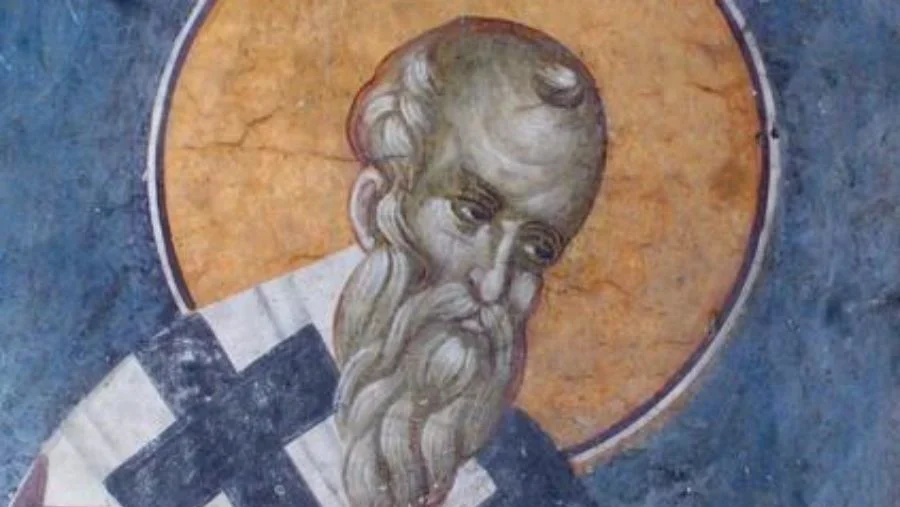
St. Epiphanius of Salamis (c. 310/320-403) was a great 4th century Church Father who is famous for defending the Catholic Faith against numerous heresies. He was ordained the bishop of Salamis in Cyprus in the 360s. His most famous work was written around 375 and called the Panarion, meaning “bread basket.” In it, he refuted the teachings of 80 heretical sects and/or philosophies from the time of Adam to his own. He was present at the Synod of Antioch (376) and the Council of Rome (382), at which he supported the claims of Paulinus II to the See of Antioch (alongside the Roman Church). He died in 403 on a journey back home to Salamis.
St. Epiphanius on Heresy, Letter 51
Let us now proceed to Letter 51, which was written by St. Epiphanius to John, Bishop of Jerusalem in 394. In it, he warns him against the dangers of various heresies, especially that of Origen, and touches upon all of the “Heretical Six” features of heresies and heretics (§§4, 6):
§4 | …If this doctrine is true what becomes of our faith? Where is the preaching of the resurrection? Where is the teaching of the apostles, which lasts on to this day in the churches of Christ?…
There can be no doubt that the meaning of the divine Scripture is different from the interpretation by which he [a heretic] unfairly wrests it to the support of his own heresy.
This way of acting is common to the Manichaeans, the Gnostics, the Ebionites, the Marcionites, and all the votaries of the other eighty heresies, all of whom draw their proofs from the pure well of the Scriptures, not, however, interpreting it in the sense in which it is written, but trying to make the simple language of the Church’s writers accord with their own wishes…
§6 | …But may God free you, my brother, and the holy people of Christ which is entrusted to you, and all the brothers who are with you, and especially the presbyter [priest] Rufinus, from the heresy of Origen, and other heresies, and from the perdition to which they lead. For, if for one word or for two opposed to the faith many heresies have been rejected by the Church, how much more shall he be held a heretic who has contrived such perverse interpretations and such mischievous doctrines to destroy the faith, and has in fact declared himself the enemy of the Church!
In these few words from just one letter, St. Epiphanius touches on each of the “Heretical Six” points outlined above, all of which I took for granted as a protestant, and protestantism relies on for its legitimacy.
- Each of the heresies he described separated from the Catholic Church, and rejected its authoritative definitions of the faith. At this point, in 394, there had already been two Ecumenical Councils—the first at Nicaea in 325, and the second at Constantinople in 381—both to address new heresies.
- He appeals to the continuous teaching of the faith since the days of the Apostles, and points out that the heretics proffer novel teaching that had never been heard before. He also emphasizes that heresy is heresy precisely because it contradicts the teaching of the Church, which has been faithfully transmitted, he says, since the time of the Apostles (i.e. via the apostolic succession of the bishops).
- He notes that it is the heretics’ novel beliefs that lead to their misinterpretation of Scripture. So in other words—exactly as St. Athanasius said (as we pointed out in the first installment of This Sounds Familiar)—heresy starts wrong by substituting something other than the authoritative Catholic Faith taught by the Catholic Church as a new rule by which they interpret Scripture.
- He observes that heretics constantly quote Scripture to make their heresy seem “biblical” and “Christian.” Once more, this aligns with the observations of St. Athanasius about heretics in the first installment.
- All of the heresies he mentions were named after the individual men who founded them, whether Origenism, Arianism, Manichaeism, etc., or after a very particular doctrine they taught. “Gnosticism,” for example, was a basket of heresies, many of which were individually named after their founders (see, for example, St. Irenaeus’s great second century work addressing many of these, entitled Against Heresies). Recall that St. Epiphanius is not explicitly naming most of the heresies he has in mind, but refers to them as part of “the other eighty heresies,” which he writes about in more detail in his aforementioned work, the Panarion.
- Given the aforementioned facts, St. Epiphanius observes that each of these heresies fails to arrive at firm conclusions about the Faith. While all appealing to Scripture in some way, they each go off in their own direction, whereas the Church remains constant in its teaching, befitting the nature of God who has revealed the true faith, namely, that He is eternal and unchanging.
Conclusion
In conclusion, like many other Church Fathers, St. Epiphanius described the same “Heretical Six” traits of heresy and heretics that I took for granted as a protestant. Perhaps most disturbing to me as a former protestant was the Church Fathers pointing out this very consistent pattern: heretics constantly citing and quoting Scripture, and pitting it against the Church in order to justify their doctrines and schism (and as a result endlessly dividing among themselves as well). “But,” I was often told, “this is what good Christians ought to do, particularly when the Church is in error!” So I thought most of my life—and so have heretics always thought, no matter how far back into the ancient mists of Church history you go.
This does not mean that the Church should not explain Her doctrines from Scripture. She should, and has, for 2,000 years. But as I saw in this letter of St. Epiphanius, and in the writings of many other Church Fathers, they did not believe the Catholic Church would ever teach error. On the contrary, they always and everywhere compare and contrast the cacophony of heretical sects with the one and only Catholic Church, never once presuming that the Church would teach a falsehood. They always and everywhere believed and assumed that its formal teaching would always accord with Scripture, given Christ’s promise to guide the Church into all truth until the end of time. Nor did this eliminate the possibility that errant bishops and priests—sometimes a great many of them—would arise and deceive many. Many Fathers had to deal with such wolves throughout their lives—indeed, that’s precisely what St. Epiphanius spent so much of his own career doing—and indeed, many founders of heresies were priests themselves. But this fact did not lead St. Epiphanius or other Church Fathers to the conclusion that the Catholic Church Herself would fall into error. Nearly a decade into my study of their writings, and I have yet to find a single example of this.
It is important to emphasize another pattern we see in this letter from St. Epiphanius, as well as in the writings of other Church Fathers, namely, that there is “the Church,” and “heresies,” and the heresies always contradict the teaching (singular) of the Church (singular). Indeed, St. Epiphanius notes in this very letter that all the multitude of heresies “have been rejected by the Church.” This necessarily assumes that the Church possesses authority to not only refute the heresies, but to articulate its own doctrine, which is the only one revealed by God.
This framework of thought is everywhere present in the Church Fathers, who were more than acquainted with many sects claiming the name of “Christian” and splitting off from the one true Church. This is not a new phenomenon, or one that began after 1517, or 1054. It has been a constant in the life of the Church—a “one niner,” as I call it (referring to “nothing new under the sun” in Ecclesiastes 1:9).
As disturbing as this discovery was at first, it was eventually liberating to realize that the Church’s experience had been so broadly consistent across so many ages. Confronted by countless heresies and schisms from the beginning She had been—but overcome, She was not!
 Buy Us a Coffee