Introduction
This “Papal Snapshot” will examine the letter from St. Pope Gregory II in which he officially tasked St. Boniface (c. 675-754) with evangelizing the pagans of Germany. It will be the first of many that examines papal authority as articulated and exercised throughout St. Boniface’s mission.
Roadmap
With that background in mind, our Roadmap is as follows:
- Our thesis is that St. Pope Gregory II’s letter to St. Boniface (listed as Letter 4 in the collection of the evangelist’s letters) exhibits a very Catholic view of the papacy. We will show this by:
- Providing historical context for the letter and St. Boniface’s life; then
- Quoting and analyzing relevant sections from the letter; then
- Summarizing the conclusions we believe can be reached from this letter.
Historical Context
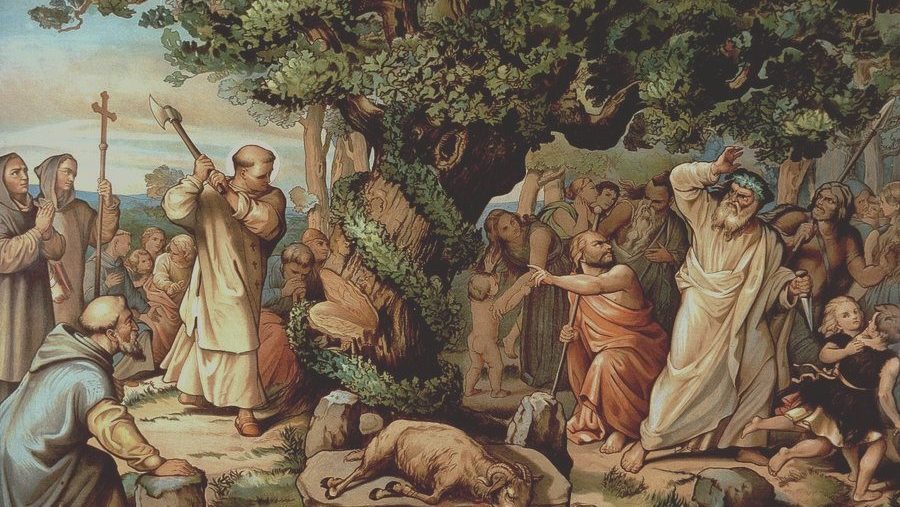
St. Boniface (c. 675-754), an English monk, priest, and later bishop, was one of the greatest evangelists of the first millennium. He belonged to a noble family from Wessex, England, and became a Benedictine monk as a young man. He was later ordained as a priest around the age of 30. He made several attempts to evangelize the Frisians (in the modern day Netherlands), and soon after a pilgrimage to Rome with Anglo-Saxon pilgrims in 718, he was tasked by St. Pope Gregory II with evangelizing the Germans east of the Rhine. He thereby became the “Apostle to the Germans.” The Pope made St. Boniface a missionary bishop, and provided him with many letters of recommendation to various rulers whose protection he required, as well as various books and ecclesiastical canons (laws/regulations) of the Church of Rome.
The nearly 80 year old St. Boniface would go on to be martyred by pagans who murdered him as he read the Bible to new Catholics on Pentecost Sunday.
St. Pope Gregory II, Letter 4 (May 15, 719)
Let us now proceed to examine St. Pope Gregory II’s letter, which he wrote on May 15, 719. The Pope opened the letter as follows1:
Your pious purpose, as it has been declared to us, and your well-proved sincerity of faith demand of us that we make use of you as our co-worker in spreading the divine words, which by the grace of God is our special care. Knowing, therefore, that you have been from childhood a student of sacred literature and that you now 10 | 11 wish, for the love of God, to extend the talent divinely entrusted to you, by dedicating yourself ceaselessly to missionary work and the teaching of the mystery of faith among the heathen, carrying to them the saving knowledge of the divine oracle, we rejoice in your loyalty and desire to further the work of grace vouchsafed to you. Wherefore, since with modest forethought you have laid before the Apostolic See your pious desire about the said mission, testing your design as a single member of a body submits itself to the sovereignty of the head, your humble submission to the direction of this head has placed your feet in the right path, and you have become as it were a perfectly articulated member of this body.
From this opening, we see that St. Pope Gregory II believed the following about the papacy:
- It was “our special care” for the Pope to evangelize non-believers. This was so “by the grace of God,” a reference to Christ’s establishment of the papacy.
- The Apostolic See (the Church of Rome) is the sovereign head of the Church on earth, and as such the rightful director of the various members of Christ’s Body, including St. Boniface. The Pope commends him for recognizing this, and submitting his evangelistic pursuits to papal approval and direction.
The Pope continued2:
Therefore, in the name of the indivisible Trinity and by the unshaken authority of the blessed Peter, Prince of the Apostles, whose government we administer by divine dispensation in his Holy See, we now place the modesty of your pious devotion upon a firm foundation and decree that with the word of God’s grace, that flame of salvation which God came to earth to proclaim, you may go forth with His guidance to those peoples who are still in the bonds of infidelity. You are to teach them the service of the kingdom of God by the persuasion of the truth in the name of Christ, the Lord our God. You will pour into their untaught minds the preaching of both the Old and the New Testament in the spirit of virtue and love and sobriety and with reasoning suited to their understanding.
Once more, we see that St. Pope Gregory II has a very Catholic view of the papacy, evident from the following assertions:
- St. Peter was the “Prince of the Apostles,” and thus their head.
- St. Peter’s government remains, by divine establishment, in the Pope as head of the Holy See (the Church of Rome).
- St. Peter’s government retains its “unshaken authority,” a claim of continuity back to St. Peter himself.
The Pope concluded his letter to St. Boniface as follows3:
Finally, we enjoin upon you that, in admitting within the Church those who have already believed in God, you will insist upon using the sacramental discipline prescribed by the official ritual formulary of our Holy Apostolic See. Whatever you may find lacking in your work, you are to report to us as you have opportunity.
From this, we see that St. Pope Gregory II believed that the “sacramental discipline” of the Church fell within the purview of his authority. He also commands St. Boniface to consult him as issues arise, so that his efforts may be done with the guidance and approval of the Roman Church, whose authority is preeminent among the churches.
Conclusion
From this short but historically significant letter, we can see that St. Pope Gregory II (and presumably St. Boniface) believed the following about the papacy:
- The Pope is the successor of St. Peter, who was Prince of the Apostles.
- The Pope exercises the authority and government of St. Peter from the Holy See, which authority and government had remained “unshaken” from the time of St. Peter himself.
- The Pope is the “sovereign” and “head” of the Church.
- Papal authority extends to the “sacramental discipline” of the Church.
 Buy Us a Coffee