Related Resources
- Podcast (Ep. 81) | Papal Snapshot: Rome’s Prophetic Destiny (St. Pope Leo the Great, Sermon 82)
Introduction
St. Pope Leo the Great (c. 400-461), as I often joke, has the “four and a half” biggest checkmarks you can get in the Catholic Church: he’s a saint, a Church Father, a Doctor of the Church, a Pope, and (the “half check”) is remembered as “the Great.” As such, as an individual, few in the history of the Church can compare with his authority.
Hence the significance of our next Papal Snapshot, which will examine his Sermon 82, delivered on June 29, 441, on the Feast of the Apostles Peter and Paul. As it turns out, we celebrate the same feast day on the same day in the same Catholic Church to this very day, nearly 1,600 years later, and it provides some wonderful insights into the ancient, biblical, and historical roots of the papacy.
Roadmap
With that background in mind, our Roadmap is as follows:
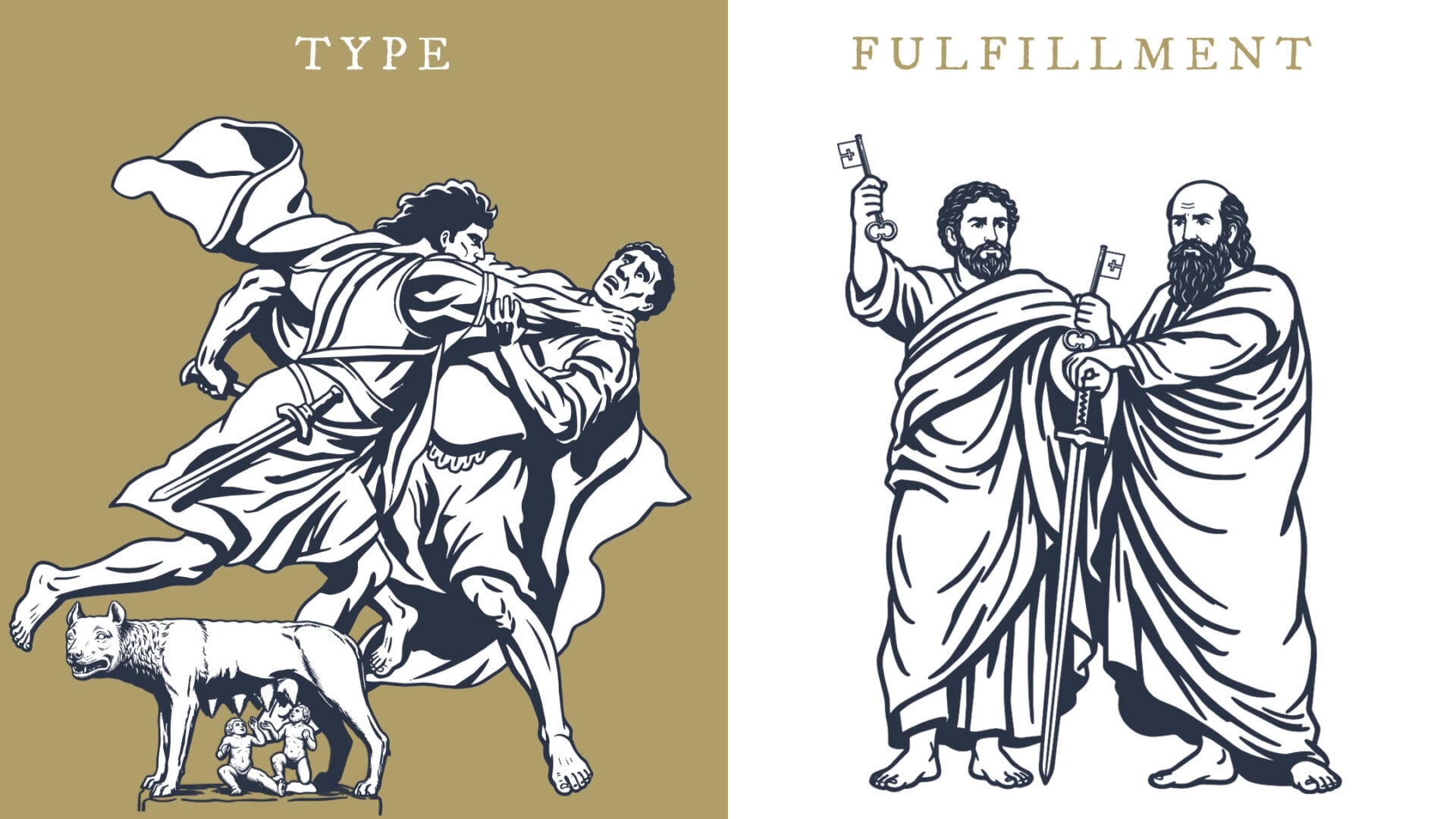
- Our thesis is that St. Pope Leo the Great’s Sermon 82 exhibits profoundly Catholic beliefs on several topics, but especially the papacy, and in particular God’s ordaining that the temporal preeminence of the “universal” pagan Rome founded by the fratricide of Remus by Romulus would be exceeded by the spiritual preeminence of a new Catholic Rome founded by the fraternal martyrdom of Sts. Peter and Paul. In short, the “universal” pagan Rome was founded by a murderer, Romulus. The “universal” (i.e. Catholic) Rome was re-founded by a martyr, St. Peter. We will show this by:
- Providing some brief historical context; then
- Quoting and analyzing Sermon 82; then
- Summarizing the conclusions we believe can be reached.
Historical Context
St. Pope Leo the Great’s Sermon 82 was delivered on the Feast of Sts. Peter and Paul, which had been kept on June 29 in Rome as early as the third century. By at least the year 258, June 29 was recognized as the day on which their relics were transferred to the Catacombs of San Sebastiano. Later on, their relics were transferred a final time, with St. Peter’s going to St. Peter’s Basilica at the Vatican, and St. Paul’s to the Basilica of St. Paul Outside the Walls, which was built on the spot where he was executed. June 29 was later adopted in the East for the same feast day.
The year 441, when this sermon was delivered, was no picnic for Rome. Political instability abounded. The Mistress of the World had long since ceased to be the capital of even the Western Roman Empire, which had barely more than 30 years left to survive. But such was the authority and moral example of Pope Leo that in 452, amidst the chaos and carnage of the fifth century, he was able to convince even Attila the Hun to not sack Rome.
In short, when Pope Leo delivered this sermon, Rome had already passed its earthly prime some time ago, and far worse was around the corner. But that is why Pope Leo’s words about the spiritual status of Rome are all the more significant.
St. Pope Leo the Great, Sermon 82 (June 29, 441)
Let us now turn to Pope Leo’s Sermon 82, which he opens as follows (§1)1:
The whole world has a part in all the holy ceremonies, dearly beloved, and the holiness of our one faith demands that, whatever is recalled to mind as done for the world’s salvation, it should be celebrated everywhere with like festivity. Yet today’s feast must be revered with a special celebration of its own for our city, beyond the respect it deserves from the rest of the world. Where the death of the leaders of the apostles has been covered with glory, there should be the chief place of joy on the day of their martyrdom. 352 | 353
These are the men through whom the Gospel of Christ enlightened you, O Rome, and you who were the teacher of error were made the disciple of truth. These selfsame men are your holy fathers and true shepherds, who built you up to be a part of the heavenly kingdom better by far and much more favorably than those twins quarreling to the point of murder [Romulus and Remus]. Yet these are the men who raised you to this glory, that, as a “holy nation, a people set apart, a priestly and royal city” (1 Pet. 2:9), you might be made the head of the world through the sacred throne of blessed Peter. You hold eminence more widely by your reverence for God than in earthly rule. Although grown larger by many victories, you have spread out the law of your empire on land and sea, nevertheless what the labors of war have subjected to you is less than what the peace of Christ has subdued.
A few observations:
- He observes that the Feast of Sts. Peter and Paul is celebrated throughout “the whole world,” and is “everywhere celebrated.” Clearly the knowledge of their martyrdom in Rome was undisputed, and everywhere taken for granted throughout the entire Church, as the ancient documentary evidence likewise proves (unanimously). While Scripture does not explicitly mention St. Peter being in Rome (though when he writes from “Babylon,” this was a well-known code word for Rome), nonetheless, no ancient Christian doubted it. Indeed, as Pope Leo points out, the feast of Sts. Peter and Paul was universal throughout the Church.
- He describes pagan Rome as being the “teacher of error,” and says it has now become “the disciple of truth,” providing us a picture of a universal source of corruption being transformed into a universal source of truth, as will become clearer later in the homily.
- He then offers a profound and striking historical “typology” of sorts by comparing the founding of pagan Rome on an act of murder—the fratricide of Remus by Romulus—and the re-founding of Christian Rome on an act of martyrdom, fraternally embraced by both Sts. Peter and Paul. Two foundings of the same universal city, two killings, one based on earthly fratricide, the other on spiritual fraternity. Pope Leo sees in this pattern the undeniable providence of God.
- He asserts that the joint martyrdom of Sts. Peter and Paul set Rome apart, to such a degree that it became “the head of the world through the sacred throne of blessed Peter.” This profoundly papal statement ascribes Rome’s position as “head of the world” not to her temporal position (which she had for quite some time already lost), but to her spiritual preeminence. This is important to note, as it is sometimes claimed that the primacy of Rome in the ancient Church was simply a derivative of its earthly power. But Pope Leo says the exact opposite: its primacy is derived directly from St. Peter and his throne.
- This is confirmed by the fact that Pope Leo declares that Rome holds even greater eminence because of religion than by its “earthly rule.” Indeed, as we have already observed, Pope Leo lived during the final days of the Western Roman Empire, when Rome itself had long since ceased to be the capital, and would go on to be sacked once more by the Vandals in 455 (just six years before his death). The “labors of war,” he declares, subjected less to Rome than “the peace of Christ,” for the very obvious reason that the boundaries of the Church had long since eclipsed the boundaries of the Roman Empire. As such, Rome’s universal temporal sway had been replaced by an even greater universal spiritual sway.
In section 2, though her spiritual preeminence is not due to her temporal power, Pope Leo nonetheless reflects on how God providentially prepared the Roman Empire for the advancement of the Gospel and His Church (pgs. 353-54):
The good and just and omnipotent God, who has never refused His mercy to the human race, has, by His overflowing kindnesses [Acts 14:17], taught all mortals in common the knowledge of himself. He has taken pity, in his very mysterious wisdom and deep compassion, on the willful blindness of those in error and their bad moral quality prone to worse things, by sending His Word, equal to Himself and co-eternal. And this “Word made flesh” (John 1:14), united the divine nature to the human in such a way that His abasement to the lowest depths, became our ascent to the heights.
So that the effect of this inexpressible grace might be spread throughout the whole world, divine Providence prepared the Roman Empire with such growth to its boundaries, that the whole population was neighbor to and bordering upon all peoples everywhere. The work, divinely planned, was especially suitable to the incorporation of many kingdoms under one rule. A general proclamation would quickly reach all the people whom the government of one city was protecting. But this city, unmindful of the Author of its dignity, although it ruled almost 353 | 354 all nations, succumbed to the errors of all nations. It seemed to have taken to itself a great religion because it did not repudiate any falsehood. Thus as much as it had been bound more tightly by the decrees of the devil, by so much has it been more wonderfully loosened by Christ.
Notice that Pope Leo seems to describe Rome as a sort of religious prostitute, taking into her bosom whatever religion came her way. But this was precisely how she received the Catholic Faith, which eventually conquered her, and made her the “capital” of the Church on earth.
In section 3, having reflected on how Providence prepared Rome and the Roman Empire for the purpose of promulgating Christianity, Pope Leo reflects on the particular role played by St. Peter, and the way in which Rome, as the center of pagan religion and philosophy, was a uniquely fitting place for the advancement of the Faith (pg. 354):
When the twelve apostles, in receiving the speech of all languages from the Holy Spirit, had undertaken to fill the world with the Gospel, and the territories of the earth were distributed to them, blessed Peter, chief of the order of the apostles, was assigned to the citadel of the Roman Empire. The light of truth, which was revealed for the salvation of all nations, would then pour itself out more effectively from the head itself through the whole body of the world.
Was there any nation whose people were not in that city then? Were there any people anywhere who did not know what Rome had learned? In this place the opinions of philosophy were about to be trampled on, in this place the emptiness of earthly wisdom was to be dissolved, here the worship of demons was overthrown, here the wickedness of all profanation was to be destroyed, where whatever had been established anywhere was enclosed, gathered together by a very diligent superstition.
A few observations:
- Pope Leo says St. Peter was the “chief of the order of the apostles.” As such, he was the source and chief of the episcopacy, or office of bishop. This is why Catholic theology affirms the authority of St. Peter is exercised not only by each individual bishop (as the chief priest of a particular diocese), but preeminently by the Bishop of Rome, as the unique occupant of, as Pope Leo explicitly called it, “the sacred throne of blessed Peter.” Thus, St. Peter is the chief and origin not only for the office of chief priest in a diocese (the bishop), but also the chief bishop in the Church (the Pope). His throne is both everywhere (i.e. each diocese), as well as preeminently somewhere (i.e. Rome).
- Pope Leo likewise observes that St. Peter was “assigned to the citadel of the Roman Empire.” Of particular interest is his use of the word “assign,” which implies that St. Peter was providentially destined to found the Church at Rome. This would make sense, not only for the reasons provided by Pope Leo, but also because of a fascinating prophecy in Daniel 2, which prophesies that “a stone…cut out by no human hand” would “smote the image on its feet of iron and clay, and broke them [the pagan kingdoms it represented] in pieces” (Dan. 2:34), referring to the Fourth Kingdom in Daniel’s prophecy (widely acknowledged to be the Roman Empire). He then says, “But the stone that struck the image became a great mountain and filled the whole earth” (Dan. 2:35). In this, we see an astoundingly accurate prophecy about the foundation of the Church. The “stone,” in its fullest sense, is Christ, as the New Testament explicitly says. But Christ’s renaming of “Simon” to “Peter” (meaning “stone” or “rock”), His giving of the keys of the kingdom of heaven to him, and the fact that St. Peter established the Church in Rome—the center of the Fourth Kingdom of Daniel 2 which was destroyed by a “stone”—surely cannot be mere coincidence. It reverberates with the ring of providence. The idea seems to be that winning the world for Christ required winning the “head” of the world, namely Rome, and elevating its universal temporal status to a new, universal, and now primarily spiritual status.
- Pope Leo indicates that St. Peter was assigned to Rome because of the universal (i.e. “Catholic”) implications of its conversion: as all false philosophies and religions had infected Rome, so too would this be the place in which the one true religion would ultimately conquer them all. As he mentioned in section 1, the Rome who had been the “teacher of error” had become the “disciple of truth.” In defeating falsehood in Rome—which falsehoods had been obtained and cultivated from every corner of the known world—the Catholic Faith was virtually defeating it everywhere. As Rome had universally corrupted the world, it would now—thanks primarily to St. Peter and his successors—enlighten the world.
In section 4, Pope Leo continues to reflect on the person of St. Peter, and how his martyrdom in Rome stood in stark contrast to his cowardice during Our Lord’s Passion (pgs. 354-55):
It is to this city that you, most blessed apostle Peter, were not afraid to come. While the apostle Paul, companion of your glory, was still engaged in the founding of other churches, you walked into this forest of wild beasts and to this deep ocean of wicked superstition more readily than when you walked on water [Matt. 14:30]. And you did not fear Rome, the mistress of the world, though you feared the maid in the house of Caiaphas, the high priest [Matt. 26:69-70]. Was the power of Claudius or the cruelty of Nero less than the judgment of Pilate or the cruelty of the Jews?
The strength of love overcame the object of fear. You did not consider that those ought to be feared whom you had accepted to love. You had already conceived this disposition of intrepid charity when the profession of your love for the Lord 354 | 355 was firmly established by the mystery of His three-fold questioning [John 21:15-17]. He did not seek anything from this probing of your spirit except that in feeding the sheep of Him whom you love, you should provide the food of heavenly nourishment with which you yourself were endowed.
Our only observation here is that Pope Leo views Christ’s command to St. Peter to “feed my sheep” through a distinctly papal lens. Christ endows St. Peter with the universal task of “feeding the sheep of Him whom you love” with “the food of heavenly nourishment” that Peter himself had received. This unique apostolic task is inherited by the direct successors of St. Peter, namely, the Bishops of Rome. This encounter between Christ and St. Peter has played a prominent role in Catholic theology for millennia—as we clearly see in Pope Leo’s sermon—and is inscribed in stone, as it were, in St. Peter’s Basilica to this day.
In section 5, Pope Leo once more refers to St. Peter’s mission to the Eternal City as divinely ordained, calling it “the citadel of Rome,” eliciting an image of a great fortress of paganism and idolatry conquered by the martyr fisherman from Galilee (pg. 355):
How many miraculous signs, how many gifts of grace, how many proofs of virtue have increased your faith! At one time you had taught those people who from the circumcision [the Jews] had believed; at another you had filled very many peoples with the laws of Gospel holiness. At yet another, you founded the Church in Antioch where the dignity of the name Christians first arose [Acts 11:26]; then you filled Pontus, Galatia, Cappadocia, Asia, and Bithynia with the laws of the Gospel preaching. With no fears for the outcome of your work, and fully aware of the limit of your age, you bore the trophy of the Cross of Christ in the Roman citadel, where by the divine plan the honor of His power and the glory of His suffering had gone before you.
In section 6, Pope Leo describes the arrival of St. Paul in Rome to join St. Peter, their common persecution during the reign of Nero, and how their example inspired countless generations of saints and martyrs (pgs. 355-56):
Your blessed co-apostle, Paul, “vessel of election” (Acts 9:15) and special teacher of the nations, coming to this city, was your associate at that time when all innocence, all honor, all liberty was suffering under the will of Nero, whose rage, inflamed by an excess of all vices, in this time drove him up to such a flood of insanity that he was the first to bring on the horror of a general persecution for the name of Christian. He seemed to think that the grace of God might be cut off through the slaughter of his holy ones. He did not know that the religion founded on the mystery of the Cross cannot be extinguished by any kind of cruelty, since “precious in the sight of the Lord is the death of his holy ones” (Ps. 116:15). This does not diminish, but it increases the Church. 355 | 356 Thus thousands of blessed martyrs give witness to how great a progeny of these two illustrious shoots of the divine seed proliferated. The followers of the triumphs of the apostles have encircled our city with an ennobled populace, shining to far distances, and they have crowned it as if with a diadem fitted with the beauty of many gems.
Pope Leo concludes the seventh and final section of his sermon by offering general acclaim for Sts. Peter and Paul. In this closing, he clearly maintains that these Apostles intercede for the earthly faithful—a conviction he asserts has been both held and verified through the lived experience of current and past generations (pg. 356):
From this guardianship, dearly beloved, divinely prepared for us as an example of patience and a confirmation of faith, we should rejoice everywhere in the memory of all the saints, but in the pre-eminence of these fathers we must surely exult with greater joy. The grace of God has raised them to such a height among all the children of the Church that he has made them as it were twin lights of the eyes in the body of which Christ is the Head. We ought to think nothing divisive, nothing disruptive in their merits and virtues, for they surpass every means of description. They were on a par in election, alike in their work, and their martyrdom made them equal.
As we ourselves have experienced and as our ancestors have learned, we believe and trust that, in all the labor of this life, we are to be aided always by the prayers of these special patrons to attain the mercy of God. As we are hindered by our own sins, so we are encouraged by the apostles’ merits, through our Lord Jesus Christ, to Whom, with the Father and with the Holy Spirit is equal glory, the same power, one divinity, forever and ever. Amen.
Conclusion
In conclusion, we have multiple examples of Catholic belief in St. Pope Leo the Great’s Sermon 82, particularly about the papacy, though other matters as well, such as the prayers of the saints in heaven for those on earth. This man—one of the greatest Saints, Church Fathers, Popes, and Doctors of the Church—believed the following:
- St. Peter was assigned the task of founding the Roman Church.
- The Roman Church is “the head of the world through the sacred throne of blessed Peter.”
- St. Peter was the “chief of the order of the apostles,” and just as he was chief among the Apostles themselves, his successor is the chief bishop over all other bishops.
- God providentially prepared the Roman Empire, and Rome itself, for the propagation of the Catholic religion, and endowed the city of Rome with a universal, or “Catholic,” mission.
- The spiritual authority of Rome is greater than its temporal authority. Its spiritual preeminence is not derived from its temporal power, but from St. Peter himself (and to a lesser extent, St. Paul).
- As pagan Rome was founded on an act of fratricide by Romulus against Remus, so Christian Rome is re-founded on an act of fraternity, the joint martyrdom of Sts. Peter and Paul, which thereby endowed it with a new universal mission.
- The saints in heaven—and on this occasion, specifically Sts. Peter and Paul—intercede for Christians on earth, often with tangible results known by all.
- This same Church, governed preeminently by St. Peter and his successors, despite all the attempts to destroy it by temporal powers, is ultimately indestructible, since its founder is God Himself.
In short, St. Pope Leo the Great’s sermon—delivered on a venerable feast day we continue to observe nearly sixteen centuries later—demonstrates a profoundly Catholic worldview, especially concerning the nature of the papacy.
 Buy Us a Coffee