Introduction
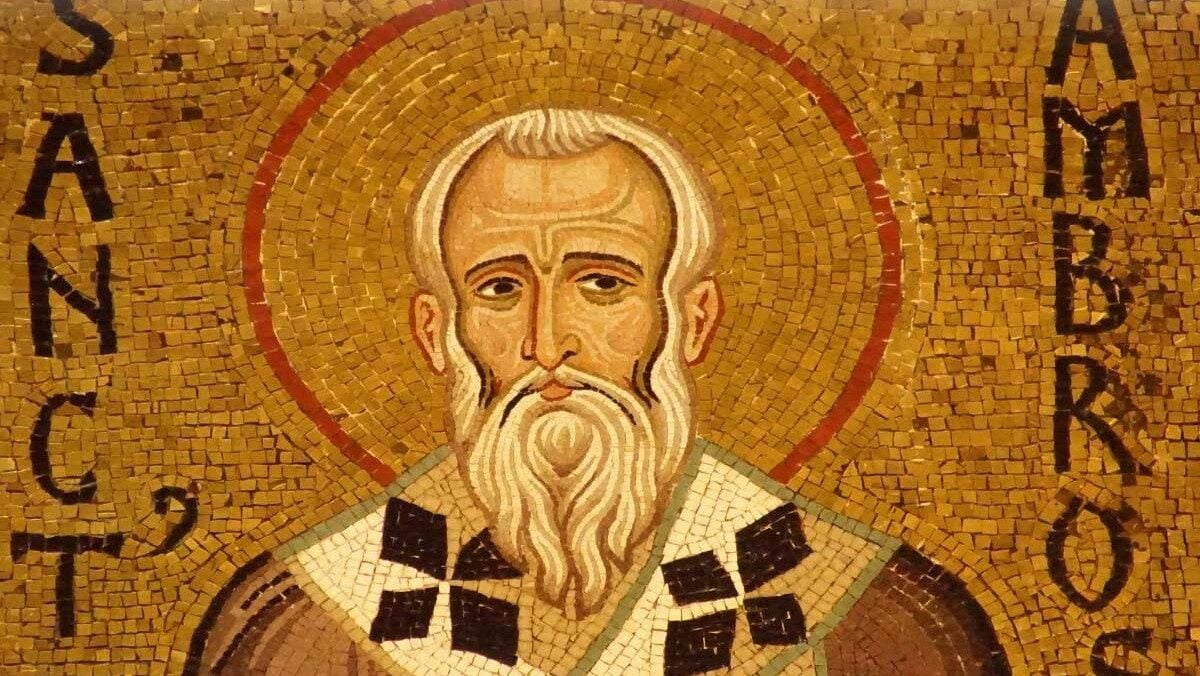
In 379, Satyrus—the brother of the Church Father St. Ambrose of Milan—unexpectedly died. In response, St. Ambrose delivered a two-part funeral discourse that has come down to us as On the Death of Satyrus.
The first discourse was for the day of his funeral, in which St. Ambrose expressed his grief over his brother, while highlighting his virtues, and rejoicing at the fact that his death was sparing him the experience of various earthly troubles going on at the time, such as barbarian invasions and the continued degradation of the Roman Empire. The second discourse was delivered a week later, and focused on the hope of the resurrection.
In the funerary discourse, St. Ambrose makes a remarkable statement about his brother’s faith as it relates to the papacy, which is the subject of this Papal Snapshot. In short, his brother believed that communion with the Pope was necessary to avoid schism—a conclusion St. Ambrose likewise shared.
Roadmap
With that background in mind, our Roadmap is as follows:
- Our thesis is that St. Ambrose’s brief comments about the necessity of communion with the Pope in his funeral oration On the Death of Satyrus reveal his Catholic beliefs about the papacy (and for good measure, we’ll also include a riveting story that reveals his Catholic beliefs about the Eucharist as well). We will show this by:
- Providing some historical context;
- Quoting and analyzing the relevant portion of On the Death of Satyrus; then
- Summarizing the conclusions we believe can be reached.
St. Ambrose, On the Death of Satyrus
Let us now dive into the funerary discourse in St. Ambrose’s On the Death of Satyrus.
Just prior to his comments about Satyrus’s beliefs about the papacy, St. Ambrose first recounted how he had survived a shipwreck on his way back to Italy after traveling to Africa to recover some family property. To avoid death, Satyrus—who was planning to become Catholic, but had not yet been baptized—asked for the Holy Eucharist, wrapped it in a napkin, and tied it around his neck. St. Ambrose recounted the story as follows (Book 1, §43):
What, then, shall I say of his reverence in regard to the worship of God? He, before being initiated in the more perfect mysteries [the sacraments], being in danger of shipwreck when the ship that bore him, dashed upon rocky shallows, was being broken up by the waves tossing it to and fro, fearing not death but lest he should depart this life without the Mystery [the Eucharist], asked of those whom he knew to be initiated the divine Sacrament of the faithful; not that he might gaze on secret things with curious eyes, but to obtain aid for his faith. For he caused it to be bound in a napkin, and the napkin round his neck, and so cast himself into the sea, not seeking a plank loosened from the framework of the ship, by floating on which he might be rescued, for he sought the means of faith alone. And so believing that he was sufficiently protected and defended by this, he sought no other aid.
St. Ambrose reflected further on this a few sections later (Book 1, §46):
For he who had felt such protection on the part of the heavenly Mystery wrapped in a napkin, how much did he expect if he received it with his mouth and drew it to the very depth of his bosom? How much more must he have been expecting of that, when received into his breast, which had so benefited him when covered with a napkin?
In this short account, we see St. Ambrose refers to the Eucharist as “the divine Sacrament of the faithful,” as “the Mystery,” as “the heavenly Mystery,” and he did not at all find it strange that his brother would attribute divine, miraculous power to it. Indeed, he saw Satyrus’s use of it to save his body from the shipwreck as a reflection of his even greater faith at what actually receiving it as a Catholic would do for his eternal soul. All of this reflects an undoubtedly Catholic belief about the Eucharist. How can mere bread be “divine,” indeed capable of bringing about miracles? In short, it can’t. St. Ambrose doesn’t believe the Eucharist is mere bread. In fact, the terms he uses leave no room for bread at all. A “divine” and “heavenly” can only be one thing: Christ Himself.
St. Ambrose then moved on to Satyrus’s desire to receive baptism, at which point he notes how he had intuited that it was not possible for one to have true faith without also keeping the unity of the Church, which he knew to be centered in Rome. St. Ambrose explained it this way (Book 1, §47):
But he was not so eager as to lay aside caution. He called the bishop to him, and esteeming that there can be no true thankfulness except it spring from true faith, he inquired whether he agreed with the Catholic bishops, that is, with the Roman Church? And possibly at that place the Church of the district was in schism. For at that time Lucifer had withdrawn from our communion, and although he had been an exile for the faith, and had left inheritors of his own faith, yet my brother did not think that there could be true faith in schism. For though schismatics kept the faith towards God, yet they kept it not towards the Church of God, certain of whose limbs they suffered as it were to be divided, and her members to be torn. For since Christ suffered for the Church, and the Church is the body of Christ, it does not seem that faith in Christ is shown by those by whom His Passion is made of no effect, and His body divided.
This line makes several important points about the belief of St. Ambrose and his brother Satyrus in the papacy:
- True faith requires remaining united in the communion of the one and only Church established by Christ, which is His Body. This is why Satyrus inquired about his local bishop before receiving baptism.
- The criteria by which it can be determined whether or not a local bishop is in communion with the Church is “whether he agreed with the Catholic bishops,” who are those bishops who agree “with the Roman Church.”
- The papacy, therefore, is the visible guarantor of Catholic unity and communion. To be “Catholic,” according to St. Ambrose, means to agree with the Roman Church—a remarkably simple formula that was first explicitly articulated by St. Irenaeus of Lyon approximately two centuries earlier when around 180 he wrote in his great work Against Heresies (Book 3, Ch. 3, §2) that “it is a matter of necessity that every Church should agree with this Church [Rome], on account of its pre-eminent authority…”
- To be in schism from the Church means “His Passion is made of no effect” in you. To depart from the body for which Christ died is to divide it, and thus fall from the faith.
Each of these points remains Catholic belief to this very day.
Conclusion
In conclusion, this short account of his brother’s coming to the Catholic Faith by St. Ambrose of Milan contains various treasures of Catholic belief about the papacy (as well as the Eucharist). What St. Ambrose taught in 379 could be taught without changing a single word in the same Catholic Church today—a continuity and solidity for which we can only offer our fervent thanksgiving to God.
 Buy Us a Coffee