Introduction
This “Papal Snapshot” analyzes a brief but powerful mention of St. Peter and his authority from St. John Chrysostom (c. 347-407) in his Homily on the Holy Martyr, St. Ignatius of Antioch, delivered while he was in Antioch in the late 300’s.
Roadmap
Our Roadmap is as follows:
- Our thesis is that what St. John Chrysostom says about St. Peter, his authority, and how his presence in Antioch elevated the status of Antioch, fits a Catholic view of the papacy. We will show this by:
- Providing some brief historical context; then
- Quoting and analyzing the relevant portion of the homily; then
- Summarizing what we believe can be reasonably concluded.
Historical Context
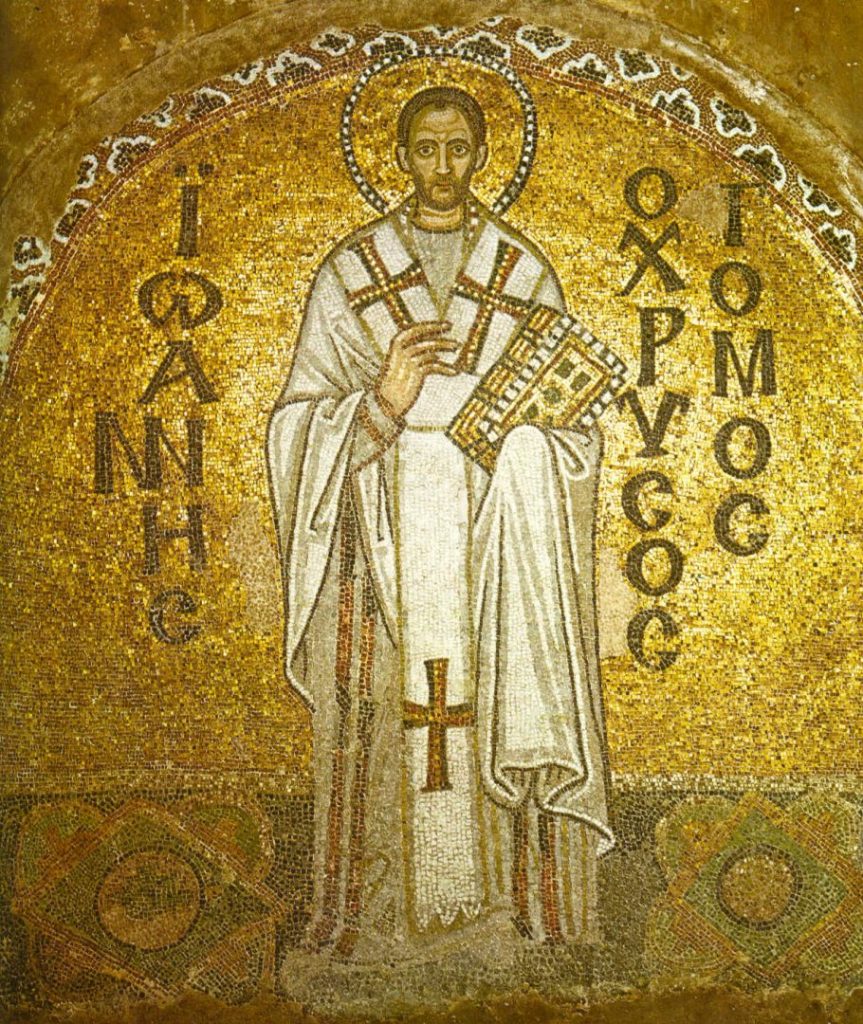
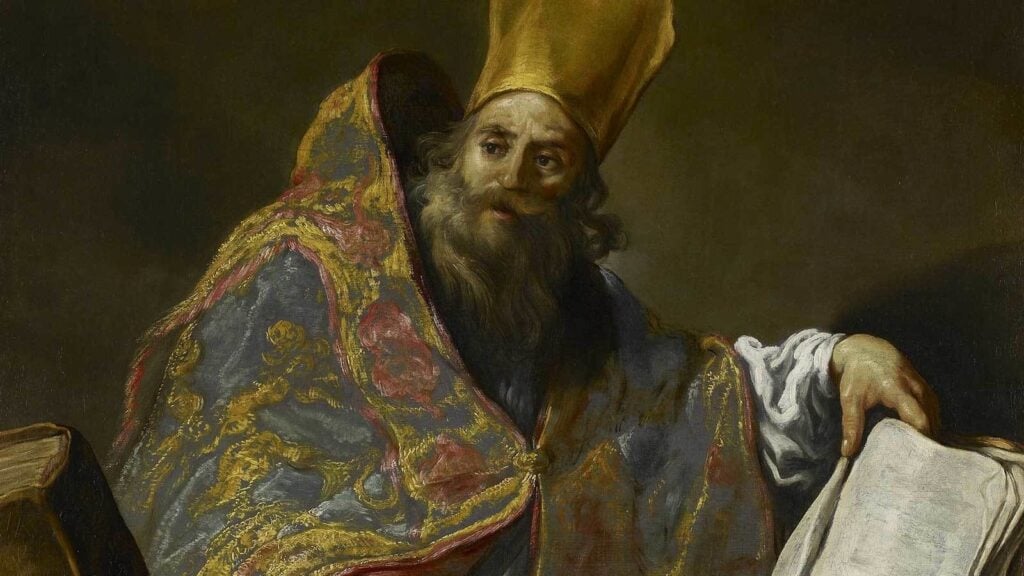
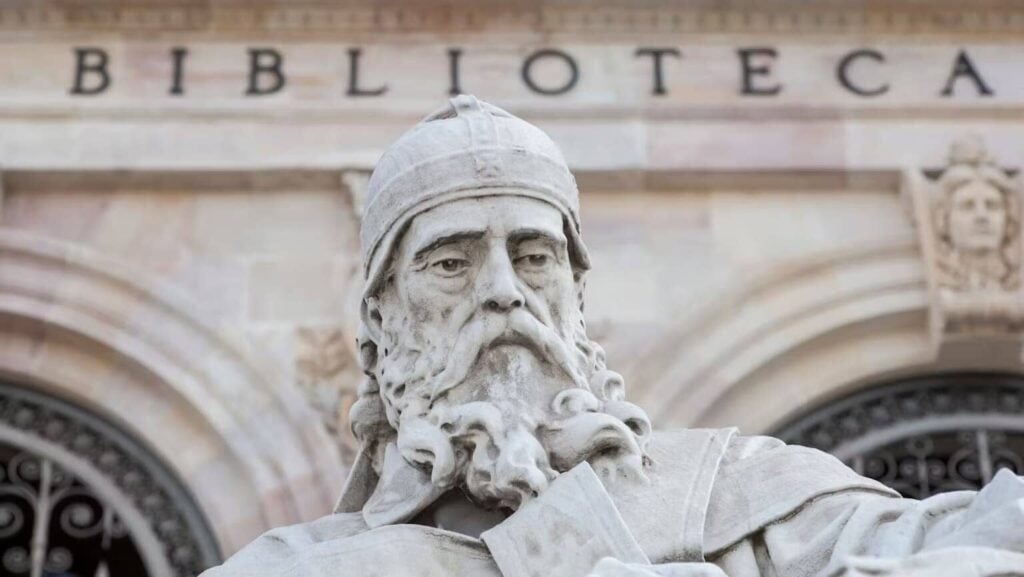
St. John Chrysostom (c. 347-407) (whom we’ll refer to simply as “St. John”) was one of the great eastern Church Fathers of the 4th and early 5th centuries. Famous for his powerful preaching and oratory, he was born in Antioch, where he served as a priest, and was later made the Archbishop of Constantinople. However, following an internal dispute in the church at Constantinople, St. John died in exile in 407. While in Antioch, St. John preached on the life and deeds of St. Ignatius of Antioch, who knew the Apostles, was ordained by St. Peter, succeeded him as the second bishop of Antioch, and died around 107 in Rome as a martyr.
St. John Chrysostom, Homily on the Holy Martyr, St. Ignatius of Antioch (c. 387-97)
Let’s now analyze St. John’s Homily on the Holy Martyr, St. Ignatius of Antioch, delivered c. 387-97 while he was serving as a clergyman in his native Antioch.
The quote relevant to the papacy comes from section 4, where St. John observed as follows about St. Peter, his authority, and what his presence did to the status of Antioch while he was there (§4):
For as in the care of armies, the wiser of the generals have on their hands the more leading and more numerous regiments, so, accordingly, in the care of cities. The more able of the rulers are entrusted with the larger and more populous. And at any rate this city was of much account to God, as indeed He manifested by the very deeds which He did. At all events the master of the whole world, Peter, to whose hands He committed the keys of heaven, whom He commanded to do and to bear all, He bade tarry here for a long period. Thus in His sight our city was equivalent to the whole world.
What this great eastern Church Father says about St. Peter is quite remarkable:
- He was “the master of the whole world”;
- He was individually given the keys of heaven by Christ; and
- The city from which St. Peter exercised his governance of the Church, while he was there, “was equivalent to the whole world” (past tense).
Each of these points by St. John are significant with respect to the papacy, since, if the papacy was divinely established, its authority must stem from St. Peter, and cannot exceed the authority Christ gave him.
First, by calling St. Peter “the master of the whole world,” St. John seems to ascribe to him an authority that is not only preeminent among the Apostles, but among all rulers. While he does not say this explicitly, if St. Peter’s authority makes him “master of the whole world,” then he is truly–as Catholics consider the Pope–the Vicar of Christ.
Likewise, since St. John makes this statement about St. Peter exclusively, the logical conclusion is that his authority exceeded that of the other Apostles. Though all the Apostles exercised the authority of the keys given to St. Peter, this authority–if St. Peter was indeed “the master of the whole world”–would be exercised through St. Peter, not independent of him. The same would necessarily apply to the successors of the Apostles (the bishops) with respect to the successor of St. Peter (the Pope). Nor was this the only homily in which St. John referred to St. Peter this way. For example, in Homily 73 on the Gospel of John, he says St. Peter “received the stewardship of the world.” Likewise, in Homily 88 on the Gospel of John, he addresses the question of why St. James, not St. Peter, received the cathedra (“throne,” or “chair”) of the church at Jerusalem. His answer was that “He [Christ] appointed Peter teacher, not of the chair, but of the world,” and had “committed the world to him.” Similar references exist throughout St. John’s works. Note the distinction he makes between the “chair” given to St. James, and the obviously greater “world” given to St. Peter–a distinction that will become more important momentarily.
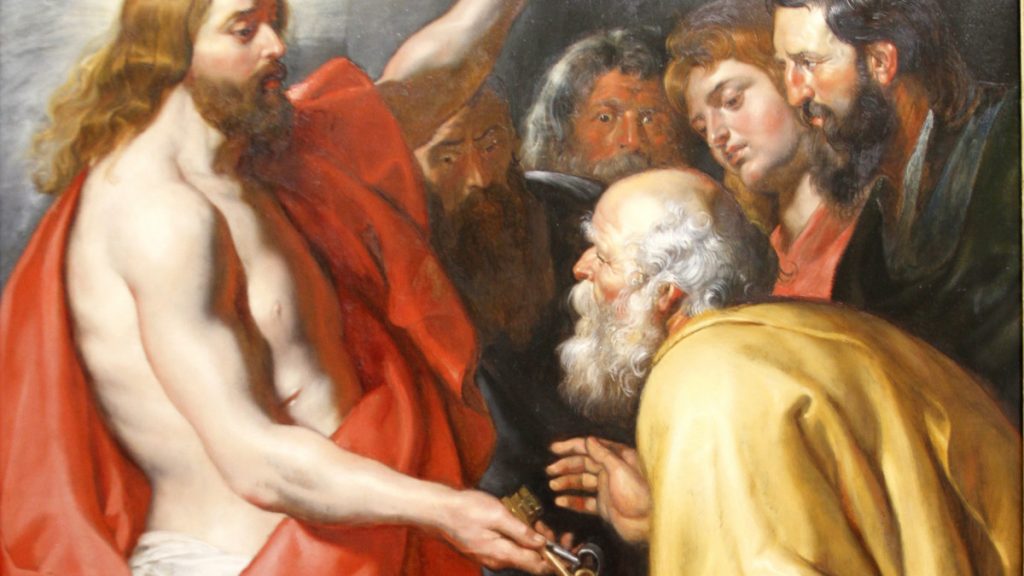
Second, it is noteworthy that St. John identifies St. Peter as the specific person to whom Christ gave the “keys of heaven.” This strictly accords with Scripture, in which Christ grants the other Apostles the power to “bind and loose” (Matt. 18:18), but grants only St. Peter the “keys” by which this authority to “bind and loose” is exercised (Matt. 16:19). St. John obviously detected and acknowledged this distinction, which was the source of St. Peter’s greater authority.
Third, it is quite significant that St. John asserts that, while St. Peter was there, Antioch “was equivalent to the whole world.” The fact that he speaks of this in the past tense, that Antioch “was equivalent to the whole world,” means whatever status was conferred upon it by St. Peter himself did not pass down to his successors in Antioch. Once more, St. John makes an important distinction.
Similarly, if this is what happened to Antioch, where St. Peter did not establish his unique cathedra (i.e. “throne”), then the implications for the status of Rome–in which St. Peter did establish his unique cathedra–are obvious. To clarify, by “unique” cathedra, we simply mean the throne in which not just apostolic authority in general is vested (as with any bishop), but the uniquely Petrine authority of “the master of the whole world,” to use St. John’s words. As we observed earlier, St. John distinguished the more ordinary apostolic authority of the “chair” (i.e. “throne”) possessed by St. James, and the superior apostolic authority over the “world” possessed by St. Peter. Therefore, when he describes the elevation of Antioch due to St. Peter’s presence, and then describes this elevation in the past tense once he leaves, the only logical conclusion is that whatever greater authority St. Peter possessed over the “world” (as opposed to that of an ordinary “chair,” as St. James had) was not left behind in Antioch.
Obviously, it remained with St. Peter, who went on to Rome. Once he established his own unique cathedra in the Eternal City, Rome would be “equivalent to the whole world,” and Rome would be the headquarters of those who were to be “the master of the whole world” (i.e. the Popes). If St. Peter did in fact establish his unique cathedra in Rome–a fact consistently asserted by ancient Christian records–then St. Peter’s status as “the master of the whole world” would continue in his successors at Rome, the Popes; and the status of Rome as “equivalent to the whole world” would remain as well, rather than become a “was,” as St. John observed about Antioch (see Study Bank | The Ancient Lists and Testimonies of Popes Succeeding from Peter, for examples of the consistent ancient Christian witness to St. Peter’s presence, and establishment of his cathedra in Rome).
Conclusion
In conclusion, St. John Chrysostom’s description of St. Peter’s role and authority fit a Catholic view of the papacy. It is impossible to imagine that the traits St. John ascribes to St. Peter, as well as Antioch while he was present, would no longer be the case once “the master of the whole world” had gone to Rome. Upon St. Peter’s arrival, the Eternal City–like Antioch before it–would have likewise become “equivalent to the whole world,” according to St. John, befitting his description of St. Peter as the Apostle who had been given the keys of heaven by Christ Himself.
While St. John does not specifically mention the bishop of Rome, his observations about St. Peter nonetheless support the theological logic of the papacy. After all, his description of St. Peter would be relevant to determining how much, if any authority the Pope, as his successor, would have. In that regard, what St. John says is exceptionally Catholic. He does not describe the Apostles as a group of equals, or St. Peter as enjoying merely a preeminence of honor. Rather, he describes St. Peter as “the master of the whole world,” as the unique possessor of the keys of heaven given by Christ, capable by his mere presence of making any city in which he dwells “equivalent to the whole world.” This accords best with the Catholic doctrine of the papacy.
 Buy Us a Coffee