Introduction
One of the most striking discoveries I made in the writings of the Church Fathers is that every time they spoke about heresy and heretics, they were describing me and my protestantism.
I don’t mean they described the specific details of protestant beliefs. Rather, they explained how heresies and heretics worked, and invariably their descriptions matched what most protestants consider normative Christianity, and how true doctrine is supposedly discerned.
And their descriptions were remarkably consistent.
Many think the word “heresy” is inherently connected to faith. But it isn’t. It actually stems from the Greek words meaning choose and choice, haireomai and hairesis respectively. Thus, in the context of theology, as we will see, to engage in heresy is “to choose” to believe other than what the Church teaches. Its meaning is thus inherently ecclesiastical in nature.
So this mini-series, This Sounds Familiar, will cover the many instances throughout the writings of the ancient Christians (primarily the Church Fathers) that describe heresy and heretics in a way that sounds very familiar, at least to people like me who came to the Catholic Faith from protestantism. This was one of the more truly disturbing aspects of my encounter with the Fathers as a protestant. Too often, what they described as aberrant in Christianity was what I considered normative. While the various heretics they described didn’t always believe what I believed as far as doctrine, they virtually always used the same means or methods to arrive at their conclusions. But these methods—particularly, interpreting Scripture contrary to the teaching of the Church—were, I believed, part of the duty of every Christian in discerning the faith (at least when I concluded the Bible meant something different than what any particular church said it meant, which necessarily included the Catholic Church if I was to have a reason to exist as a protestant).
Indeed, as they did in so many other ways, the writings of the Fathers on this topic showed me that the protestant claim to be recovering the ancient faith was simply false. In many ways, we had simply adopted the very same tactics of the ancient heretics against the same Catholic Church, and it was for that very reason that we—like them—eventually split into a million pieces.
In short, the writings of the Fathers on this topic shocked me out of my stupor, and played a key role in helping me realize the truth of the Catholic Faith as taught by the Catholic Church.
For this first installment of This Sounds Familiar, we will review some of the writings of St. Athanasius of Alexandria, who many protestants consider to be a standard-bearer of orthodoxy. Nevertheless, I discovered that St. Athanasius’s views on how to correctly discern the true faith were not merely absent within protestantism, but often contrary to it. In his battles with Arian heretics who claimed Christ wasn’t fully God, he often confuted them by pointing to the very things Catholics continue to point to today: Scripture, of course; but also the tradition and teaching of the Church—everything that has been passed down, and how the Church has consistently and authoritatively understood it. As I was shocked to discover, it was often the Arians who insisted on a form of “sola scriptura” in order to justify their heresy, because in order to justify their interpretations of Scripture, they had to divorce it from how the Church had always understood it. St. Athanasius consistently called them out for it, as we will see.
Roadmap
With that background in mind, our Roadmap for this first installment of the This Sounds Familiar series is as follows:
- Our thesis is that the Church Fathers describe heretics in a manner that is disturbingly consistent with how many protestants approach Christianity to this day. Our first example of this will come from the writings of the great fourth century Church Father, St. Athanasius of Alexandria. We will show this by:
- First, listing the six common features of heretics described by the Church Fathers (which we call “The Heretical Six”);
- Second, providing a brief overview of Scripture’s descriptions of heresy, and its command to maintain unity;
- Third, introducing St. Athanasius and providing some historical context for his battle with the Arian heretics;
- Fourth, going through six of St. Athanasius’s works—Discourses 1-3 Against the Arians, De Synodis, De Decretis, and Apology Against the Arians—to show how his descriptions of heretics align with how many protestants approach Christianity (we will cover more of his works in future installments); and
- Finally, summarizing St. Athanasius’s view of heretics from the previously quoted six works, and contrast them with a revealing comment made by Martin Luther.
One quick note before we begin: St. Athanasius’s writings have a good deal to say about the papacy, whose authority he consistently appealed to in word and action. We will cover the specifically papal aspects of his beliefs in other installments. Here, we will focus more generally on his description of heretics as contrasted with true Christians, i.e. Catholics in the Catholic Church, in which he appeals to the authority of the Church, bishops, and Ecumenical Councils more generally.
The Heretical Six: What Heretics Share in Common
Before we dive into the writings of St. Athanasius, let’s first provide a summary that the This Sounds Familiar series will constantly refer back to, which I’ll call: The Heretical Six. Each of these is drawn from the writings of the Church Fathers, and together they represent a summary of those writings which we will unfold and prove throughout this series.
With that background in mind, the six characteristics are as follows:
- Heretics separate from the Catholic Church, and deny its authority.
Given its profound importance, this initial point warrants brief reflection, as it serves in many respects as the foundation for all the rest. The Fathers consistently took for granted that the Catholic Church—the sole Church instituted by Christ—possesses the mandate to teach, and indeed communicates a universal doctrine to all people in Christ’s own name. The notion that authority resides merely at the level of the “local church” (a common protestant assertion) was foreign to patristic thought. Yet even within their own framework, protestants do not hold that a local body teaches with Christ’s infallible authority, leaving them free to reject its guidance whenever their personal reading of Scripture shifts—a pattern demonstrated thousands of times over, giving rise to countless protestants sects. Consequently, heretics do not merely withdraw from the Catholic Church, they reject the very teaching authority Christ bestowed upon it, which would otherwise demand their submission.
- Heretics interpret Scripture according to a novel, previously unknown principle, even if it contradicts the tradition of the Church (“tradition” meaning everything that has been passed down in the Church, not just Scripture).
- Based on this novel principle, heretics concoct a new set of beliefs around which they form their own sect, which they erroneously claim is the “true faith” and “Christian” (sometimes they even try to claim they are still “Catholic”).
- To justify their heresy, heretics’ primary tactic is to cite and quote Scripture as much as possible so that their new religion sounds “biblical.”
- Heresies are often named after the men who concoct them, or for a very particular doctrine they taught.
- Lastly, the doctrines and definitions put forward by heretics are in perpetual flux, subjecting the certainty and unity of Faith enjoined by the Apostles to endless and irreconcilable disputations.
To say that I was shocked after reading such descriptions from Church Fathers East and West, century after century, is an understatement, as they precisely fit normative protestantism, regardless of its particular brand or flavor.
Let me offer an important caveat that repeats what I said before, but to ensure clarity: note that these principles do not necessarily relate to particular doctrines. Rather, they have to do with the very manner in which heresies come about, and the means by which they are defended by heretics. The contention is not “Protestant Sect A believes the exact same set of doctrines as Ancient Heretical Sect B” (although sometimes there is some overlap). Rather, the contention is that “Protestant Sects in general engage in the same overall methodology of the ancient heretical sects, and, in like manner, end up with a thousand contrary doctrines in the process.”
In short, these characteristics of heretics were simply another powerful example of a “one-niner,” my term summarizing Ecclesiastes 1:9, which declares there is “nothing new under the sun.”
Scripture’s Descriptions of Heresy, and its Command to Maintain Unity
Suffice it to say, after reading such consistent descriptions of heretics, I realized that what I had grown up and considered “normal” for Christians well into my adulthood was in fact not normal, not Christian, and contrary to the Faith of my ancestors. I took for granted principles which all of them considered certain signs of heresy. But it was not altogether a shock to me, for having loved and voraciously studied Scripture for many years, it was impossible to avoid its constant commands to remain unified, and hold the same Faith. Indeed, I had not found a single example in Scripture of a Christian taking the Scriptures, interpreting them for themselves, and separating from the rest of the Church—exactly what I thought was normative as a protestant (see Ep. 2 | No One in Scripture Interpreted it on Their Own).
Instead of rampant division, I found St. Paul telling the Philippians to “complete my joy by being of the same mind, having the same love, being in full accord and of one mind” (Phil. 2:2).
And to the Ephesians, he declared as follows (Eph. 4:4-6, 13):
There is one body and one Spirit, just as you were called to the one hope that belongs to your call, one Lord, one faith, one baptism, one God and Father of us all, who is above all and through all and in all…until we all attain to the unity of the faith and of the knowledge of the Son of God…
How can you claim to possess “the unity of the faith” when you contradict one another on the actual teachings of that faith? How can you claim to possess “knowledge of the Son of God” if you all teach different things about Him? By definition, you are claiming that this “knowledge” is actually different things.
Likewise, St. Paul said to the Corinthians: “I appeal to you, brethren, by the name of our Lord Jesus Christ, that all of you agree and that there be no dissensions among you, but that you be united in the same mind and the same judgment” (1 Cor. 1:10), after which he decried the fact that various factions were choosing leaders and identifying themselves with the names of those leaders rather than Christ. Once more, Scripture itself confronted me as a protestant with the glaring reality that I was not, in fact, “united in the same mind and the same judgment” as my fellow Christians, all of whom (like me) acknowledged Scripture to be our supreme authority. And yet, we all differed in our judgment about the meaning of this supreme authority. The result was that we all claimed it taught different things, with no authority competent to adjudicate our disputes, since at the end of the day, we each claimed Scripture was on our side. There was, in fact, no way in principle for us to arrive at “the same judgment” that St. Paul commanded.
Naturally, I also remembered St. Peter’s words about the ease with which Scripture may be twisted, and used as a pretext to undermine the faith itself—ironically, using the very letters of St. Paul that protestants so often weaponize against the Catholic Church (2 Pet. 3:16-17):
There are some things in them [St. Paul’s letters] hard to understand, which the ignorant and unstable twist to their own destruction, as they do the other scriptures. You therefore, beloved, knowing this beforehand, beware lest you be carried away with the error of lawless men and lose your own stability.
Nor was this any mere congregational or local church matter. Indeed, St. Peter wrote those words to numerous churches at the same time. And in the same Scriptures we have a Council of the Apostles and presbyters who, in resolving a religious dispute, claimed their teaching “has seemed good to the Holy Spirit and to us” (Acts 15:28), and their decisions were “delivered to them [all the local churches] for observance” (Acts 16:4). For more, see #12 | Why Acts 15 Led Me to the Catholic Church.
And finally, Christ Himself was quite clear at the Last Supper (John 17:20-21):
I do not pray for these [the Apostles] only, but also for those who believe in me through their word, that they may all be one; even as thou, Father, art in me, and I in thee, that they also may be in us, so that the world may believe that thou hast sent me.
As Christ quite explicitly declared, unity was required not only of the Apostles themselves, but of all those who would come to believe in Him through their testimony.
Thus, having read the Scriptures for many years, I was already aware of how often it commanded those things which I had never been able to square with what I saw and experienced in protestantism.
So when I read how the Church Fathers consistently described heretics, shocked as I was, it struck a deep chord, for their descriptions not only made more sense of Scripture, but also describe the reality of protestantism since the 16th century with uncanny accuracy. In short, their descriptions sounded quite familiar.
St. Athanasius and the Arian Heretics
So for this first installment of This Sounds Familiar, let us turn to the writings of St. Athanasius, which offer many striking examples of this phenomenon. He is widely admired by many protestants, yet in my experience, very few have actually read his works (or at least not many of them), leaving them unaware that his beliefs about the Church directly contradict their own on numerous and salient points. This will only be Part 1 for St. Athanasius, as we will cover more of his writings in future installments of This Sounds Familiar.
St. Athanasius was the greatest champion of the Catholic Faith against the Arian heresy in the fourth century, hence his sometimes being called “the Great.” The Council of Nicaea convened in 325 to respond to the teachings of an Egyptian priest named Arius who came from the same diocese as St. Athanasius in Alexandria. Arius taught that Christ was not fully God, in the sense that, while He had perhaps been involved in creating the universe with God the Father, He was not co-eternal with Him, and thus in some sense a created being. The Council of Nicaea affirmed the Catholic Faith, which had always believed that Christ was fully God and fully man, and that He was the eternally begotten Son of God the Father, and thus co-eternal with Him. By virtue of the fact that they taught Christ was created, the Arians essentially negated the fatherhood of the Father, since prior to Christ’s supposed creation, there was no Son, and thus there was a time when there was no Father. The Church refuted this, teaching that God had always been a Father (God the Father), and had always had a Son (God the Son). They are, as the Council later defined in its famous creed, of the “same substance,” meaning, both were equally divine, despite being different Persons within the one Triune God. Neither of them had ever existed apart from the other.
St. Athanasius attended the Council of Nicaea as a deacon, but was later made the Bishop of Alexandria in Egypt, in which capacity he heroically defended the Nicene creed against the Arians. He was exiled, slandered, expelled from his own diocese multiple times, and nearly murdered more than once.
Since St. Athanasius is generally respected among protestants—including myself before my conversion—I was shocked to discover him saying so many things that directly contradicted protestant beliefs and principles. His descriptions of heretics and how they operated sounded disturbingly and ominously familiar.
Discourse 1 Against the Arians
We’ll begin with St. Athanasius’s Discourse 1 Against the Arians.
In its opening, St. Athanasius identifies one of Arianism’s most dangerous tendencies—its constant use of Scripture to deceive the faithful (§1):
But, whereas one heresy, and that the last, which has now risen as harbinger of Antichrist, the Arian, as it is called, considering that other heresies, her elder sisters, have been openly proscribed, in her craft and cunning, affects to array herself in Scripture language, like her father the devil, and is forcing her way back into the Church’s paradise—that with the pretense of Christianity, her smooth sophistry (for reason she has none) may deceive men into wrong thoughts of Christ—nay, since she has already seduced certain of the foolish, not only to corrupt their ears, but even to take and eat with Eve, till in their ignorance which ensues they think bitter sweet, and admire this loathsome heresy, on this account I have thought it necessary, at your request, to unrip “the folds of its breast-plate” (Job 41:13), and to show the ill savor of its folly. So while those who are far from it may continue to shun it, those whom it has deceived may repent; and, opening the eyes of their heart, may understand that darkness is not light, nor falsehood truth, nor Arianism good; nay, that those who call these men Christians are in great and grievous error, as neither having studied Scripture, nor understanding Christianity at all, and the faith which it contains.
Next, like many other Church Fathers, he points out that this new heresy, like all the others, while claiming to be “Christian,” was in fact initiated by a known individual, and had taken its name from them (§3):
Thus, though Arius be dead, and many of his party have succeeded him, yet those who think with him, as being known from Arius, are called Arians. And, what is a remarkable evidence of this, those of the Greeks who even at this time come into the Church, on giving up the superstition of idols, take the name, not of their catechists, but of the Savior, and begin to be called Christians instead of Greeks: while those of them who go off to the heretics, and again all who from the Church change to this heresy, abandon Christ’s name, and henceforth are called Arians, as no longer holding Christ’s faith, but having inherited Arius’s madness.
In §8, St. Athanasius chastises the Arian heretics for asserting a “faith” that was “not from our fathers.” We will reserve the text of this quote for our conclusion, where we will contrast it with the sentiments of Martin Luther.
Later in the work, St. Athanasius is quite clear that the proper interpretation of Scripture is done with the Church (§44):
This then I consider the sense of this passage, and that, a very ecclesiastical sense…
Likewise, he asserted that while heretics tend to employ Scripture frequently, since they do so apart from the Church “according to their wont,” they employ it in an “irreligious” way. They thereby make their own peculiar and novel beliefs—rather than the faith of the Church—the standard by which they interpret (and thereby misunderstand) the Scriptures (§§52-53):
§52 | …For being forced from the conceptions or rather misconceptions of their own hearts, they fall back upon passages of divine Scripture, and here too from want of understanding, according to their wont, they discern not their meaning; but laying down their own irreligion as a sort of canon of interpretation, they wrest the whole of the divine oracles into accordance with it. And so on the bare mention of such doctrine, they deserve nothing but the reply, “You do err, not knowing the Scriptures nor the power of God” (Matt. 22:29); and if they persist in it, they must be put to silence, by the words, “Render to” man “the things that are” man’s, “and to God the things that are God’s” (Matt. 22:21).
§53 | …These passages they brought forward at every turn, mistaking their sense…and thus they deceive the thoughtless, making the language of Scripture their pretense, but instead of the true sense sowing upon it the poison of their own heresy…
So in this first Discourse against the Arians, we see strong gestures by St. Athanasius toward important Catholic truths:
- The true interpretation of Scripture is “ecclesiastical” (i.e. within the Church);
- Heretics misinterpret Scripture because they start with their own error rather than the faith of the Church as the standard by which they interpret it;
- Heretics are often named after their founders, not after Christ or the Church; and
- Heretics quote Scripture frequently in order to give their false teachings an appearance of orthodoxy.
Discourse 2 Against the Arians
We now proceed to St. Athanasius’s Discourse 2 Against the Arians. In the first half of the work, he refutes the Arians by (among other things) pointing to the faith that Christians had always learned in the Church as the standard by which to properly interpret Scripture (§34):
Who heard, in his first catechizing, that God has a Son and has made all things by His proper Word, but understood it in that sense in which we now mean it? Who on the rise of this odious heresy of the Arians, was not at once startled at what he heard, as strange, and a second sowing, besides that Word which had been sown from the beginning?
Notice his reference to the reader’s “first catechizing.” Catechesis was the process by which the faithful (and converts) were taught the mysteries of the Catholic Faith, and in the case of converts, before receiving baptism. In other words, St. Athanasius directs the reader to the Faith that had been passed down and taught in the Church itself as the proper standard for interpreting Scripture. As a protestant, this was the opposite of what I believed, namely, that we start not with a particular doctrine in order to properly interpret the Scriptures, but with the Scriptures themselves in order to come up with the correct doctrine.
Likewise, in §40, St. Athanasius rejects the Arian notion about God’s wisdom because “neither in the divine oracles [Scripture] is found another wisdom besides this Son, nor from the fathers have we heard of any such…” He thus appeals to Scripture, as well as successors of the Apostles, the bishops (often referred to as “fathers”).
In many places, St. Athanasius went on to explain why citing Scripture, on its own, was not the path to the true Faith. After all, Satan himself had quoted Scripture to Christ. So quoting Scripture, and being able to weave it together according to a seemingly coherent individual or denominational theology, wasn’t enough. Rather, the interpretation of Scripture must be guided by what in various places he called the “ecclesiastical” and “religious sense,” which could only be found in the Church.
Discourse 3 Against the Arians
We now proceed to St. Athanasius’s Discourse 3 Against the Arians, where he continues to contrast what he considered the private interpretations of the heretical Arians with the public (and thus authoritative) faith of the Church (§10):
However here too they introduce their private fictions, and contend that the Son and the Father are not in such wise “one,” or “like,” as the Church preaches, but, as they themselves would have it.
This contrast between “private fictions” and the public teaching of the Church is consistent throughout St. Athanasius’s writings.
He later references the various ways in which one arrives at a correct interpretation of Scripture (§18):
And yet, needless though it be to refine upon these passages, considering their so clear and religious sense, and our own orthodox belief, yet that their [the Arians’] irreligion may be shown here also, come let us shortly, as we have received from the fathers, expose their heterodoxy from the passage.
Note that St. Athanasius considers Scripture to have a “clear and religious sense” precisely because it is read through the prism of “orthodox belief.” In other words, understanding Scripture requires adherence to a pre-existing faith, which is itself the rule for correctly interpreting it. That faith has been “received from the fathers,” and exposes heretical heterodoxy. This is the faith St. Athanasius elsewhere spoke of having been received by every Catholic in their catechesis.
This is confirmed in an even more explicit fashion later in the same work (§28):
[W]hat they [the Arians] now allege from the Gospels they certainly give an unsound interpretation, we may easily see, if we now consider the scope of that faith which we Christians hold, and using it as a rule, apply ourselves, as the Apostle teaches, to the reading of inspired Scripture. For Christ’s enemies, being ignorant of this scope, have wandered from the way of truth, and have stumbled on a stone of stumbling [Rom. 9:32], thinking otherwise than they should think.
Thus, for St. Athanasius, Scripture is not the only rule of faith. The faith constantly held by Christians is itself the rule of faith for properly understanding Scripture. This is precisely the opposite of what virtually every protestant would argue, namely that Scripture is the rule for knowing the faith.
Throughout his writings, the great Saint constantly extols Scripture as having the greatest authority in the Church. It is an essential element of the “rule of faith.” However, and crucially, it is not the only one. According to St. Athanasius, the rule of faith is that standard by which we properly understand the Scriptures as well—a canon of interpretation found only within the Church, and thus a rule that is both outside, and completely compatible with (indeed necessary to) a proper reading of Scripture, since it has been passed down in the Church Herself, as the Scriptures themselves were.
Indeed, as he says, this is exactly “as the Apostle teaches.” Perhaps he was thinking of verses such as 2 Thessalonians 2:15, in which St. Paul commands: “So brethren, stand firm and hold to the traditions which you were taught by us, either by word of mouth or by letter.” Or perhaps 1 Corinthians 11:2, where he told the Corinthians “I commend you because you remember me in everything and maintain the traditions even as I have delivered them to you.” Both verses were frequently cited by St. Athanasius in his battles with the Arians, who often appealed to the Scriptures to justify their heresy.
Thus, for St. Athanasius, the original means by which the original Christians had received the faith—through the Apostolic preaching and example lived out among them—could not be pitted against the written Scriptures they had received from the very same Apostles. The Apostolic tradition included both. They are not at odds, but partners in a necessary and essential union, particularly when it came to resolving controversies of the faith. It is because heretics lack this essential rule of faith found only in the Catholic Church that St. Athanasius later says (§42):
[B]eing in great ignorance as regards these words [of Scripture], and being stupefied about them, they think they have in them an important argument for their heresy. But I, when the heretics allege it and prepare themselves with it, see in them the giants again fighting against God [a reference to the Nephilim, etc.].
It was for this reason, in §55 of the same work, he called heresy “self-willed irreligion.”
A bit later, he again asserts the necessity of interpreting Scripture with an “ecclesiastical scope,” which he called “an anchor for the faith” (§58):
Had Christ’s enemies thus dwelt on these thoughts, and recognized the ecclesiastical scope as an anchor for the faith, they would not have made shipwreck of the faith, nor been so shameless as to resist those who would fain recover them from their fall, and to deem those as enemies who are admonishing them to be religious.
In §67, St. Athanasius concludes that since the heretics deny all these things, “the divine Scriptures are closed to them, and from every part of them they are refuted as insensate and Christ’s enemies.”
Interpreting Scripture apart from the tradition and authority of the Church was for St. Athanasius the path to perdition, not to the pure Christian Faith. In other words: the exact opposite of what I had been taught as a protestant, which was made all the more confusing given that I, like most protestants, considered St. Athanasius a pillar of orthodoxy. But how could a “pillar of orthodoxy” assert such blatantly unorthodox things? I realized that either St. Athanasius was not a pillar of orthodoxy, or my protestant understanding of “orthodoxy” was flawed.
De Synodis, or Councils of Ariminum and Seleucia
We proceed to another work, De Synodis, in which St. Athanasius refutes two Arian councils held in Ariminum and Seleucia.
In various places throughout this work, St. Athanasius decried the manner in which heretics simply reject the traditions and teachings of the fathers, by which he meant the bishops of the Church, including those who promulgated the Nicene Creed (§7):
Having therefore no reason on their side, but being in difficulty whichever way they turn, in spite of their pretenses [including citing Scripture], they have nothing left but to say, “Forasmuch as we contradict our predecessors, and transgress the traditions of the Fathers, therefore we have thought good that a Council should meet…”
Note that in his summary “quote” of the Arians, St. Athanasius specifically says they contradicted those who came before them, and “transgress the traditions of the Fathers.” This was no appeal a protestant could brook. Indeed, the protestants—if, like the Arians, they were convinced they were right about scripture—would follow them in doing the exact same thing!
By so doing, the Arians, St. Athanasius declared, were acting contrary to the teachings of the Apostles, which had been faithfully delivered by these same fathers (§14):
The blessed Apostle approves of the Corinthians because, he says, “you remember me in all things, and keep the traditions as I delivered them to you” (1 Cor. 11:2); but they, as entertaining such views of their predecessors, will have the daring to say just the reverse to their flocks: “We praise you not for remembering your fathers, but rather we make much of you, when you hold not their traditions.” And let them go on to accuse their own unfortunate birth, and say, “We are sprung not of religious men but of heretics.” For such language, as I said before, is consistent in those who barter their Fathers’ fame and their own salvation for Arianism, and fear not the words of the divine proverb, “There is a generation that curses their father” (Prov. 30:11), and the threat lying in the Law against such [Ex. 21:17]. They then, from zeal for the heresy, are of this obstinate temper; you, however, be not troubled at it, nor take their audacity for truth. For they dissent from each other, and, whereas they have revolted from their Fathers, are not of one and the same mind, but float about with various and discordant changes. And, as quarrelling with the Council of Nicaea, they have held many Councils themselves, and have published a faith in each of them, and have stood to none, nay, they will never do otherwise, for perversely seeking, they will never find that Wisdom which they hate. I have accordingly subjoined portions both of Arius’s writings and of whatever else I could collect, of their publications in different Councils; whereby you will learn to your surprise with what object they stand out against an Ecumenical Council and their own Fathers without blushing.
Note that for St. Athanasius, standing against the authority of an Ecumenical Council was tantamount to denying the teaching of the Apostles. No doubt he had the example of the Council of Jerusalem in Acts 15 in his mind.
St. Athanasius also described how the Arians justified their heresy and departing from the traditions of the fathers by appealing to Scripture as their sole authority, claiming to reject everything that was not written—an excuse that was all too familiar to me as a protestant (§36):
“But,” they say, “all this is not written: and we reject these words as unscriptural.” But this, again, is an unblushing excuse in their mouths. For if they think everything must be rejected which is not written, wherefore, when the Arian party invent such a heap of phrases, not from Scripture, “Out of nothing,” and “the Son was not before His generation,” and “Once He was not,” and “He is alterable,” and “the Father is ineffable and invisible to the Son,” and “the Son knows not even His own essence”; and all that Arius has vomited in his light and irreligious Thalia [a work by Arius], why do not they speak against these, but rather take their part, and on that account contend with their own Fathers?
Later in the same work, St. Athanasius praised Catholics for following the true faith handed down by the very fathers (bishops) rejected by the Arians (§54):
What then I have learned myself, and have heard men of judgment say, I have written in few words; but do you, remaining on the foundation of the Apostles, and holding fast the traditions of the Fathers, pray that now at length all strife and rivalry may cease, and the futile questions of the heretics may be condemned…
De Decretis, or Defense of the Nicene Definition
We now proceed to De Decretis, St. Athanasius’s defense of the definition of the Council of Nicaea.
Once again, near the beginning, St. Athanasius not only appeals to the episcopal authority that anathematized the Arians, but again identifies the true faith as the “ecclesiastical faith” that had followed “the tradition of the Fathers” (§3):
On this the Bishops, having negatived the terms they [the Arians] had invented, published against them the sound and ecclesiastical faith…this [is] the Church’s faith, and the tradition of the Fathers…
Note that he refers to the authority of the bishops to “negative” the terms “invented” by heretics. This necessarily refers to episcopal authority—the authority of the bishops as successors of the Apostles—which he believed was an essential ingredient in expounding “the sound and ecclesiastical faith…the Church’s faith, and the tradition of the Fathers.”
In the next section, he describes something that should sound very familiar to those acquainted with protestantism, namely how those who hold true doctrine are not only united among themselves, but with what had been delivered to them by the fathers. Heretics, on the other hand, were constantly shifting their positions and quarreling with one another—a process he describes in detail as taking place among the Arians, who were constantly rewording and changing their confessions of faith (§4):
For, what our Fathers have delivered, this is truly doctrine; and this is truly the token of doctors, to confess the same thing with each other, and to vary neither from themselves nor from their fathers; whereas they who have not this character are to be called not true doctors but evil. Thus the Greeks [heretics], as not witnessing to the same doctrines, but quarreling one with another, have no truth of teaching; but the holy and veritable heralds of the truth agree together and do not differ. For though they lived in different times, yet they one and all tend the same way, being prophets of the one God, and preaching the same Word harmoniously.
This struck a chord for me as a protestant, because I knew exactly what this was like: congregations splitting over different beliefs and theologies, writing out new and different “statements of faith” that seemed to constantly change, incapable of agreeing even on what they considered “essential,” and/or constantly watering it down in order to make an increasingly superficial “agreement” possible. Jesus could not both teach X, and not teach X, and yet this is precisely what I was confronted with as a protestant, even among virtuous, good-faith, and well-educated teachers (both living and dead). St. Athanasius’s description of 4th century heretics matched my exact experience in the 20th and 21st centuries.
In a later section, St. Athanasius rhetorically asks by which “teacher” or “tradition” the Arians arrived at their conclusions. Of course, the Arians claimed that tradition was “Scripture,” but St. Athanasius rejects this (§13):
Therefore let them tell us, from what teacher or by what tradition they derived these notions concerning the Savior? “We have read [in Scripture],” they will say [citing a verse]…But they seem to me to have a wrong understanding of this passage also; for it has a religious and very orthodox sense, which had they understood, they would not have blasphemed the Lord of glory…
Note that St. Athanasius refers to the “religious and very orthodox sense” as the genuine meaning of Scripture. But how would this genuine meaning of Scripture be differentiated from the heretical meaning ascribed to it by the Arians? Undoubtedly by the same means St. Athanasius referred to initially: the right “teacher” and “tradition.” Who was this “teacher” and “tradition”? It was simply the teaching of the Catholic Church, passed on via apostolic succession by the same “fathers” St. Athanasius so often refers to, the bishops.
I thus saw that St. Athanasius was consistently appealing to the very things the heretics rejected—binding Apostolic tradition, and the rulings/definitions of our fathers in the faith at Ecumenical Councils, whose authority bound the entire Church.
I was also disturbed to realize that so many of the principles I and the protestants I respected espoused concurred not with St. Athanasius, but with the Arians! To add insult to injury, we defended the same principles the great Saint identified as heretical in exactly the same way he described the Arians doing so: claiming to reject anything outside of Scripture, and profusely quoting it based on our own interpretations to justify our own theologies as we denied the very authority of the Church and its tradition that St. Athanasius appealed to.
But it got even worse.
Apology Against the Arians
We turn now to the final text of this initial entry in the This Sounds Familiar series, Part 1 of St. Athanasius’s writings: namely, the opening section of his Apology Against the Arians.
Early in the work, St. Athanasius consistently contrasts heretics with the Church, whose authority has anathematized them. While we address St. Athanasius’s theology of the papacy elsewhere, it is worth noting here that he highlights the bishop of Rome, as he often did in many of his writings, indicating his belief that the Pope had greater authority than other bishops, which he not only claimed with his words, but evinced in his actions (§19):
For behold, after their former letters concerning the Arians, of which also we have sent you copies, they now openly stir up the Arian madmen against the Church, though the whole Catholic Church has anathematized them; they have appointed a Bishop over them; they distract the Churches with threats and alarms, that they may gain assistants in their impiety in every part. Moreover, they send Deacons to the Arian madmen, who openly join their assemblies; they write letters to them, and receive answers from them, thus making schisms in the Church, and holding communion with them; and they send to every part, commending their heresy, and repudiating the Church, as you will perceive from the letters they have addressed to the Bishop of Rome and perhaps to yourselves also. You perceive therefore, dearly beloved, that these things are not undeserving of vengeance: they are indeed dreadful and alien from the doctrine of Christ.
St. Athanasius then quotes the Council of Sardica’s letter to his own Church of Alexandria, which likewise coupled the teaching of the Church with what had been passed down by the Fathers (§§37/41):
We were not ignorant, but the fact was well known to us, even before we received the letters of your piety, that the supporters of the abominated heresy of the Arians were practicing many dangerous machinations, rather to the destruction of their own souls, than to the injury of the Church. For this has ever been the object of their unprincipled craft; this is the deadly design in which they have been continually engaged, namely, how they may best expel from their places and persecute all who are to be found anywhere of orthodox sentiments, and maintaining the doctrine of the Catholic Church, which was delivered to them from the Fathers…
Once more, here as elsewhere, St. Athanasius contradicts the Arians by appealing to the doctrine, preaching, and authority of the Catholic Church as delivered and defined by the successors of the Apostles (the bishops).
St. Athanasius vs. Martin Luther
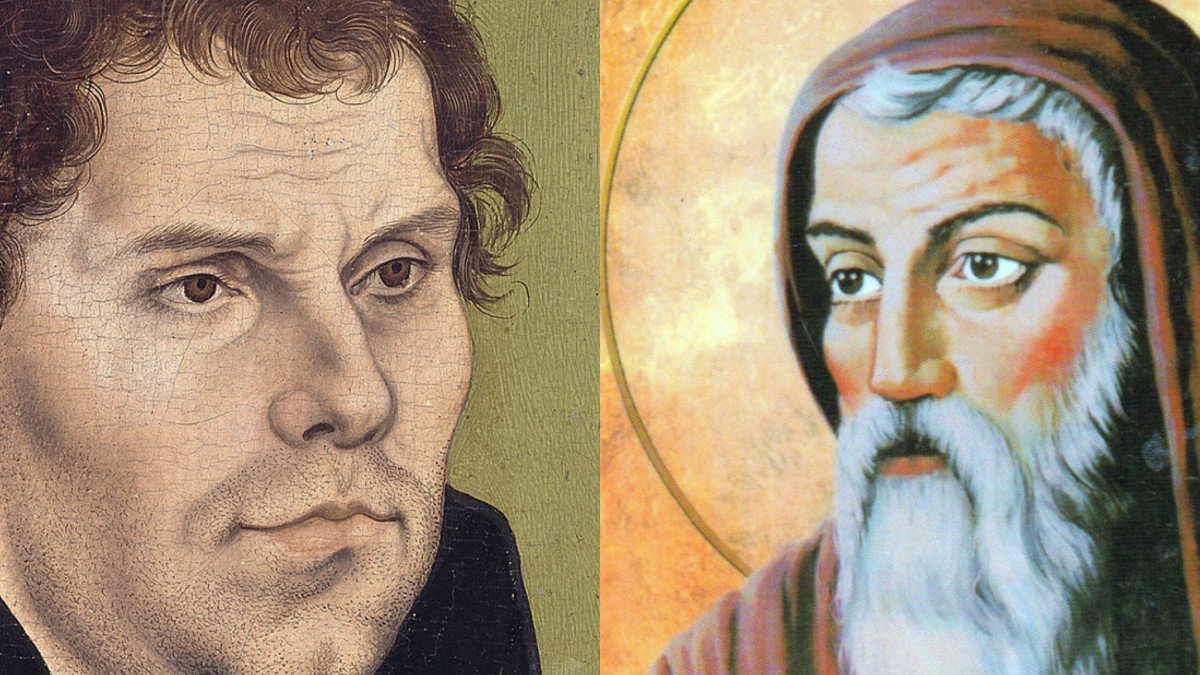
In reading St. Athanasius, I couldn’t help but notice how different he was from Martin Luther, the man that “started,” or at least catalyzed the creation of protestantism. A bare comparison between the two shall suffice to make this final observation.
As promised earlier, we now quote St. Athanasius’s Discourse I Against the Arians (§8) in order to show just how greatly he and Luther differed from one another:
But if they themselves [the Arians] own that they have heard it [their heresy] now for the first time, how can they deny that this heresy is foreign, and not from our fathers? But what is not from our fathers, but has come to light in this day, how can it be but that of which the blessed Paul has foretold, that “in the latter times some shall depart from the sound faith, giving heed to seducing spirits and doctrines of devils, in the hypocrisy of liars; cauterized in their own conscience, and turning from the truth” (1 Tim. 4:1)?
This could not be more different than Martin Luther in his Table Talk (§§530, 533-34), where he openly despised the Church Fathers, and admitted he couldn’t find his notion of “faith” among them (and thus, the novelty of his theology)[FOOTNOTE 1]:
§530 | Behold what great darkness is in the books of the Fathers concerning faith…St Jerome, indeed, wrote upon [books in Scripture], but, alas! very coldly. Ambrose wrote six books upon the first book of Moses, but they are very poor. Augustin wrote nothing to the purpose concerning faith…I can find no exposition upon the Epistles to the Romans and Galatians, wherein anything is taught pure and right… 232 | 233
§533 | We must read the Fathers cautiously, and lay them in the gold balance, for they often stumbled and went astray, and mingled in their books many monkish things…
§534 | The more I read the books of the Fathers, the more I find myself offended; for they were but men, and, to speak the truth, with all their repute and authority, undervalued the books and writings of the sacred apostles of Christ.
After reading St. Athanasius, I knew that his descriptions of heretics were in fact describing me. My protestantism—indeed all protestantism—operated in precisely the same way he described the heresies of his own day operating: appealing to Scripture alone, pitting it against the authority and tradition of the Catholic Church, and the multiplying of contradictory sects and faiths, all claiming to be the true Christian religion. As such, I realized that my protestant faith, no matter what variety it happened to be, could only be what St. Athanasius described Arianism to be, namely, a self-made faith, not the Faith. After all, with Arianism, we rejected the authority of the Catholic Church; we introduced as dogma ideas that had never been believed by Christians; we used these ideas as a new standard, or canon of interpretation by which to re-interpret Scripture in a novel way; and we constantly cited and quoted Scripture to make it seem as if this non-Christian interpretation was in fact “biblical,” even as we contradicted one another in the process.
I realized that while neither I nor any other protestant I knew was Arian, we nonetheless acted like them, and shared a great deal of theological presuppositions with them. I knew something had to change: me.
Conclusion
From these first six works of St. Athanasius, we can see that he described heretics as follows:
- They reject the authority of the Catholic Church;
- They reject the authority of “the fathers” (bishops in apostolic succession from the Apostles) to define the faith;
- They interpret Scripture on novel principles that lack continuity with previous belief and Church teaching; and
- As a result of rejecting the authority of the fathers and the Church in general, they endlessly split and divide from one another, and cannot articulate consistent statements of faith.
In short, as a protestant who loved and admired St. Athanasius for his orthodoxy, upon actually reading his writings, I discovered that he asserted all sorts of things I considered extremely unorthodox in order to defend his orthodoxy with respect to the divinity of Christ. Indeed, what he described as typical of heretics was also typical of me, as a protestant.
This realization was shocking, and indeed played a powerful role in my coming into the Catholic Church, whose tradition and authority was constantly commended by St. Athanasius against heretics who—like me—rejected both.
 Buy Us a Coffee