(Updated May 28, 2025)
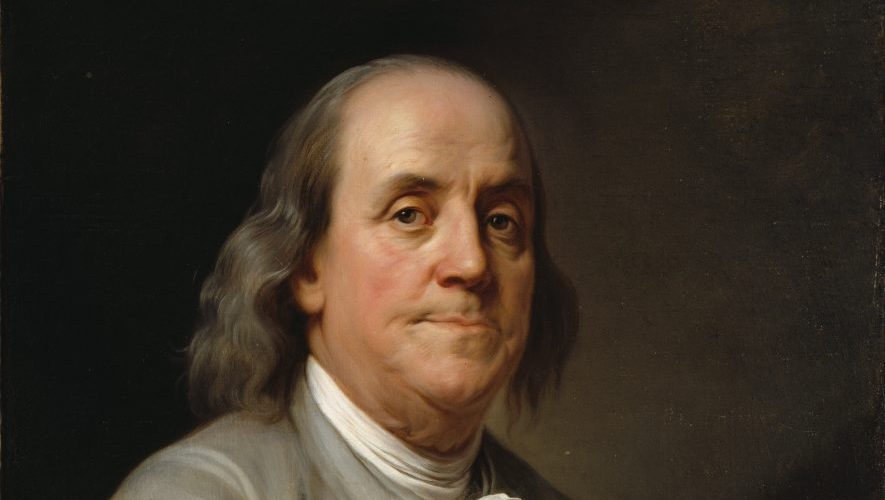
Benjamin Franklin (1706-1790) was an American Founder. An entrepreneur, scientist, and statesmen, Franklin served in many roles during the colonial, Revolutionary, and early Republic periods, including as the first Postmaster General of the United States, and as America’s foreign minister to France.
Next to each quote are the Topic Quote Archives in which they are included.
This Quote Archive is being continuously updated as research continues. Quotes marked with “***” have not yet been organized into their respective Topic Quote Archives.
Speeches and Other Public Acts
Benjamin Franklin, A Proclamation for a General Fast (December 9, 1747)
Franklin assisted members of the Governor’s Council in writing this Proclamation. He records the details in his Autobiography:
Calling in the Aid of Religion, I propos’d to them the Proclaiming a Fast, to promote Reformation, and implore the Blessing of Heaven on our Undertaking. They embrac’d the Motion, but as it was the first Fast ever thought of in the Province, the Secretary had no Precedent from which to draw the Proclamation. My Education in New England, where a Fast is proclaim’d every Year, was here of some Advantage. I drew it in the accustomed Stile, it was translated into German, printed in both Languages and divulg’d thro’ the Province.
The words of the Proclamation:
Forasmuch as it is the Duty of Mankind, on all suitable Occasions, to acknowledge their Dependence on the Divine Being, to give Thanks for the Mercies received, and no less to deprecate his Judgments, and humbly pray for his Protection: And as the Calamities of a bloody War, in which our Nation is now engaged, seem every Year more nearly to approach us, and the Expedition formed for the Security of these Plantations, hath been laid aside…and there is just Reason to fear, that unless we humble ourselves before the Lord, and amend our Ways, we may be chastised with yet heavier Judgments: We have therefore thought fit, on due Consideration thereof, to appoint Thursday, the seventh Day of January next, to be observed throughout this Province as a Day of Fasting and Prayer; exhorting all, both Ministers and People, to observe the same with becoming Seriousness and Attention, and to join with one Accord in the most humble and fervent Supplications, That Almighty God would mercifully interpose, and still the Rage of War among the Nations, and put a Stop to the Effusion of Christian Blood: That he would preserve and bless our Gracious King, guide his Councils, and give him Victory over his Enemies, to the Establishing a speedy and lasting Peace: That he would bless, prosper and preserve all the British Colonies, and particularly, that he would take this Province under his Protection, confound the Designs and defeat the Attempts of its Enemies, and unite our Hearts, and strengthen our Hands in every Undertaking that may be for the Public Good, and for our Defense and Security in this Time of Danger: That he would graciously please to bless the succeeding Year with Health, Peace and Plenty, and enable us to make a right Use of his late afflicting Hand, in a sincere and thorough Reformation of our Lives and Manners, to which the Ministers of all religious Societies are desired earnestly to exhort their People. And it is recommended to all Persons to abstain from servile Labor on the said Day.
Benjamin Franklin, An Address to the Public from the Pennsylvania Society for Promoting the Abolition of Slavery, and the Relief of Free Negroes Unlawfully Held in Bondage (November 9, 1789)1
Ending Slavery
Encouraged by this success [of the Society], and by the daily progress of that luminous and benign spirit of liberty which is diffusing itself throughout the world, and humbly hoping for the continuance of the divine blessing on our labors, we have ventured to make an important addition to our original plan, and do therefore earnestly solicit the support and assistance of all who can feel the tender emotions of sympathy and compassion, or relish the exalted pleasure of beneficence.
Slavery is such an atrocious debasement of human nature that its very extirpation, if not performed 157 |158 with solicitous care, may sometimes open a source of serious evils.
The unhappy man who has long been treated as a brute animal, too frequently sinks beneath the common standard of the human species. The galling chains that bind his body do also fetter his intellectual faculties and impair the social affections of his heart. Accustomed to move like a mere machine, by the will of a master, reflection is suspended; he has not the power of choice; and reason and conscience have but little influence over his conduct, because he is chiefly governed by the passion of fear. He is poor and friendless, perhaps worn out by extreme labor, age, and disease.
Under such circumstances, freedom may often prove a misfortune to himself, and prejudicial to society.
Attention to emancipated black people, it is therefore to be hoped, will become a branch of our national policy; but, as far as we contribute to promote this emancipation, so far that attention is evidently a serious duty incumbent on us, and which we mean to discharge to the best of our judgment and abilities.
To instruct, to advise, to qualify those, who have been restored to freedom, for the exercise and enjoyment of civil liberty, to promote in them habits of industry, to furnish them with employments suited to their age, sex, talents, and other circumstances, and to procure their children an education calculated for their future situation in life; these are the great outlines of the annexed plan, which we have adopted, and which we conceive will essentially promote the 158 | 159 public good, and the happiness of these our hitherto too much neglected fellow-creatures.
Constitutional Convention (1787)
Benjamin Franklin, Call for Prayer at the Constitutional Convention (June 28, 1787)2
The small progress we have made after four or five weeks close attendance and continual reasonings with each other—our different sentiments on almost every question, several of the last producing as many noes as ayes, is methinks a melancholy proof of the imperfection of the Human Understanding. We indeed seem to feel our own want of political wisdom, since we have been running about in search of it. We have gone back to ancient history for models of Government, and examined the different forms of those Republics which having been formed with the seeds of their own dissolution now no longer exist. And we have viewed Modern States all around Europe, but find none of their Constitution suitable to our circumstances.
In this situation of this Assembly, groping as it were in the dark to find political truth, and scarce able to distinguish it when presented to us, how has it happened, sir, that we have not hitherto once thought of humbly applying to the Father of Lights [Jas. 1:17] to illuminate our understandings? In the beginning of the contest with Britain, when we were sensible of danger, we had daily prayers in this room for the Divine protection. Our prayers, sir, were heard—and they were graciously answered. All of us who were engaged in this struggle must have observed frequent instances of a superintending Providence in our favor. To that kind Providence we owe this happy opportunity of consulting in peace on the meanings of establishing our future national felicity. And have we now forgotten that powerful friend? Or do we imagine we no longer need its assistance?
I have lived, sir, a long time; and the longer I live, the more convincing proofs I see of this truth—that God governs in the affairs of men. And if a sparrow cannot 209 | 210 fall to the ground without his notice [Matt. 10:29], is it probable than an empire can rise without his aid?
We have been assured, sir, in the sacred writings, that “except the Lord build the house, they labor in vain that build it” [Ps. 127:1]. I firmly believe this, and I also believe that without his concurring aid, we shall succeed in this political building no better than the builders of Babel [Gen. 11:1-9]; we shall be divided by our little, partial, local interests, our projects will be confounded, and we ourselves shall become a reproach and a byword down to future ages [Deut. 28:37; Jer. 24:9; Joel 2:17; Zech. 8:13]. And what is worse, mankind may hereafter from this unfortunate instance despair of establishing government by human wisdom, and leave it to chance, war, and conquest.
I therefore beg leave to move—that henceforth prayers imploring the assistance of Heaven, and its blessings on our deliberations, be held in this Assembly every morning before we proceed to business, and that one or more of the Clergy of this City be requested to officiate in that service.
Mr. Sherman seconded the motion.
Mr. Hamilton and several others expressed their apprehensions that however proper such a resolution might have been at the beginning of the Convention, it might at this late day…bring on it some disagreeable animadversions and lead the public to believe that the embarrassments and dissensions within the Convention, had suggested this measure.
It was answered by Doctor Franklin and Mr. Sherman and others, that the past omission of a duty could not justify a further omission—that the rejection of such a proposition would the Convention to more unpleasant animadversions than the adoption of it: and that the alarm out of doors that might be excited for the state of things within, would at least be as likely to do good as ill.
Mr. Williamson observed that the true cause of the omission could not be mistaken. The Convention had no funds.
Mr. Randolph proposed in order to give a favorable aspect to the measure, that a sermon be preached at the request of the Convention on the 4th of July, the anniversary of Independence; and 210 | 211 thenceforward prayers be used in the Convention every morning.
Dr. Franklin seconded this motion. After several unsuccessful at tempts for silently postponing the matter by adjournment, the adjournment was at length carried, without any vote on the motion.
Writings
Benjamin Franklin, Doctrines to be Preached (1731)3
That there is one God Father of the Universe.
That he [is] infinitely good, Powerful and wise.
That he is omnipresent.
That he ought to be worshiped, by Adoration Prayer and Thanksgiving both in public and private.
That he loves such of his Creatures as love and do good to others: and will reward them either in this World or hereafter.
That Men’s Minds do not die with their Bodies, but are made more happy or miserable after this Life according to their Actions.
That Virtuous Men ought to league together to strengthen the Interest of Virtue, in the World: and so strengthen themselves in Virtue. 179 | 180
That Knowledge and Learning is to be cultivated, and Ignorance dissipated.
That none but the Virtuous are wise.
That Man’s Perfection is in Virtue.
Benjamin Franklin, Proposals Relating to the Education of Youth in Pennsylvania (October, 1749)4
History will also afford frequent Opportunities of showing the Necessity of a Public Religion, from its Usefulness to the Public; the Advantage of a Religious Character among private Persons; the Mischiefs of Superstition, etc. and the 336 | 337 Excellency of the Christian Religion above all others ancient or modern…
[Franklin’s footnote] To have in View the Glory and Service of God, as some express themselves, is only the same Thing in other Words. For Doing Good to Men is the only Service of God in our Power; and to imitate his Beneficence is to glorify him. Hence Milton says, “The End of Learning is to repair the Ruins of our first Parents, by regaining to know God aright, and out of that Knowledge to love him, to imitate him, to be like him, as we may the nearest by possessing our Souls of true Virtue.”
Benjamin Franklin, On the Price of Corn, and Management of the Poor, in the London Chronicle (November 29, 1766)5
Franklin on Charity and Welfare
I think the best way of doing good to the poor, is not making them easy in poverty, but leading or driving them out of it. In my youth I traveled much, and I observed in different countries, that the more public provisions were made for the poor, the less they provided for themselves, and of course became poorer. And, on the contrary, the less was done for them, the more they did for themselves, and became richer. There is no country in the world where so many provisions are established for them…and do they use their best endeavors to maintain themselves, and lighten our shoulders of this burden?—On the contrary, I affirm that there is no country in the world in which the poor are more idle, dissolute, drunken, and insolent. The day you passed that act, you took away from before their eyes the greatest of all inducements to industry, frugality, and sobriety, by giving them a dependence on somewhat else than a careful accumulation during youth and health, for support in age or sickness. In short, you offered a premium for the encouragement of idleness, and you should not now wonder that it has had its effect in the increase of poverty…SIX days shalt thou labor [Ex. 20:9; Deut. 5:13], though one of the old commandments long treated as out of date, will again be looked upon as a respectable precept; industry will increase, and with it plenty among the lower people; their circumstances will mend, and more will be done for their happiness by inuring them to provide for themselves, than could be done by dividing all your estates among them.
Benjamin Franklin, An Imaginary Speech, in The Public Advertiser (February 7, 1775)6
In a late debate, a certain North British Colonel though proper to recommend himself to the Court, by grossly abusing the Americans. I send you the Answer I should have made to 722 | 723 him had I been present when he uttered his invective…
I am an American: In that character I trust this House will shew some little indulgence to the feelings which are excited by what fell this moment from an honorable and military gentlemen under the gallery. According to him, sir, the Americans are unequal to the people of this country in devotion to women, and in courage, and in what, in his sight seems worse than all, they are religious… 723 | 725
Sir, they were such religionists, that vindicated this country from the tyranny of the Stuarts. Perhaps the honorable gentleman may have some compassionate feelings for that unhappy family: does that sharpen his resentment against the Americans, who inherit from those ancestors not only the same religion, but the same love of liberty and spirit to defend it?
Poor Richard’s Almanac
Benjamin Franklin, Poor Richard Improved (1750)7
I have heard, that once, in a new Edition of the Common Prayer, the following Sentence, We shall all be changed in a Moment, in the Twinkling of an Eye [1 Cor. 15:52]; by the Omission of a single Letter, became, We shall all be hanged in a Moment, etc. to the no small Surprise of the first Congregation it was read to.
Benjamin Franklin, Poor Richard Improved (1751)8
If your Riches are yours, why don’t you take them with you to t’other World?
Benjamin Franklin, Poor Richard Improved (1757)9
Proportion your Charity to the Strength of your Estate, or God will proportion your Estate to the Weakness of your Charity.
Autobiography (1791)
Benjamin Franklin, Autobiography (1791)10
At length he took for his Text that Verse of the 4th Chapter of Philippians, Finally, Brethren, Whatsoever Things are true, honest, just, pure, lovely, or of good report, if there be any virtue, or any praise, think on these Things; and I imagined in a Sermon on such a Text, we could not miss of having some Morality: But he confined himself to five Points only as meant by the Apostle, viz. 1. Keeping holy the Sabbath Day. 2. Being diligent in Reading the Holy Scriptures. 3. Attending duly the Public Worship. 4. Partaking of the Sacrament. 5. Paying a due Respect to God’s Ministers. These might be all good Things, but as they were not the kind of good Things that I expected from that Text, I despaired of ever meeting with them from any other, was disgusted, and attended his Preaching no more… 1383 | 1412
Calling in the aid of religion, I proposed to them [the Governor and Council] the proclaiming a fast, to promote reformation, and implore the blessing of Heaven on our undertaking. They embraced the motion, but as it was the first fast ever thought of in the province [of Pennsylvania], the secretary had no precedent from which to draw the proclamation. My education in New England, where a fast is proclaimed every year, was here of some advantage. I drew it in the accustomed style, it was translated into German, printed in both languages, and divulged through the Province.
Letters
Benjamin Franklin, To Jane Mecom (July 28, 1743)11
I am so far from thinking that God is not to be worshiped, that I have composed and wrote a whole Book of Devotions for my own Use: And I imagine there are few, if any, in the World, so weak as to imagine, that the little Good we can do here, can merit so vast a Reward hereafter. There are some Things in your New England Doctrines and Worship, which I do not agree with, but I do not therefore condemn them, or desire to shake your Belief or Practice of them. We may dislike things that are nevertheless right in themselves…and when you judge of others, if you can perceive the Fruit to be good, don’t terrify yourself that the Tree may be evil, but be assured it is not so; for you know who has said, “Men do not gather Grapes of 427 | 428 Thorns or Figs of Thistles” (Matt. 7:16).
Benjamin Franklin, To Peter Collinson (May 9, 1753)12
To relieve the misfortunes of our fellow creatures is concurring with the Deity, ’tis Godlike, but if we provide encouragements for Laziness, and supports for Folly, may it not be found fighting against the order of God and Nature, which perhaps has appointed Want and Misery as the proper Punishments for, and Cautions against as well as necessary consequences of Idleness and Extravagancy.
Benjamin Franklin, To Joseph Huey (June 6, 1753)13
The faith you mention has doubtless its use in the world. I do not desire to see it diminished, nor would I endeavor to lessen it in any man. But I wish it were more productive of good works than I have generally seen it: I mean real good works, works of kindness, charity, mercy, and public spirit [Micah 6:8], not holiday-keeping, sermon reading or hearing, performing church ceremonies, or making long prayers filled with flatteries and compliments, despised even by wise men, and much less capable of pleasing the Deity [Matt. 6:7, 23:14]. The worship of God is a duty, the hearing and reading of Sermons may be useful; but if men rest in hearing and praying, as too many do, it is as if a tree should value itself on being watered and putting forth leaves, though it never produced any fruit [Matt. 7:18, 12:33].
Your great Master [Jesus] thought much less of these outward appearances and professions than many of his modern disciples. He preferred the doers of the world to the mere hearers [James 1:22]; the son that seemingly refused to obey his father and yet performed his commands, to him that professed his readiness but neglected the works [Matt. 21:28-32]; the heretical but uncharitable Samaritan to the uncharitable though orthodox Priest and sanctified Levite [Luke 10:29-37]; and those who gave food to the hungry, drink to the thirsty, raiment to the naked, entertainment to the stranger, and relief to the sick, etc. [Matt. 25] though they never heard of his name he declares shall in the last day be accepted when those who cry ‘Lord, Lord’; who value themselves on their faith though great enough to perform miracles, but have neglected good works shall be rejected [Matt. 7:21-23]. He professed that he came not to call the righteous but sinners to repentance; which implied his modest opinion that there were some in his time so good that they need not hear even him for improvement; but now a days we have scarce a little parson, that does not think it the duty of every man within his reach to sit under his petty ministrations, and that whoever omits 476 | 477 them offended God. I wish to such more humility…
Benjamin Franklin, To George Whitefield (June 19, 1764)
But Cotton [Mather] I remember in the Vigor of his Preaching and Usefulness. And particularly in the Year 1723, now half a Century since, I had reason to remember, as I still do a Piece of Advice he gave me. I had been some time with him in his Study, where he condescended to entertain me, a very Youth, with some pleasant and instructive Conversation. As I was taking my leave he accompanied me through a narrow Passage at which I did not enter, and which had a Beam across it lower than my Head. He continued Talking which occasioned me to keep my Face partly towards him as I retired, when he suddenly cried out, “Stoop! Stoop!” Not immediately understanding what he meant, I hit my Head hard against the Beam. He then added, “Let this be a Caution to you not always to hold your Head so high; Stoop, young Man, stoop—as you go through the World—and you’ll miss many hard Thumps.” This was a way of hammering Instruction into one’s Head: And it was so far effectual, that I have ever since remembered it, though I have not always been able to practice it.
Benjamin Franklin, To George Whitefield (June 19, 1764)
Your frequently repeated Wishes and Prayers for my Eternal as well as temporal Happiness are very obliging. I can only thank you for them, and offer you mine in return. I have my self no Doubts that I shall enjoy as much of both as is proper for me. That Being who gave me Existence, and through almost threescore Years has been continually showering his Favors upon me, whose very Chastisements have been Blessings to me, can I doubt that he loves me? And if he loves me, can I doubt that he will go on to take care of me not only here but hereafter? This to some may seem Presumption; to me it appears the best-grounded Hope; Hope of the Future; built on Experience of the Past.
Benjamin Franklin, To Samuel Mather (July 7, 1773)14
Providence seems by every means intent on making us a great people. May our virtues public and private grow with us, and be durable, that liberty, civil and religious, may be secured to our posterity, and to all from every part of the old world that take refuge among us.
Benjamin Franklin, To John Langdon (1788)15
Opposing Slavery
From your Excellency’s station, they [the Pennsylvania Society for Promoting the Abolition of Slavery, and the relief of Free Negroes unlawfully held in bondage] hope your influence will be exerted, hereafter, to prevent a practice which is so evidently repugnant to the political principles and form of government lately adopted by citizens of the United States [the Constitution], and which cannot fail of delaying the enjoyment of the blessings of peace and liberty, by drawing down the displeasure of the great and impartial Ruler of the Universe upon our country.
Benjamin Franklin, To Ezra Stiles (March 9, 1790)16
“As to Jesus of Nazareth…”
You desire to know something of my Religion…Here is my Creed. I believe in one God, Creator of the Universe. That he governs it by his Providence. That he ought to be worshiped. That the most acceptable service we render to him is doing good to his other children. That the soul of man is immortal, and will be treated with justice in another life respecting its conduct in this. These I take to be the fundamental principles of all sound religion, and I regard them as you do in whatever sect I meet with them.
As to Jesus of Nazareth, my opinion of whom you particularly desire, I think the system of morals and his religion, as he left them to us, the best the world ever saw or is likely to see; but I apprehend it has received various corrupting changes, and I have, with most of the present dissenters in England, some doubts as to his Divinity; though it is a question I do not dogmatize upon, having never studied it, and think it needless to busy myself with it now, when I expect soon an Opportunity of knowing the Truth with less Trouble. I see no harm, however, in its being believed, if that belief has the 1179 | 1180 good consequences, as probably it has, of making his doctrines more respected and better observed.
I shall only add, respecting myself, that, having experienced the goodness of that Being in conducting me prosperously through a long life, I have no doubt of its continuance in the next, though without the smallest conceit of meriting such goodness…All sects here, and we have a great variety, have experienced my good will in assisting them with subscriptions for building their new places of worship; and, as I have never opposed any of their doctrines, I hope to go out of the world in peace with them all.
Footnotes
- Benjamin Franklin, John Bigelow, ed., The Works of Benjamin Franklin, Vol. 12 (New York: G.P Putnam’s Sons, 1904), 157-59. ↩︎
- James Madison, Notes of Debates in the Federal Convention of 1787 (Athens, OH: Ohio University Press, 1985), 210-11. ↩︎
- Benjamin Franklin, J.A. Leo Lemay, ed., Franklin: Writings (New York: Library of America, 2005), 179-80. ↩︎
- Benjamin Franklin, J.A. Leo Lemay, ed., Franklin: Writings (New York: Library of America, 2005), 336-37, 342. ↩︎
- Benjamin Franklin, J.A. Leo Lemay, ed., Franklin: Writings (New York: Library of America, 2005), 588. ↩︎
- Benjamin Franklin, J.A. Leo Lemay, ed., Franklin: Writings (New York: Library of America, 1987), 722-23, 725. ↩︎
- Benjamin Franklin, J.A. Leo Lemay, ed., Franklin: Writings (New York: Library of America, 2005), 1257. ↩︎
- Benjamin Franklin, J.A. Leo Lemay, ed., Franklin: Writings (New York: Library of America, 2005), 1268. ↩︎
- Benjamin Franklin, J.A. Leo Lemay, ed., Franklin: Writings (New York: Library of America, 2005), 1293. ↩︎
- Benjamin Franklin, J.A. Leo Lemay, ed., Franklin: Writings (New York: Library of America, 1987), 1383, 1412. ↩︎
- Benjamin Franklin, J. A. Leo Lemay, ed., Franklin: Writings (New York: Library of America, 2005), 427-28. ↩︎
- Benjamin Franklin, J. A. Leo Lemay, ed., Franklin: Writings (New York: Library of America, 2005), 469. ↩︎
- Benjamin Franklin, J. A. Leo Lemay, ed., Franklin: Writings (New York: Library of America, 2005), 476-77. ↩︎
- Benjamin Franklin, J. A. Leo Lemay, ed., Franklin: Writings (New York: Library of America, 2005), 883. ↩︎
- Benjamin Franklin, J. A. Leo Lemay, ed., Franklin: Writings (New York: Library of America, 2005), 1170. ↩︎
- Benjamin Franklin, J. A. Leo Lemay, ed., Franklin: Writings (New York: Library of America, 2005), 1179-80. ↩︎
 Buy Us a Coffee