Introduction
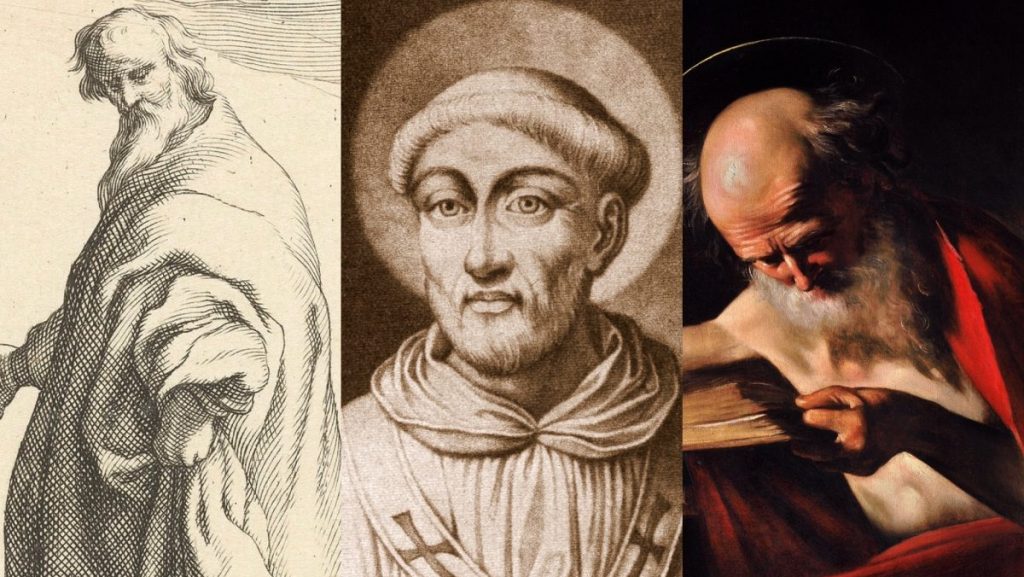
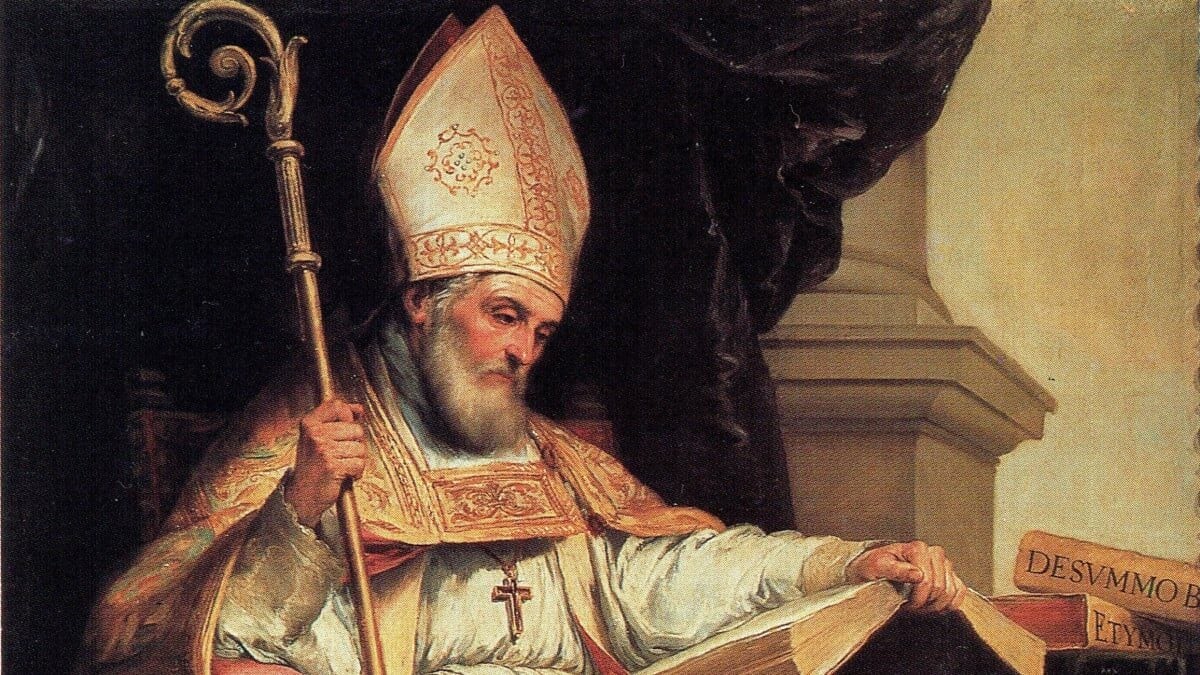
This “Papal Snapshot” concerns the assertions by St. Isidore of Seville (c. 560-636), a great western Church Father, that he and all bishops owe obedience to the Pope. He made these statements in his Letter 6, to General Claudius.
By way of background, I was initially inspired to cover this topic by a prominent protestant apologist who attempted to quote St. Isidore in such a way as to deny papal authority, in both St. Peter, and later Popes. Having read a great deal of St. Isidore, I knew this claim was false, and–as must often take place in the never-ending game of wack-a-mole against protestant misrepresentations and (sometimes) lies about the Church–I decided to devote several “Papal Snapshots” to the writings of St. Isidore. This is the first.
Roadmap
With that background in mind, our Roadmap is as follows:
- Our thesis is that St. Isidore of Seville’s Letter 6 exhibits Catholic belief about the papacy, particularly in what it asserts about the obedience owed to the Pope by all bishops. We will show this by:
- Providing historical context for the letter; then
- Quoting and analyzing relevant sections from the letter; then
- Summarizing the conclusions we believe can be reached from this letter.
Historical Context
St. Isidore’s Letter 6 is written to a “General Claudius.” The exact identity of this correspondent is unknown, but he was likely a general nobleman in the Visigothic Kingdom, which had recently unified the Iberian peninsula (modern-day Spain and Portugal), and come into communion with the Catholic Church after the conversion of King Reccared from Arianism in 589. The Visigoths were a Gothic “barbarian” people who played an important role in the fall of the western Roman Empire. They later settled in southern Gaul (modern-day France) and expanded into Hispania (modern-day Spain).
As Archbishop of Seville and a leading intellectual of the time, St. Isidore played an important role in the early decades of the Catholic kingdom of the Visigoths, offering counsel to various royal officials, nobles, and ecclesiastical figures on theological and other issues. He presided over the Second and Third Synods of Seville (in 619 and 624 respectively), and the Fourth Council of Toledo in 633 (which was for all of Spain, given that Toledo served as the capital of the Visigothic Kingdom).
St. Isidore of Seville, Letter 6: To General Claudius
In Letter 6, St. Isidore is apparently responding to questions from General Claudius about the Catholic Faith, likely in light of the recent conversion of the Visigothic Kingdom. While we do not have General Claudius’s original letter, we can infer from St. Isidore’s answers that his questions related mostly to the papacy and the filioque. This latter word is Latin and means “and the Son.” It had been adopted in many parts of the West as part of the Creed, and was a persistent source of controversy with some in the East. Whereas the Creed had previously affirmed a belief that the Holy Spirit proceeds “from the Father,” the addition of the word “filioque” added “and the Son” to this formulation.
In section 1, it is clear that General Claudius had addressed St. Isidore with these and various questions about the Catholic Faith (§1)1:
Receiving your letter of your Catholic strength, I praise the omnipotence of our Lord Jesus Christ, who through your prosperous successes and triumphs mercifully bestows upon his Holy Church the glory of triumphing over its enemies at the present time. When you urge me with pious requests to reply to your questions, I rejoice in the Lord because you eagerly inquire about that which pertains to the Catholic faith. Thus to that which you first mentioned, I shall reply rationally and simply to you, omitting many things.
What were the matters “first mentioned” by General Claudius? From the very next section, it appears he had asked St. Isidore about the papacy. So long as the Visigoths had remained Arians, they were disobedient to the Pope. But upon becoming Catholics, St. Isidore explained, they now had the obligation of obeying St. Peter’s successor in Rome (§2)2:
Thus I know that I am at the head of the Church of Christ as long as I confess to show due obedience reverently, humbly, and devotedly in everything to the Roman pontiff in particular, as the vicar of God, before all other prelates of the Church. On the other hand, I decide that someone coming boldly as a heretic is completely foreign to the body of the faithful. I hold this belief firmly and consider it valid not from the choice of my own judgment but rather with the authority of the Holy Spirit.
St. Isidore makes several remarkable assertions in this section:
- He, as a bishop, must show reverence and obedience to the Pope of Rome.
- The Pope is the “Vicar of God, before all other prelates of the Church”–meaning, his authority is not a “first among equals,” but indeed superior to any other bishop.
- This belief about the Pope is based not on human opinion, but on “the authority of the Holy Spirit,” meaning, it is divinely revealed.
In the next section, St. Isidore is clear that while the Pope is to be obeyed, and this obligation is a matter of divine revelation, even this obedience still has its limits (§3)3:
But if (may it not be) he is not manifestly unfaithful, our obedience is harmed in no way unless he teaches against the faith. Besides, the Lord prescribes that bad prelates should be obeyed in good orders when he says: “Do what they say”; He orders that their bad works should be avoided when he adds: “But do not do what they do” (Matt. 23:3). Bad prelates should also be obeyed in doubtful orders as long as the Church tolerates them unless a suspicion of heresy can justly result from the prelate’s manifest defamation in his teaching. Concerning similar situations the same also appears true. In manifestly bad orders even good prelates should by no means be obeyed because God sometimes hides to the greater what he reveals to the lesser.
Here, St. Isidore lays out a framework for when prelates–including the Pope–should either be obeyed or disobeyed. In short, unless a bishop is “manifestly” teaching contrary to the faith, even if he is a bad one, he should be obeyed, which would include the Pope. For this he cites Our Lord’s words about obeying even the scribes and Pharisees who “sit on Moses’s seat,” a portion of Scripture often cited by the Fathers for just such situations. The default is obedience, even when the bishop in question is not particularly virtuous.
St. Isidore goes so far to say that even bad bishops should be obeyed in “doubtful orders as long as the Church tolerates them,” once more, unless they are manifestly (i.e. obviously) heretical. The presence of such “doubtful orders” does not justify a layman, or even a bishop under the authority of the Pope, taking matters into their own hands. Likewise, for obviously “bad orders,” even good bishops should be disobeyed, St. Isidore says.
He does not explain in great detail what the outer limits of obedience to the Pope may be, nor does he provide any details about how the infallibility of the Church comes into play. As he said at the beginning of his letter to General Claudius, he is “omitting many things.” But the primary point here is this: in Catholic theology to this day, even the Pope may be disobeyed under certain circumstances–a point made by many theologians (including many saints) throughout Church history. His occupying the pinnacle of the ecclesiastical hierarchy, and even the infallibility of his office under certain circumstances, in no way means every utterance or decision he makes is owed obedience. To dive deeper into this topic, we recommend the wonderful 2019 book by Italian historian Roberto de Mattei, Love for the Papacy & Resistance to the Pope in the History of the Church.
St. Isidore then proceeds to the filioque issue, which we include here not to fully explore this issue, but rather to see what he says about the Roman Church, and how it puts some “meat” on the framework of obedience and disobedience has laid out in the previous section (§4)4:
Likewise, you took care to make known to me the objection of some Greeks that in the synod of Nicaea and Constantinople it is said that it was prohibited under pain of anathema in the Apostles’ Creed and in that 31 | 33 of holy Athanasius to take away or add something concerning the Catholic faith; and so some of the Greeks boldly strive to reprehend the Romans because in the profession of holy faith they sing with heart and mouth to God: “Who proceeds from the Father and the Son,” although in the aforementioned councils it was stated: “Who proceeds from the Father,” and the Holy Roman Church approves and believes that the Holy Spirit proceeds from the Father and the Son.
St. Isidore then spent much of the rest of the letter explaining how the filioque was in no way heretical. This exchange serves as perhaps an incomplete, but nonetheless helpful application of his “rules” for obedience and disobedience outlined in section 3. By virtue of the fact that he affirmed the filioque, St. Isidore clearly believed it was not “manifestly” heretical. In its favor he cites the approval and belief of the Roman Church. Thus, even if he–a bishop–considered it “doubtful,” he still believed it should be obeyed because it had received the approval of the Roman Church (and given that he affirmed such obedience on the basis of divine revelation, it would not be logical for him to presume that such judgments in doubtful matters could be heretical, since God Himself would require such obedience–which is an implicit nod at infallibility). But, we know St. Isidore considered the filioque neither “manifestly” heretical, nor doubtful, as he goes on to explain its basis from Scripture.
We can thus see that St. Isidore believed, as a matter of divine revelation, that when it comes to matters of faith, the Pope should be obeyed in his judgments, even if they are doubtful. This logically implies the infallibility of the papal office in at least some occasions, and not in others, since the God Whose revelation made such obedience necessary would not require anyone to obey or believe in a lie. This matches Catholic teaching to this day.
Conclusion
From his Letter 6 to General Claudius, though short, we can thus see that St. Isidore of Seville believed the following about the papacy:
- All bishops owe greater obedience to the Pope than to any other bishop (he is thus not a “first among equals,” but possesses superior authority);
- The Pope is the “Vicar of God” (or, as he is more often called today, the “Vicar of Christ,” which is the same thing);
- The Pope’s authority, and the obedience it is owed, are a matter of divine revelation;
- The Pope should only be disobeyed if his orders are manifestly heretical–otherwise, even if they are doubtful, they should be obeyed; and
- While St. Isidore does not explicitly state his belief in papal infallibility, given that he believed obedience to the Pope was a matter of divine revelation–and that such obedience, though not owed on every occasion, was the default duty of Christians and bishops–this logically necessitates the doctrine of papal infallibility, at least with respect to some situations, since–as we earlier observed–the God Who reveals would never require anyone to obey or believe a lie. This matches, as we said, Catholic teaching to this day.
We thus see that–contrary to the assertions of some pop protestant apologists who apparently do not thoroughly read the sources they seek to weaponize against the Church–St. Isidore had a thoroughly Catholic understanding of the papacy.
Footnotes
- St. Isidore of Seville, Gordon B. Ford, Jr., trans., The Letters of St. Isidore of Seville, 2nd rev. edition (Amsterdam: Adolf M. Hakkert, 1970), 31. ↩︎
- Ibid. ↩︎
- Ibid. ↩︎
- St. Isidore of Seville, Gordon B. Ford, Jr., trans., The Letters of St. Isidore of Seville, 2nd rev. edition (Amsterdam: Adolf M. Hakkert, 1970), 31, 33. ↩︎
 Buy Us a Coffee