Introduction
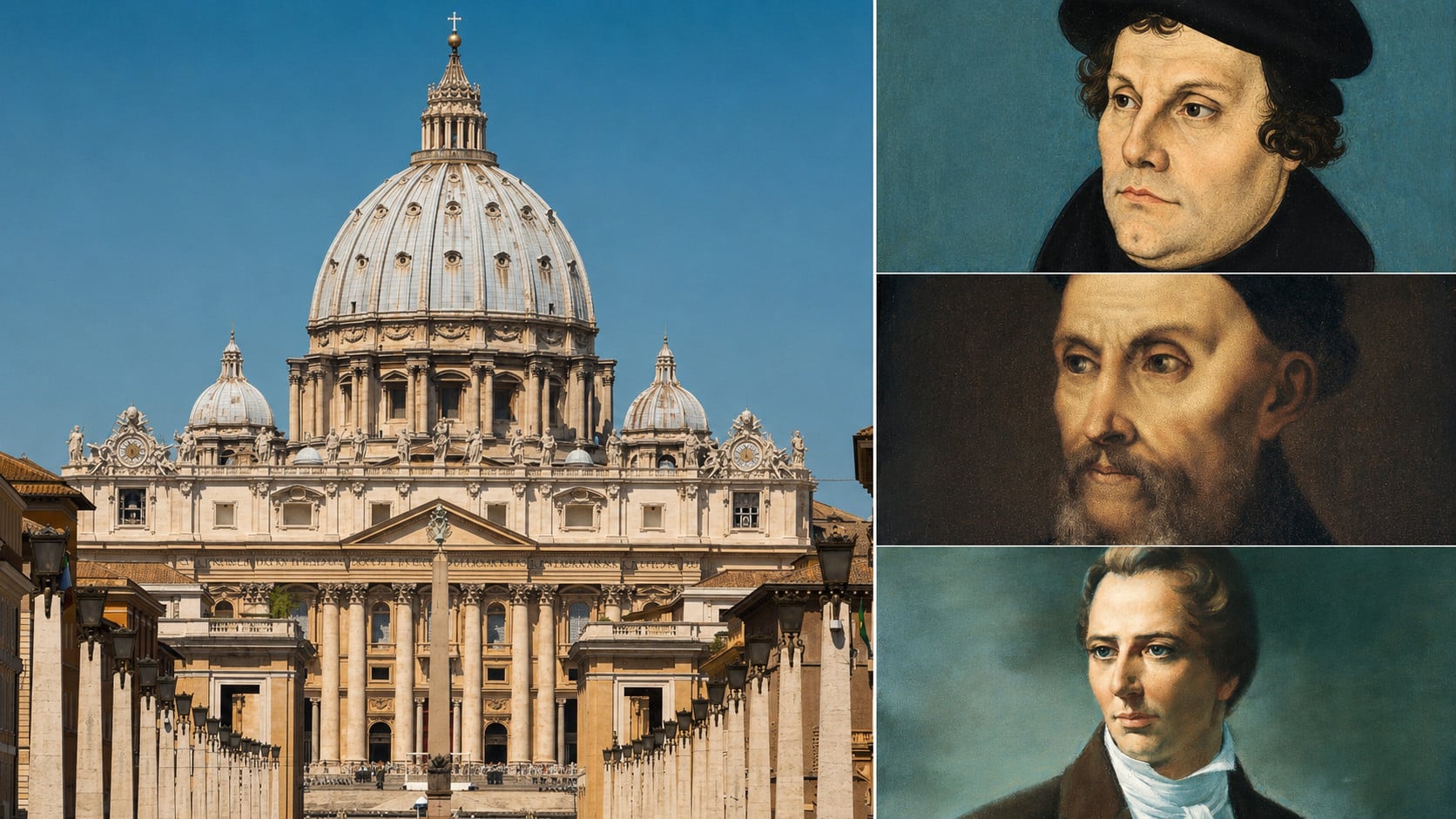
This article has an undoubtedly controversial headline. But as I will explain, while exploring the writings of the Church Fathers, I realized there was a disturbing similarity between protestantism and Mormonism with respect to their views of Church history, and the theological implications of those views.
And the most sobering reality is that most protestants don’t even realize it.
Roadmap
With that background in mind, our Roadmap is as follows:
- Our thesis is that most protestants, whether they realize it or not (and the vast majority do not), have essentially the same theology of history as the Mormons (“Latter-Day Saints,” or LDS). We will show this in four parts, followed by a disturbing, but necessary conclusion.
- First, we will summarize LDS belief about the “Great Apostasy” after the deaths of the Apostles, how they believe priesthood authority ceased, and thus needed to be “restored” by Joseph Smith in the 19th century.
- Second, we will show that the vast majority of protestants reject multiple essential doctrines on which the Church Fathers were unanimous, specifically: baptismal regeneration (how we become Christians); apostolic succession (how the Church is governed); and the Christian sacrifice of the Eucharist (how we worship). We’ll call these the “Three Doctrines” as a shorthand.
- Third, we’ll explain why, if the Church Fathers were unanimously wrong about the “Three Doctrines,” then in fact there was a “Great Apostasy” as the LDS teach, even if protestants don’t explicitly claim this. It is simply a logical deduction.
- Fourth, we’ll explain why most protestants are therefore logically required to believe in a “Great Apostasy” theory of history that is shockingly identical to LDS doctrine, despite the fact that many of them think they reject this. They often never realize their quandary for one simple reason: they are unfamiliar with Church history.
- We will then conclude with the disturbing, but unavoidable conclusion of these facts: namely, that if there was indeed a “Great Apostasy” not even a century after the establishment of the Church and the promulgation of the Gospel by Jesus Christ and the Apostles, but the “true” version of both have now been available for multiple centuries (whether since the 16th century via protestantism, or the 19th century via the LDS), this necessarily means that either the protestant “reformers” or the “prophet” Joseph Smith were superior to Jesus Christ Himself, since what they established has lasted for centuries, whereas what Christ originally established fell apart almost immediately. Therefore, their claims to represent the true teaching of Christ are shown to be false, because they implicitly rely on what can only be a claim to be superior to Christ Himself.
Part 1 | The Supposed “Great Apostasy” of the LDS
The Church of Jesus Christ of Latter-Day Saints (LDS), commonly known as “Mormons,” believes that after the death of the last Apostle, there was a “Great Apostasy,” and the true gospel was lost. It officially teaches the following about this “Great Apostasy” (taken from one of their teaching pamphlets on their official website):
Following the death of Jesus Christ, wicked people persecuted and killed many Church members. Other Church members drifted from the principles taught by Jesus Christ and His Apostles. The Apostles were killed, and priesthood authority—including the keys to direct and receive revelation for the Church—was taken from the earth. Because the Church was no longer led by priesthood authority, error crept into Church teachings. Good people and much truth remained, but the gospel as established by Jesus Christ was lost. This period is called the Great Apostasy.
This apostasy resulted in the formation of many churches with conflicting teachings. During this time, many men and women sought the truth, but they were unable to find it. Many good people believed in God and Jesus Christ and tried to understand and teach truth, but they did not have the full gospel or priesthood authority. As a result, each generation inherited a state of apostasy as people were influenced by what previous generations passed on, including changes to Christ’s gospel.
Some inspired people, such as Martin Luther and John Calvin, recognized that practices and doctrines had been changed or lost. They tried to reform the churches to which they belonged. Without priesthood authority, however, Christ’s gospel could not be returned to its original form. A restoration was needed.
A few observations.
First, an anecdote. For several months, I hosted several LDS missionaries and one of their local leaders in my home for theological discussions. Their teaching on the “Great Apostasy” was the focus of most of my questions, and the springboard for many of my counter-arguments. While they claimed that “priesthood authority,” the “keys” of the Church, had been lost, I quoted for them the words of St. Pope Clement of Rome, and St. Ignatius of Antioch. Both were disciples of the Apostles (St. Clement was likely even mentioned in the Bible, Phil. 4:3), and both very clearly testify to the reality of the Christian priesthood, the divine establishment of the episcopate (the office of bishop), and the succession of bishops directly from the Apostles as a necessary part of the Church’s constitution.
I printed out a page worth of quotes for everyone. “These men, disciples of the Apostles, seem completely unaware of any loss of priesthood authority,” I said. The LDS men were very kind and generous, but dead silent when I said this. Their official doctrine made a claim that priesthood authority was lost, but the disciples of the Apostles themselves very clearly said otherwise. I had the impression that they (like most protestants, including myself before 2017) were completely ignorant of the Church Fathers. The only response they had was their claim of having a “testimony” after reading the Book of Mormon—their typical, and thoroughly gnostic fall-back. There was nothing else they could say: the plain facts of history refuted their notions of a “Great Apostasy.”
Second, the LDS note that this “Great Apostasy” led to “many churches with conflicting teachings.” What’s ironic is that you do not see this among the Church Fathers and the Catholic Church. That would be a huge subject to unpack, and beyond the scope of this article. But the Church Fathers consistently speak of the continuity of the Catholic Faith, the authority and unity of the Catholic Church, and its perpetual existence until Christ returns. Many of them knew of one another during both their lifetimes, and centuries later, as they were often explicitly recognized as authoritative by ecumenical councils of the Catholic Church, by Popes, and by a broad consensus among bishops. Indeed, the Fathers identified the reality of “conflicting teachings” spoken of by the LDS existing among heretics and schismatics, who broke from the very “priesthood authority” and “keys” the LDS claim were lost after the death of the Apostles, but which the Church Fathers in every century acknowledged to exist in the Catholic Church.
Third, it is no doubt significant that the LDS identify figures such as Luther and Calvin—whose teachings, ironically, contradicted each other as well as the Catholic Church on numerous points—as “inspired people” on the timeline toward the “restored Gospel” they claim to possess thanks to Joseph Smith. They claim that Luther and Calvin recognized that certain truths had been “changed” and “lost.” It is again deeply ironic that many Catholic converts who come from a protestant background come to the Church precisely because they read the ancient Church Fathers, and realize that protestant doctrines are nowhere to be found in their writings. That which they were told was “changed” and “lost” they see never happened. It’s a myth. Yet the LDS counter this with the same basic claim as many protestants: that Luther and Calvin rediscovered doctrines that were “changed” or “lost.”
But as I discovered when I dove into the Church Fathers myself, the historical record shows otherwise.
Part 2 | The Three Doctrines Rejected by Most Protestants
Protestants object to many different Catholic doctrines. However, the Church Fathers exhibit an overwhelming, sometimes even unanimous consensus on many of the Catholic doctrines that the vast majority (sometimes all) protestants reject—and on matters that can hardly be considered anything less than “essential.”
I will focus on three, as they get to the heart of the Gospel and Christian life:
- Baptismal regeneration (how we become Christians);
- Apostolic succession (how the Church is governed); and
- The Christian sacrifice of the Eucharist (how we worship as Christians).
As previously mentioned, I’ll refer to these as the “Three Doctrines.”
By rejecting these Three Doctrines on which the Fathers are unanimous, not only is any protestant claim to be in continuity with historic Christianity falsified, but they are logically required to affirm a “Great Apostasy” theory of history that is virtually identical with that of the LDS. After all, if after the death of the Apostles every Christian of which we have any record believed in the Three Doctrines that most and in some cases all protestants reject, how could that be anything other than a “Great Apostasy”?
But if protestants are correct, a “Great Apostasy” is precisely what happened.
Part 3A | Why Most Protestants Must Conclude There Was a “Great Apostasy”—Whether They Like it or Not
Let’s start with the Great Commission, in which Christ commissioned the Apostles as follows (Matt. 28:19-20):
19 Go therefore and make disciples of all nations, baptizing them in the name of the Father and of the Son and of the Holy Spirit, 20 teaching them to observe all that I have commanded you; and lo, I am with you always, to the close of the age.”
Jesus commanded them to do two things:
- Baptize; and
- Teach new disciples all of His commandments.
Undoubtedly Christ’s commandments included how the Church ought to be governed, and how Christians ought to worship. These are necessary doctrines, without which there could be no Christian religion (or really any religion whatsoever, as every religion has guidelines for how you convert, the governance of its members, and how they worship). That is why every Christian “denomination” of any kind has a doctrine or set of beliefs about each.
Thus, the Three Doctrines are necessarily intrinsic to the Great Commission itself.
And on each of the Three Doctrines, the Church Fathers are unanimous in asserting Catholic doctrine. Obviously, we can’t show all the evidence for that here. But to get a glimpse of it, you can check out Eternal Christendom’s Quote Archives on Baptismal Regeneration, Apostolic Succession, and The Blessed Sacrament of the Holy Eucharist.
Suffice it to say, the evidence is overwhelming.
But I was unaware of this evidence when I was a protestant. Once I was exposed to it, I realized the following conclusion was inescapable: if the unanimous patristic consensus on the Three Doctrines was wrong, then the Church after the Apostles literally got everything about the Great Commission wrong.
This necessary conclusion must be pondered in all its disturbing implications.
No matter how you slice it, this would be a Great Apostasy, and thus a point on which a large majority of protestants would be compelled by facts to agree with the foundational premise of Mormonism—that the Church as established by Christ fell apart after the death of the last Apostle, and therefore the “true gospel” was in need of “restoration.” It is no wonder the LDS admire Luther and Calvin.
At this point, and in the interest of both charity and clarity, we acknowledge that protestants are far closer to the truth than the LDS. On what the “gospel” is, and how it is “restored/recovered,” Mormons and protestants obviously have huge disagreements.
But it is very significant that each of their doctrinal systems stem from a shared presupposition—indeed, a shared historical justification—that the original Church established by Christ apostatized virtually immediately.
Many protestants don’t phrase it this way, and many sincerely believe this is not their view of history, simply because they are unaware of the historical facts. Indeed, some of the more “mainline” branches of protestantism (as we will see) affirm at least some of the Three Doctrines themselves. However, as we will also see, the vast majority of protestants today reject them. So if you believe the Church got it completely wrong on the Three Doctrines so intrinsic to the Great Commission—a point that is historically incontestable if the doctrines believed by most protestants today are true—then it is impossible to claim a Great Apostasy didn’t happen after the death of the Apostles, exactly as the LDS claim. These protestants and the LDS will differ significantly on how this “Great Apostasy” should be rectified. But the facts of history, compared to what they teach, mean both share the presupposition that a Great Apostasy did in fact take place: the difference being that the LDS say it explicitly, and most protestants today believe it implicitly.
Once more, to be perfectly clear on our meaning: most protestants do not explicitly affirm a Great Apostasy occurred. The claim is that if their doctrines are correct, and the unanimous patristic consensus on the Three Doctrines is wrong, then the facts of history necessarily require them to affirm a Great Apostasy took place.
After all, if all the ancient Christians of which we have any record affirm the Three Doctrines, then all the ancient Christians did not, in fact, have the true Christian Faith as taught by Scripture—if these protestants are correct.
This can be nothing other than a “Great Apostasy.”
Part 3B | The Vast Majority of Protestants Reject the Unanimous Witness of the Ancient Church
So how many protestants are we talking about here? To answer this question, we’ll start with the largest protestant country in the world—the United States—and rely on the Pew Research Center’s Religious Landscape Study published in February 2025.
As we said, most protestants reject the Three Doctrines, but not all. We’ll be generous, and say that Lutherans and Anglicans (including Episcopalians) do not reject baptismal regeneration or apostolic succession. These are the only major protestant sects who in one form or another, or at least sometimes (depending on the Lutheran you are talking to) accept them (though even then, not always in the Catholic form). Some Lutherans reject apostolic succession, and some Anglicans reject baptismal regeneration. But for the sake of argument, we’ll stipulate that all of them accept both doctrines. Both of them, however, reject the sacrifice of the Eucharist. Thus, with respect to the Three Doctrines, the major protestant sects believe as follows:
- Baptismal regeneration (rejected by all except Lutherans and Anglicans, again, broadly defined);
- Apostolic succession (rejected by all except Lutherans and Anglicans, again, broadly defined); and
- Sacrifice of the Eucharist (rejected by all).
According to Pew’s Religious Landscape Study, protestants of one kind or another constitute 46.6% of the American population. This includes those classified by Pew as “Evangelical Protestant” (25.4%), “Mainline Protestant” (14.7%), and “Historically Black Protestant” (6.5%). Among protestants, Lutherans of one kind or another constitute 3.6%, while Anglicans constitute 1.5% of the American population, for a combined total of 5.1%.
Thus, Lutherans and Anglicans constitute approximately 10.9% of American protestants (5.1 out of 46.6). Therefore, with respect to baptismal regeneration and apostolic succession, 89.1% of American protestants, at a minimum, reject all of the Three Doctrines on which the Church Fathers were unanimous.
Worldwide, there are approximately 77 million Lutherans, and 85 million Anglicans, for a total of 162 million people. There are approximately 900 million protestants worldwide, making the combination of Lutherans and Anglicans approximately 18% of protestants as a whole.
Therefore, around the world, at a minimum, approximately 82% of protestants reject baptismal regeneration and apostolic succession (this despite the fact that we are treating all Lutherans and Anglicans as affirming it, which is not always the case).
We are thus in a solid position to assert that “most” protestants reject the absolutely unanimous consensus of the Church Fathers on the Three Doctrines.
This is functionally equivalent to saying that most protestants believe that after the Apostles died, the Church got the Great Commission completely wrong by failing to uphold true doctrine on how we become Christians, how the Church is governed, and how Christians worship.
Again, if that is not a “Great Apostasy,” what is?
Part 4 | 1st Century Great Apostasy = Creature Stronger than the Creator
Why is this significant? Because the undeniable implication of this historical theory is that what the Son of God Himself established did not survive, but what was established by some other non-Incarnate man did. In the LDS case, this is Joseph Smith, who they consider a prophet. For protestants, it’s the “reformers” of the 16th century.
Protestants deny there have been any divinely inspired prophets after the death of the last Apostle. However, they also contend that since the advent of the protestant movement, the “gospel” has been “restored” and/or “recovered.” Indeed, for the vast majority of protestants who reject the Three Doctrines, that is what they must believe, if in fact their doctrines are correct, since the historical record we have of the Christian Faith in the preceding 1,500 years contradicts them. Not only that, but they believe this “true gospel” has been available to the world for the last 500 years—again, a “gospel” that differs quite significantly from the Three Doctrines unanimously upheld in the ancient Church.
This belief necessitates an unavoidably dark conclusion: it means that which was restored by mere men has managed to last at least 500 years; while that which was established by God in the Flesh, Jesus Christ, didn’t even last past the death of the Apostles.
Are these conclusions stated out loud? No. Many protestants claim they are simply teaching what the Bible teaches, which means (they say) the Three Doctrines are false. But if no Christian believed this “true gospel” before them, the disturbing conclusions we’ve outlined follow as apodictically as 2 + 2 = 4. To deny the Three Doctrines universally espoused by all the ancient Christians can only mean that this “true gospel” has so far lasted much longer (500 years), and persisted much more effectively (the spread of protestantism around the world), when re-established by men than when it was supposedly originally established by Christ Himself!
To see the logical absurdity of this position more clearly, consider a brief thought experiment: If the “true gospel” excludes the Three Doctrines, it implies that Jesus Christ established a Church that dissolved almost instantly. Yet, we are expected to believe that the version “recovered” by 16th-century reformers has miraculously endured where the original did not. This would mean Jesus Christ Himself taught this “true gospel” to His Apostles, who taught it to the first generation of Christians. But after the death of the last Apostle, this “gospel” disappeared completely.
But this is not the end of the matter. Once this “true gospel” that disappeared almost immediately was recovered in the 16th century, this time it endured for at least 500 years, and even spread throughout the world—something it was never able to do even after being established by Jesus Christ Himself!
Therefore, if indeed the “true gospel” necessarily denies the Three Doctrines, that means its re-establishment by protestants in the 16th century was far more effective than its establishment by the Incarnate Word, Jesus Christ Himself, in the 1st century! The creatures are greater than the Creator! The creatures who could not promise to guide the Church into all truth after their deaths somehow managed to perpetuate the “true gospel” better than the God-man who did promise to guide the Church into all truth until His return.
This is but another way of saying that the theology of history proposed by most protestants—whether they realize it or not (and once more, most do not)—necessarily elevates the creature above the Creator. This, in short, is precisely what the Church and the Church Fathers have always described as “heresy”: choosing to believe one’s opinion about religion, rather than what God has actually revealed, as taught to the world by His Church, which is His Body.
Conclusion | Protestants May Shudder, but This is the Necessary Consequence of Their Theology
I suspect the vast majority of protestants would shudder at the idea that this is in fact the theory of history they have implicitly adopted. What I am here to tell them is that, shocked and scandalized as they may be by this assertion, this is in fact the only theory of history remaining to them based on their own theological presuppositions, presuppositions which they share with Mormonism. It is no wonder that such presuppositions necessarily lead to the conclusion that the creature was able to establish something far stronger than the Creator. Christ’s Church fell apart, so we needed Joseph Smith to “restore” it. Christ’s gospel was totally lost, so we needed Martin Luther, John Calvin, and a thousand others to “recover” it (no matter that they often contradict one another as much as they contradict the Church!).
This is what I realized about my own protestantism before I converted to the Catholic Faith. The facts spoke for themselves. The testimony of my Christian ancestors was clear. If my rejection of the Three Doctrines was correct, then a Great Apostasy had to have occurred. And if a Great Apostasy had occurred, that meant the “true gospel” recovered in the 16th century by men had exhibited greater endurance and power than when it had supposedly been originally established by the Son of God Himself in the first century. The logic was unavoidable. The conclusions, likewise, were unavoidable.
The theological premises of the vast majority of protestants today necessarily and unavoidably lead to these disturbing conclusions, which indicate to us that protestantism (not individual protestants doing their best to follow Jesus with what they know, but the ism to which they belong) is not from heaven, but from Hell.
This is why, whether it realizes it or not, the vast majority of modern protestantism has a Mormonism problem.
 Buy Us a Coffee