Introduction
The ancient Church was full of accounts of miracles and preternatural events. A famous source of many such stories are the Dialogues1 of St. Pope Gregory the Great (c. 540-604), which consisted of four books of discussions between the great Pope and a deacon named Peter. Book 2 is the most famous ancient account of the life of St. Benedict, while the others touched upon various theological issues and miracle accounts.
Many of these stories exemplify the reality of Catholic belief in the ancient Church. One such account—one could even call it a “ghost story”—concerns a disputed papal election and the appearance of a dead deacon named Paschasius requesting prayers for his soul. The entire account is very revealing with respect to multiple Catholic doctrines, but especially Purgatory. The events it describes took place almost a century prior to St. Pope Gregory the Great’s recounting of them in his Dialogues in 593.
Roadmap
With that background in mind, our Roadmap is as follows:
- Our thesis is that the “ghost story” about deacon Paschasius in St. Pope Gregory the Great’s Dialogues (Book 4, §42) offers strong evidence of the reality of Purgatory (as well as this ancient and greatest of Pope’s very Catholic views of it), and secondarily other Catholic beliefs about relics, exorcism, mortal and venial sins, and good works. We will show this by:
- Quoting and analyzing the “ghost story” in the Dialogues; then
- Summarizing the conclusions we believe can be reached.
The “Ghost Story” of St. Pope Gregory the Great
Before we proceed to the “ghost story” shared by St. Pope Gregory the Great, let’s first consider the theological context he provided beforehand about the cleansing of non-mortal sins after death, in Book 4, §41. What he says aligns with the Catholic theology of Purgatory (pg. 249):
When he [St. Paul] says that men are saved by passing through fire [1 Cor. 3:12-15], he is not referring to men who build on this foundation in iron, bronze, or lead, that is, in mortal sins which are indestructible by fire. He specifies those who build on this foundation in wood, grass, and straw, that is, in venial or trivial sins, which fire consumes easily. In this connection we should also remember that in the world to come no one will be cleansed even of the slightest faults, unless he has merited such a cleansing through good works performed in this life.
St. Pope Gregory the Great makes several notable assertions:
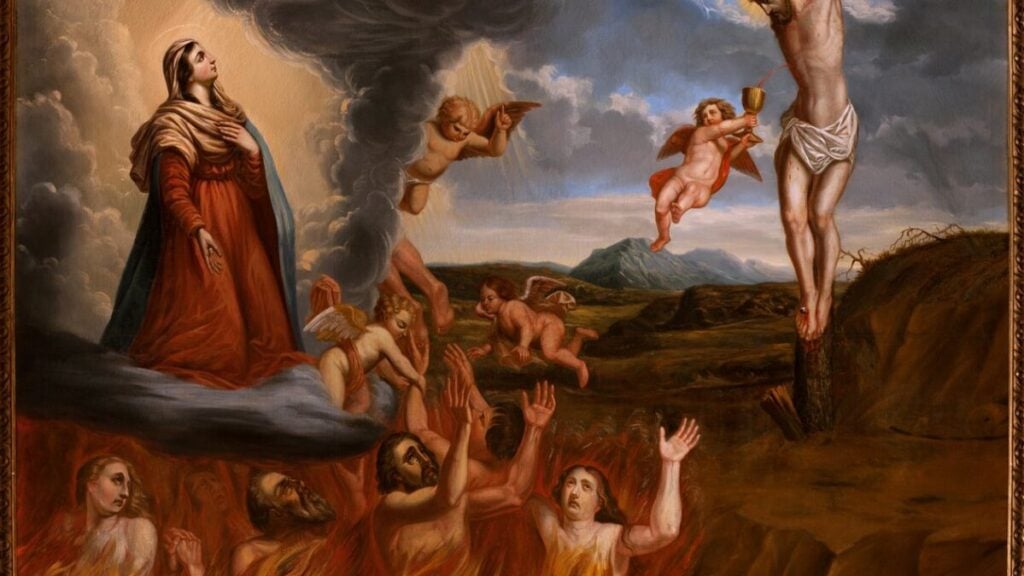
- There is a cleansing of sins that takes place after death (in many places throughout his writings, including in the Dialogues, he explicitly calls this “Purgatory”).
- The only sins that are cleansed in Purgatory are venial (“trivial”), not mortal sins.
- These sins are cleansed by the merits one has acquired by good works during life (meaning, works done by the power of God’s grace in the soul).
With that theological context in mind, let us now proceed to the “ghost story” St. Pope Gregory the Great shared with deacon Peter immediately after the section quoted above, in Book 4, §42 of his Dialogues (pgs. 249-50):
When I was still a young layman, I heard my elders and men acquainted with the circumstances tell of Paschasius, a deacon of the Apostolic See. His highly orthodox and brilliantly written books on the Holy Spirit are still read. He was a man of outstanding sanctity and very zealous in the practice of almsgiving. His kindness to the poor was remarkable, while for himself he had nothing but contempt.
In the dispute over the papacy between the parties of Symmachus and Lawrence, which was accompanied by the excitement of popular demonstrations, he cast his vote for Lawrence. Even though Symmachus was later on accepted 249 | 250 unanimously by both parties, Paschasius would not change his affiliations, but to the end of his life reserved his devotion and respect for Lawrence, the man whom the Church by the judgment of her bishops had refused to set up as her head.
Paschasius died during the reign of Pope Symmachus. A possessed person touched his dalmatic [liturgical vestment], which had been laid on the coffin, and was instantly cured. A long time afterward, Germanus, Bishop of Capua, whom I have already mentioned [Book 2, §35; Book 4, §8], came to the baths of Angulus [like the Baths of Diocletian] at his doctor’s advice. As he entered the hot baths, he found the deacon Paschasius standing there as an attendant. Germanus was shocked and asked what a man of his dignity was doing in such a place. “The only reason I am serving here,” the deacon answered, “is that I endorsed the party of Lawrence against Symmachus. But I beg you, pray for me to the Lord. When you come back and no longer find me here, you will know that your prayers have been heard.”
Germanus, therefore, gave himself to fervent prayer, and, when he returned a few days later, Paschasius no longer appeared. This purification from sin after death was possible because the deacon had sinned through ignorance, and not through malice. What we are to believe is that through his previous alms deeds he obtained the grace of receiving forgiveness at a time when he was no longer able to do meritorious works.
This “ghost story” presents us with several intriguing assertions:
- Deacon Paschasius was a very virtuous man, particularly with regard to the poor.
- In a dispute over who was the rightful Pope, Paschasius chose and remained committed to Lawrence, even after St. Pope Symmachus was accepted as Pope (he reigned from 498-514).
- After his death during the reign of St. Pope Symmachus, Paschasius’s liturgical vestments—which had touched his coffin—expelled a demon from a possessed person who touched them. The fact that his relics could produce such effects indicated that he had died in a state of grace, and was therefore a saint (or, as we will see, close to it, with some cleansing to undergo in Purgatory first).
- When Bishop Germanus of Capua visited some baths (apparently in Rome), Paschasius appeared to him and asked him to pray for him until he should no longer appear. The bishop obliged him, and several days later, Paschasius no longer appeared at the baths.
- St. Pope Gregory the Great ascribed Paschasius’s disappearance to the purification of his sins in Purgatory by the prayers of Bishop Germanus (such prayers would not have helped him if he was damned in Hell). Thus, it seems Paschasius had appeared as some sort of ghost while being cleansed in Purgatory.
- St. Pope Gregory the Great took this to indicate that Paschasius’s support of Lawrence, even after the election of St. Pope Symmachus, was a venial sin because it was done in ignorance, not malice; and his cleansing was made possible by his almsgiving to the poor while still alive (though he also ascribed it to the prayers of Bishop Germanus).
So in this one “ghost story,” we see St. Pope Gregory the Great offer fascinating observations on papal politics (and the culpability involved in identifying the wrong Pope); on the power of relics of holy people to expel demons; on the ghostly apparitions of souls in Purgatory; and the cleansing of their sins by the prayers of those on earth, as well as their own past good works. All in all, a very Catholic “ghost story”!
Conclusion
From this “ghost story,” we can therefore conclude the following about both the reality of Catholic teaching on these subjects, as well as St. Pope Gregory the Great’s belief in that teaching:
- Relics of holy people have the power to exorcise demons, and it is possible for holy men to mistakenly identify the true Pope out of ignorance and not go to Hell.
- Those who die in a state of grace but still have venial sins on their souls will have them cleansed in Purgatory.
- Souls undergoing cleansing in Purgatory can appear to those who are still alive and request their prayers to assist in their purification. Such prayers are in fact helpful.
- Finally, good works done in a state of grace (which is what makes them “good,” i.e. meritorious)—particularly almsgiving for the poor—are an effective way to obtain pardon in Purgatory.
Thus, this brief “ghost story” shows both that St. Pope Gregory the Great had profoundly Catholic beliefs about relics, exorcism, mortal and venial sins, good works, and Purgatory; as well as the truth of Catholic teaching about each of these subjects.
 Buy Us a Coffee