Roadmap
Our Roadmap for this Eucharist Snapshot is as follows:
- Our thesis is that St. Jerome’s Against the Pelagians articulates a Catholic belief in the Eucharist as a daily sacrifice offered at mass. We will show this by:
- Providing some brief historical context; then
- Quoting and analyzing the relevant portion of Against the Pelagians; then
- Summarizing the conclusions we believe can be reached.
Historical Context
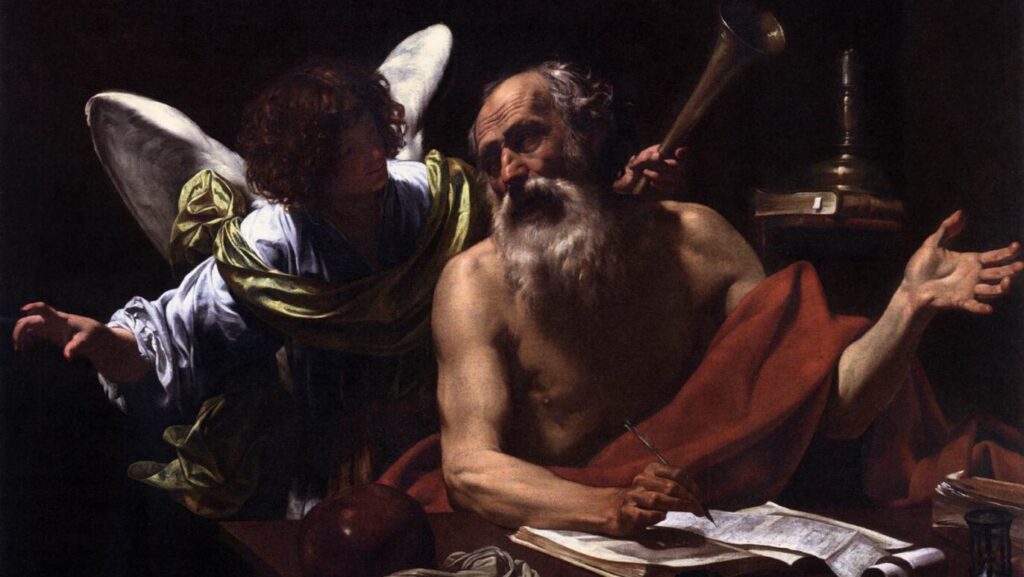
St. Jerome (c. 342/347-420) was one of the great 4th century Church Fathers and biblical scholars. A contemporary of St. Augustine and many other great Fathers, he fought—like many of them—against the heresies of the day. One of them was Pelagianism, which originated with the British-born monk Pelagius (c. 354-418). This infamous heresy—which was the focus of much of St. Augustine’s later life and work—denied original sin, and the necessity of grace for meritorious acts (i.e. with grace understood by the Church as God’s own transformative life and power in the soul, enabling acts which are pleasing to Him and merit eternal rewards).
In 417, approximately three years before his death, St. Jerome wrote his work Against the Pelagians, which was framed as a dialogue between a Catholic and a Pelagian. While the Eucharist did not play a prominent role in this work, St. Jerome nevertheless alludes to it several times as a “sacrifice,” and says several other things about it that continue to align with Catholic teaching and practice to this day.
St. Jerome on the “Daily Sacrifice”
St. Jerome first mentions the Eucharist in Book 1 of Against the Pelagians, where he addresses the apparent Pelagian tendency to exaggerate, in this case, about clothing (Book 1, §29):
[E]verywhere you are prone to exaggeration, and indulge in ambitious flights. This is why you add that “The bravery of dress and ornament is an enemy of God.” What enmity, I should like to know, is there towards God if my tunic is cleaner than usual, or if the bishop, priest, or deacon, or any other ecclesiastics, at the offering of the sacrifices walk in white? Beware, you clergy; beware, you monks; widows and virgins, you are in peril unless the people see you begrimed with dirt, and clad in rags. I say nothing of lay men, who proclaim open war and enmity against God if they wear costly and elegant apparel.
St. Jerome addresses the Pelagians by sarcastically using the example of clerical garb worn during the liturgy, and specifically says that bishops, priests, deacons, and “other ecclesiastics” (meaning, men who hold offices in the church) are present “at the offering of the sacrifices,” by which he is referring to the sacrifice of the Eucharist.
This is reinforced in the third book, where once again St. Jerome refers to the Eucharist as a “sacrifice,” one that the Lord instructed the Apostles to carry out daily (Book 3, §15):
Our Lord so instructed His Apostles that, daily at the sacrifice of His body, believers make bold to say, “Our Father, Who art in Heaven, hallowed be Thy name”; they earnestly desire the name of God, which in itself is holy, to be hallowed in themselves; you say, “You know, Lord, how holy, how innocent, and how pure are my hands.” Then they say: “Thy Kingdom come,” anticipating the hope of the future kingdom, so that, when Christ reigns, sin may by no means reign in their mortal body, and to this they couple the words, “Thy will be done in earth as it is in Heaven”; so that human weakness may imitate the angels, and the will of our Lord may be fulfilled on earth; you say, “A man can, if he chooses, be free from all sin.” The Apostles prayed for the daily bread, or the bread better than all food, which was to come, so that they might be worthy to receive the body of Christ; and you are led by your excess of holiness and well established righteousness to boldly claim the heavenly gifts.
A few points to consider:
- St. Jerome refers to the Eucharist as “the sacrifice of His [Christ’s] body” which is offered “daily.” This continues to be the practice throughout much of the Catholic Church to this day, where the mass—understood to be the sacrifice of Christ’s Body and Blood—is offered as a daily sacrifice to God.
- St. Jerome also says that the Lord “instructed His Apostles” to say the Lord’s Prayer at the Eucharistic sacrifice. This would be an example of Apostolic Tradition that is not explicit in Scripture, but found primarily in the constant belief and practice of the Church. The liturgy of the ancient Church, and indeed the Church up to this day, has always included the Lord’s Prayer.
- In opposition to the Pelagian contention that “A man can, if he chooses, be free from all sin,” St. Jerome proposes the sacrifice of the Eucharist as counter-evidence. He points out that the Lord’s Prayer includes a petition that God’s will be done on earth as it is in Heaven, and thus implicitly acknowledges the need for divine assistance to do God’s will. Such assistance being received, it must be cooperated with in order to worthily receive this “bread better than all food,” this “body of Christ,” these “heavenly gifts,” i.e. the Eucharist. Thus, his point is that man is not capable of being worthy to receive the Eucharist by the power of his will alone, as the Pelagians contended. Rather, God’s grace is necessary—a grace we must cooperate with, no doubt, but necessary nonetheless—without which none of our efforts will attain the necessary righteousness to “claim the heavenly gifts.” This likewise accords with the universal ancient witness that one must be baptized (which cleanses the soul of both original and personal sin) and in a state of grace (meaning, you’ve repented of all mortal sin) in order to receive the Eucharist.
Conclusion
From these brief remarks by St. Jerome, we can conclude the following:
- The Eucharist is the Body of Christ, a sacrifice offered daily in the churches.
- This sacrifice is done under the ministration of men who hold clerical office in the Church, namely bishops, priests, deacons, and “other ecclesiastics.”
- To receive this sacrifice, one must be in a “worthy” state, what the Church (and St. Jerome elsewhere) calls a “state of grace,” which is obtained initially by baptism, and later by confession of all mortal sins one may have fallen into.
While St. Jerome’s observations about the Eucharist in this work are scant, they nonetheless perfectly align with Catholic teaching on the Eucharist to this day.
 Buy Us a Coffee