Introduction
One thing that was so powerful for me as a protestant reading the Church Fathers was how seamlessly they read the Old and New Testaments together, and in such a way that it often confirmed the Catholic Faith. As a protestant, I often didn’t know how to square so much of the Old Testament with much of the New Testament, if various protestant teachings about it were true. One such example would have been Psalm 119, which extols the law of God, its reading, its doing, and that doing so is required for salvation. But viewing the law in such a way was oftentimes difficult, if not outright condemned by many protestant sects. This is one of many examples.
The Church Fathers, however, not only showed me how to do so, but the method by which to do the same, namely typology, in which everything in the Old Testament is read as a “type” that is fulfilled by the New Testament (see Becoming Catholic #6 | Typology: How Christ and the Apostles Unlocked the Scriptures). Typology was a tool used by some protestants in some protestant circles I was familiar with, but never in a way that was as rich, multifaceted, and comprehensive as I saw in the Church Fathers. The result was the revolutionizing of my reading of Scripture, particularly the Old Testament.
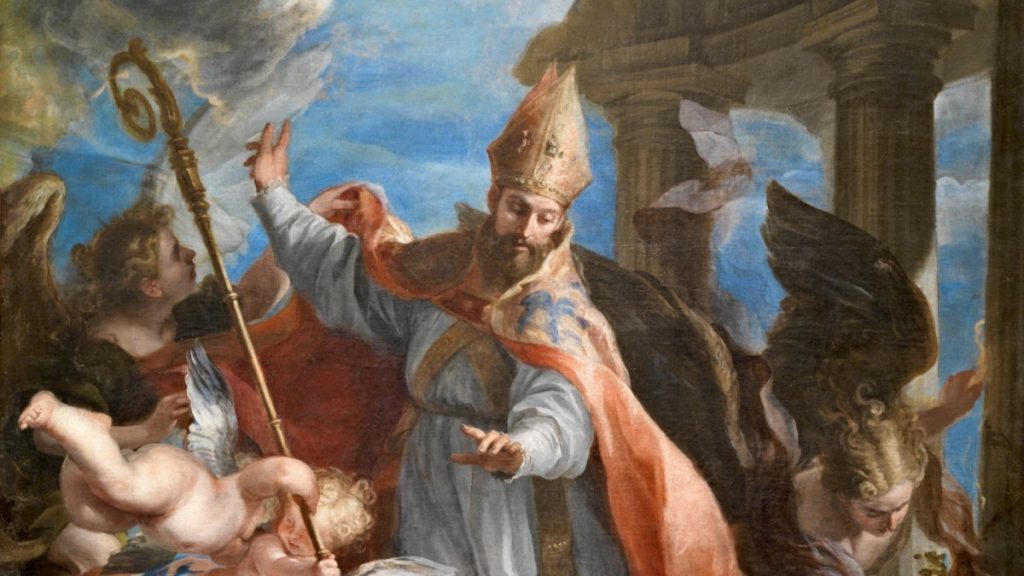
One such example comes from St. Augustine’s Exposition of Psalm 45, in which he interprets this Messianic psalm in a way that validates the Catholic doctrine of apostolic succession.
Roadmap
With that background in mind, our Roadmap is as follows:
- Our thesis is that St. Augustine’s Exposition of Psalm 45 shows a thoroughly Catholic understanding of apostolic succession, drawn typologically from the Old Testament and its prophecies of the Church. We will show this by:
- Quoting St. Augustine’s Exposition of Psalm 45; and
- Summarizing the conclusions we believe can be reached from it.
St. Augustine, Exposition of Psalm 45
Let us now proceed to St. Augustine’s Exposition of Psalm 45, where he provides commentary on Psalm 45:16 in support of Apostolic Succession (see Becoming Catholic Quote Archive | Apostolic Succession for more quotes on this subject from the Church Fathers). The verse, with a bit of context, reads as follows (Ps. 45:15-17):
15 With joy and gladness they are led along as they enter the palace of the king. 16 Instead of your fathers shall be your sons; you will make them princes in all the earth. 17 I will cause your name to be celebrated in all generations; therefore the peoples will praise you for ever and ever.
Here is the commentary of St. Augustine from Exposition of Psalm 45 (§29):
“Instead of your fathers, children are born to you” (Ps. 45:16).
Nothing can be more manifest. Now consider the “Temple of the King” itself (Ps. 45:15), for it is on its behalf he speaks, on account of the unity of the body that is spread throughout all the world: for those very persons who have chosen to be virgins, cannot find favor with the King unless they be led into the Temple of the King.
“Instead of your fathers, are your children born to you” (Ps. 45:16).
It was the Apostles [who] begat you: they were “sent”; they were the preachers; they are “the fathers.” But was it possible for them to be with us in the body forever? Although one of them said, “I desire to depart, and to be with Christ, which is far better; to abide in the flesh is necessary for your sakes” (Phil. 1:23-24). It is true he said this, but how long was it possible for him to remain here? Could it be until this present time, could it be to all futurity? Is the Church then left desolate by their departure? God forbid.
“Instead of your fathers, children have been born to you” (Ps. 45:16).
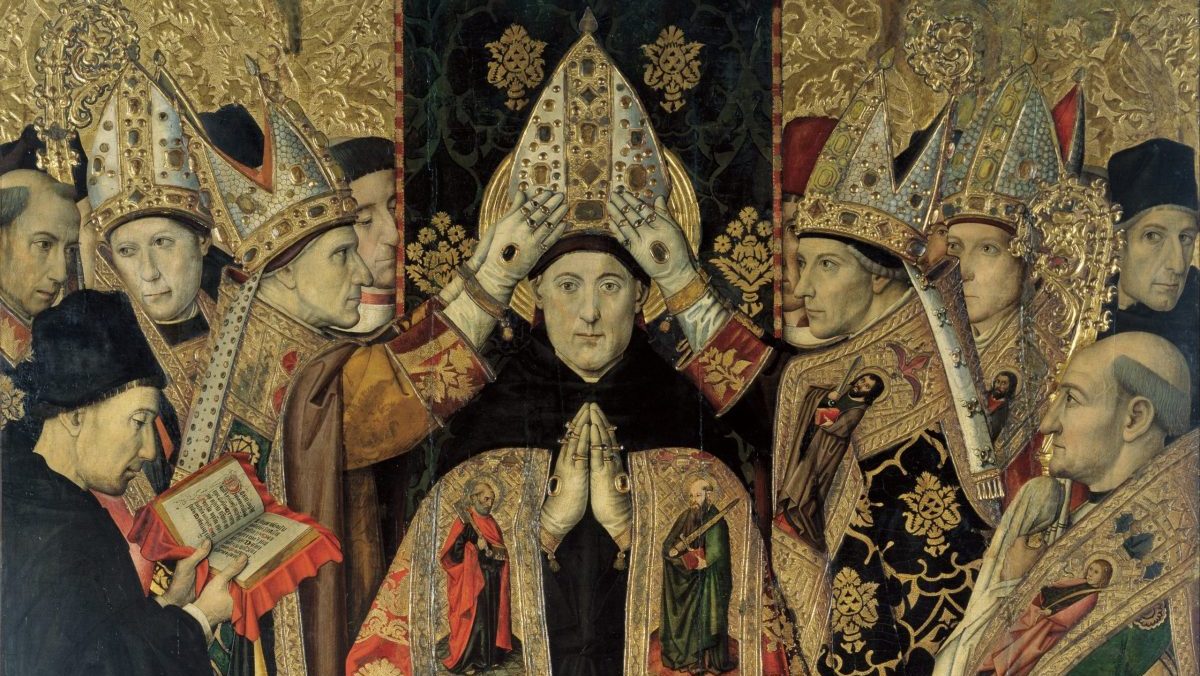
What is that? The Apostles were sent to you as “fathers”; instead of the Apostles, sons have been born to you; there have been appointed Bishops. For in the present day, from where do the Bishops throughout all the world derive their origin? The Church itself calls them fathers; the Church itself brought them forth, and placed them on the thrones of “the fathers.” Think not yourself abandoned then, because you see not Peter, nor see Paul; [that you] see not those through whom you were born. Out of your own offspring has a body of “fathers” been raised up to you.
“Instead of your fathers, have children been born to you” (Ps. 45:16).
Observe how widely diffused is the “Temple of the King,” that “the virgins that are not led to the Temple of the King,” may know that they have nothing to do with that marriage.
“You shall make them princes over all the earth” (Ps. 45:16).
This is the Catholic Church: her children have been made “princes over all the earth”; her children have been appointed instead of the “fathers.” Let those who are cut off own the truth of this, let them come to the One Body; let them be led into the Temple of the King. God has established His Temple everywhere; has laid everywhere “the foundations of the Prophets and Apostles” (Eph. 2:20). The Church has brought “forth sons”; has made them “instead of her fathers” to be “princes over all the earth.”
From this verse, in a generally Messianic Psalm about Christ and His kingdom, St. Augustine concludes that the Church was not “left desolate” of leadership after the death of the last Apostle, but enjoys it through their successors, the bishops. As with all the Psalms, St. Augustine reads it as pointing forward to the New Covenant and the Catholic Church. Likewise, he says the bishops sit on the “thrones” of the Apostles. These are none other than the “thrones” of the kingdom Jesus promised to the Apostles, and by extension their successors (see Matt. 19:28, Luke 22:28-30, and Apoc. 20:4, as well as Becoming Catholic #39, where we unpack this subject further).
St. Augustine concludes, as he often did, with a call to all who have separated from the Catholic Church to come Home.
Such examples—among countless others from the writings of the Fathers, but particularly St. Augustine—helped show me as a protestant that my ideas about the Church falling away, or being corrupted into oblivion, or requiring some sort of general and radical “reformation” that fundamentally departed from so much that came before, were simply not part of the ancient Christian mindset. Fathers like St. Augustine and others believed the Church, as Christ’s Body, in some sense partook of His divinity, and was thereby secured against such eventualities. The provision of successors of the Apostles until the end of the world was one such security Christ gave His Church.
Conclusion
From St. Augustine’s Exposition of Psalm 45, we can conclude the following about his understanding of apostolic succession:
- The Apostles were the original “fathers” of the Church;
- As “fathers,” they gave birth to spiritual “children,” so that the Church would not be left “desolate” after their death;
- These “children” are the bishops who have succeeded the Apostles throughout the world, and who have in turn become the new “fathers” of the Church;
- These “fathers” sit on the apostolic “thrones” of the Church;
- This one true Church is the Catholic Church, which is “one body,” the Temple that is “everywhere,” and whose children are now “princes over all the earth.”
In short, St. Augustine’s ecclesiology was profoundly Catholic, not only in its name, but in its substance.
 Buy Us a Coffee